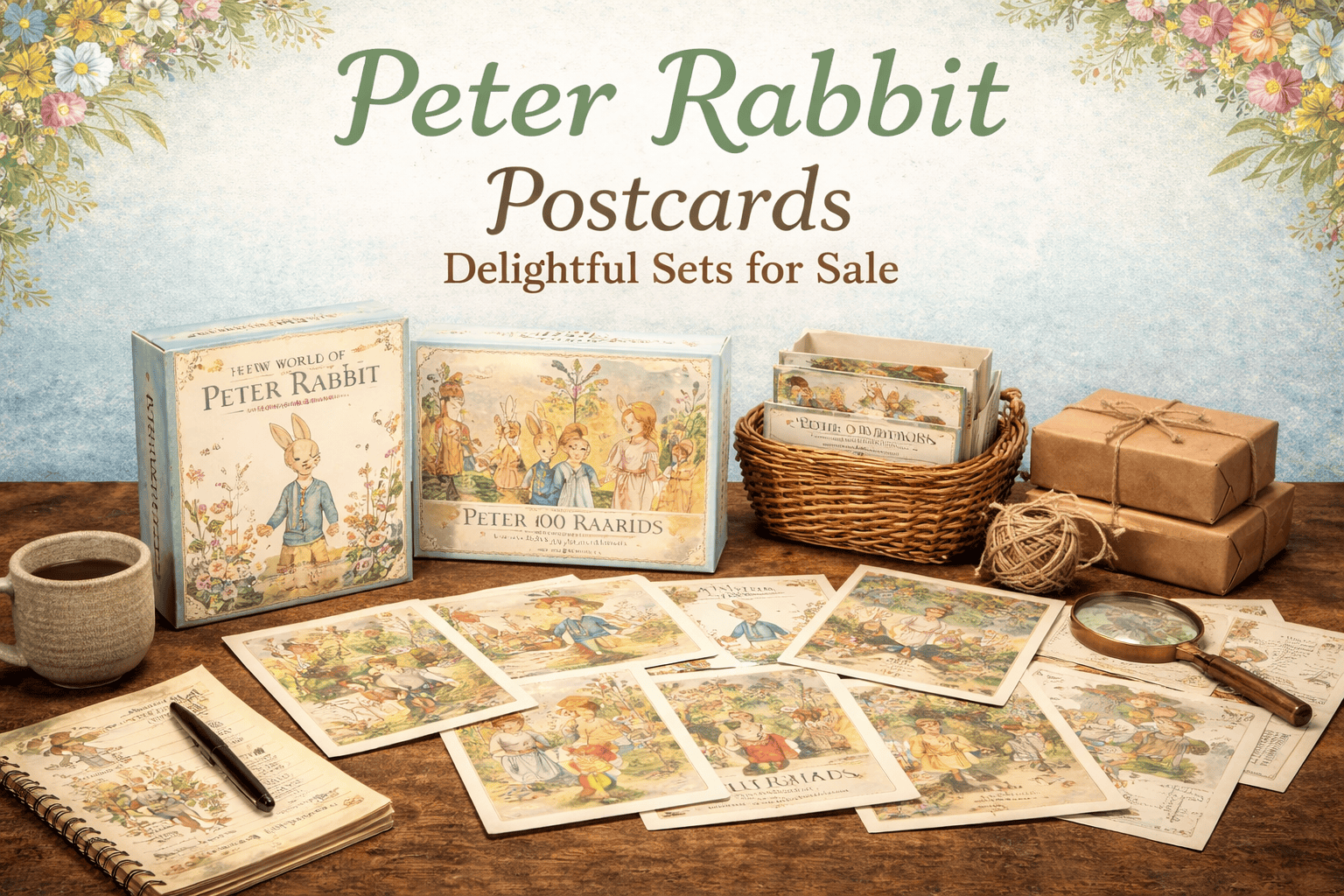
At a Glance
Peter Rabbit postcards sell more frequently and at higher prices than most postcard types, driven by recognisable characters and consistent buyer demand, which makes these one of the strongest-performing postcard types in my listings.
Position in the System
This sits in the Source → Evaluate stage.
I am assessing whether character-based postcard sets like this are worth buying, listing, and scaling as part of a print and postcard catalogue.
Should You Buy Peter Rabbit Postcards to Resell?
These are strong resale stock.
Demand is both consistent and more active than most postcard types, and buyers are willing to pay higher prices compared to standard or niche postcards.
The outcome is a combination of faster sales and higher average sale value, which makes these significantly more effective as catalogue stock.
What Are Peter Rabbit Postcards?
These postcards are based on Beatrix Potter illustrations, featuring well-known characters such as Peter Rabbit.
The key difference from most postcards is recognisability. Buyers are not just purchasing a postcard, they are buying familiar characters and imagery with broad appeal.
Where I Got These
This batch was sourced as a multiple purchases totalling 690 postcards for £84.48.
This works out at roughly £0.12 per card, which leaves strong margin even at higher sale prices.
Real Sales Data (From My Listings)
Performance so far, over roughly the past month:
- Total units listed: 690
- Total cost: £84.48
- Gross sales: £629.57
- Net profit: £527.63
- Realised net profit: £589.95
Return on investment:
- ROI: 625%
- Realised ROI: 2,662%
Typical pricing:
- Lower end: around £4.00
- Higher end (mounted / grouped): £7.00 to £14.00+
Sales are coming through consistently, including multiple transactions within days, and often in grouped purchases rather than single items.
How Long Do They Take to Sell?
These sell more quickly than other postcard types.
Sales are appearing within days rather than weeks, with continued activity over time rather than long gaps between orders.
This creates a much faster turnover compared to standard or niche postcards.
This is noticeably faster than other postcard types I have listed, where sales are typically spaced out over weeks rather than days.
What Actually Sells
The strongest factor is recognisable characters.
Buyers are drawn to:
- well-known Beatrix Potter illustrations
- familiar scenes and characters
- items that can be used as display pieces
Unlike other postcards, where individual image strength varies, these benefit from consistent demand across the whole set.
This creates a more even distribution of sales across the full set rather than relying on a few standout images.
How I List Peter Rabbit Postcards
These are listed individually and as mounted display pieces.
Mounted versions increase perceived value and allow for higher pricing, while still maintaining strong demand.
Compared to other postcard types, presentation has a larger impact because buyers are treating them as decorative items rather than simple collectibles.
When I Wouldn’t Buy These
I would leave these if:
- the cost per card is too high
- the set contains weaker or less recognisable material
- pricing leaves limited margin after fees
The strength of demand does not remove the need to buy correctly.
My Rule for Buying These
These work well when the cost per card stays low relative to their higher sale price.
At around £0.10–£0.15 per card, the model works strongly. Above that, margin tightens, although demand still remains stronger than most postcard types.
Profit Reality
These are high-performing postcards.
The combination of higher sale price and consistent demand produces both strong ROI and faster turnover.
Unlike slower postcard types, the return is not just high on paper, but realised more quickly through regular sales.
How These Compare to Other Postcards
Compared to James Bond Postcards, these sell more frequently and at higher prices, with stronger overall demand.
Compared to London Postcards by David Gentleman, these are significantly faster and more profitable, with a higher price ceiling.
Compared to Dungeons & Dragons Postcards, these have a much broader buyer base and more consistent sales activity.
These sit at the strongest end of postcard demand.
Final Verdict: Should You Buy Them?
These are among the best-performing postcard types.
They combine recognisable demand, higher pricing, and consistent sales, which makes them well suited for building a catalogue that produces both turnover and profit.