
At a Glance
David Gentleman London postcards sell slowly but consistently, typically in the £3.50 to £4.95 range, and work as background stock rather than fast turnover.
Position in the System
This sits in the Source → Evaluate stage.
I am not documenting the artist here. I am deciding whether a job lot like this is worth buying, listing, and holding as part of a working postcard inventory.
Should You Buy These to Resell?
These are worth buying when the cost per card is low and you are comfortable holding stock.
They sell steadily rather than quickly, with individual sales coming through over time rather than in bursts. That makes them suitable as background stock within a broader catalogue rather than anything you would rely on for fast turnover.
What Are David Gentleman London Postcards?
David Gentleman produced a series of London postcards focused on everyday city scenes rather than standard tourist landmarks, which gives them a slightly different appeal compared to typical postcard stock.
They are easy to recognise once you have handled a few, which becomes useful when scanning job lots and making quick buying decisions.
Real Sales Data (From My Listings)
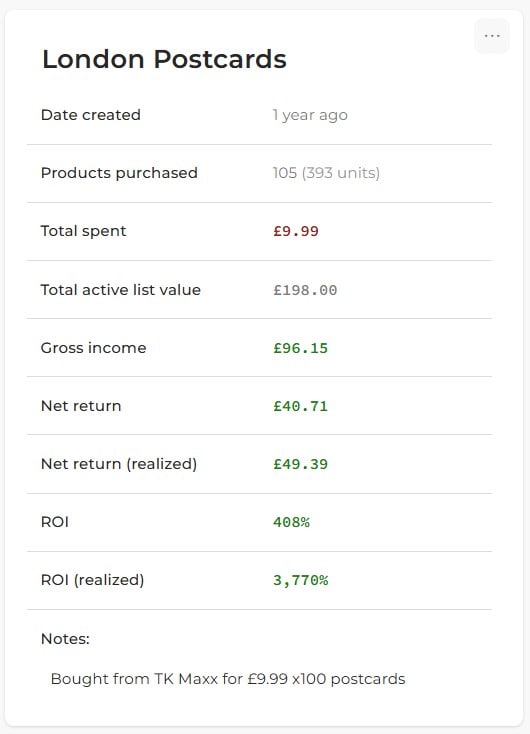
These results are based on sales over roughly the past year
This batch came from TK Maxx, where I paid £9.99 for 100 postcards.
From that batch, I listed a total of 393 units across different formats and variations. Total revenue from these listings has been £96.15, with a net return of £40.71 and a realised net return of £49.39.
Return on investment comes out at 408 percent, with realised ROI significantly higher once costs have been fully recovered.
Most sales fall into a narrow range, with loose postcards typically selling at around £3.50 and framed versions closer to £4.95. Sales come through individually rather than in clusters, with a steady background flow over time.
These sales have come through as individual transactions over several months, rather than in a short period after listing. Prices tend to sit in a narrow range, with most sales falling between roughly £2.50 and £3.00 depending on the listing format.
How Long Do They Take to Sell?
These are slow sellers in practical terms.
Some postcards sell earlier, usually the more visually distinctive designs, but the majority sit before selling. Over time, sales come through one by one rather than in waves.
This means capital is tied up for longer, although at a low cost per card that remains workable within a larger system.
Sales are spread across several months rather than happening early, which reinforces the pattern of steady but slow movement
What Actually Sells
The stronger designs move first, particularly those with clearer composition or more recognisable London elements.
Postcards that are more muted or less visually distinct still sell, but they take longer and tend to sit deeper in the listing cycle before moving.
Condition matters, but not to the same extent as older or rarer postcards. Presentation and clarity of the image have a more noticeable impact on which cards sell first.
There is consistent demand, but it shows up gradually rather than in clusters
How I List David Gentleman Postcards
I list these individually rather than as bundles, as that allows buyers to choose specific scenes and generally produces better overall returns.
I use two formats, loose postcards at a lower price point and framed postcards at a higher price point. Framed versions achieve a higher sale price but move more slowly, while loose postcards sell more consistently over time.
Photos are kept simple, with clear front and back images for loose cards and a straightforward display view for framed versions.
When pricing postcards like this, I keep the structure consistent across the catalogue, with loose cards at a lower price and framed versions slightly higher
Where I Found These
This batch came from TK Maxx, which was a one-off opportunity rather than a reliable sourcing channel.
These postcards do appear in job lots and mixed collections, but not consistently. The key is recognising them quickly when they do appear and assessing whether the batch works at a per-card level.
When I Wouldn’t Buy These
I would leave these if the cost per card is too high to support slower sales, or if the designs in the batch are mostly weak or repetitive.
I would also pass if condition is poor across the group, or if the cards are not suitable for individual listing, as the model relies on separating them and selling them one by one.
My Rule for Buying These
The numbers only work when the cost per card is low enough to absorb slower movement.
At around 10p per card, the model works comfortably. As the cost increases, the margin tightens quickly once fees and postage are taken into account, and the slower turnover becomes harder to justify.
This is the same decision process I use across sourcing, as outlined in How to tell if you have a demand problem or a listing problem when diagnosing stock performance.
Profit Reality
These are not high-margin items on an individual basis.
The structure is simple, with low acquisition cost, sale prices in the £3.50 to £4.95 range, and fees and postage taking a meaningful share of each sale.
Profit comes from consistency across multiple sales rather than any individual transaction, which makes this a steady stock line rather than a high-value flip.
I’ve sold a steady number of these over time, with sales continuing months after listing.
How These Compare to Other Postcards
Compared to standard tourist postcards, these tend to sell more slowly but with slightly more defined buyer interest. Compared to more obscure artist postcards, they are easier to recognise and produce more consistent sales over time. They sit in the middle, not fast, not rare, but reliable enough when bought at the right price.
Compared to James Bond Postcards, these sell more slowly but are cheaper to source, which can make the overall return more stable over time.
Compared to Dungeons & Dragons Postcards, these have broader appeal and more consistent demand, even though both sit in a similar price range.
Final Verdict: Should You Buy Them?
These are worth buying when the cost is low and you are building a broader postcard catalogue.
On their own, they are not especially strong, but within a larger system they produce steady, low-level returns that accumulate over time.