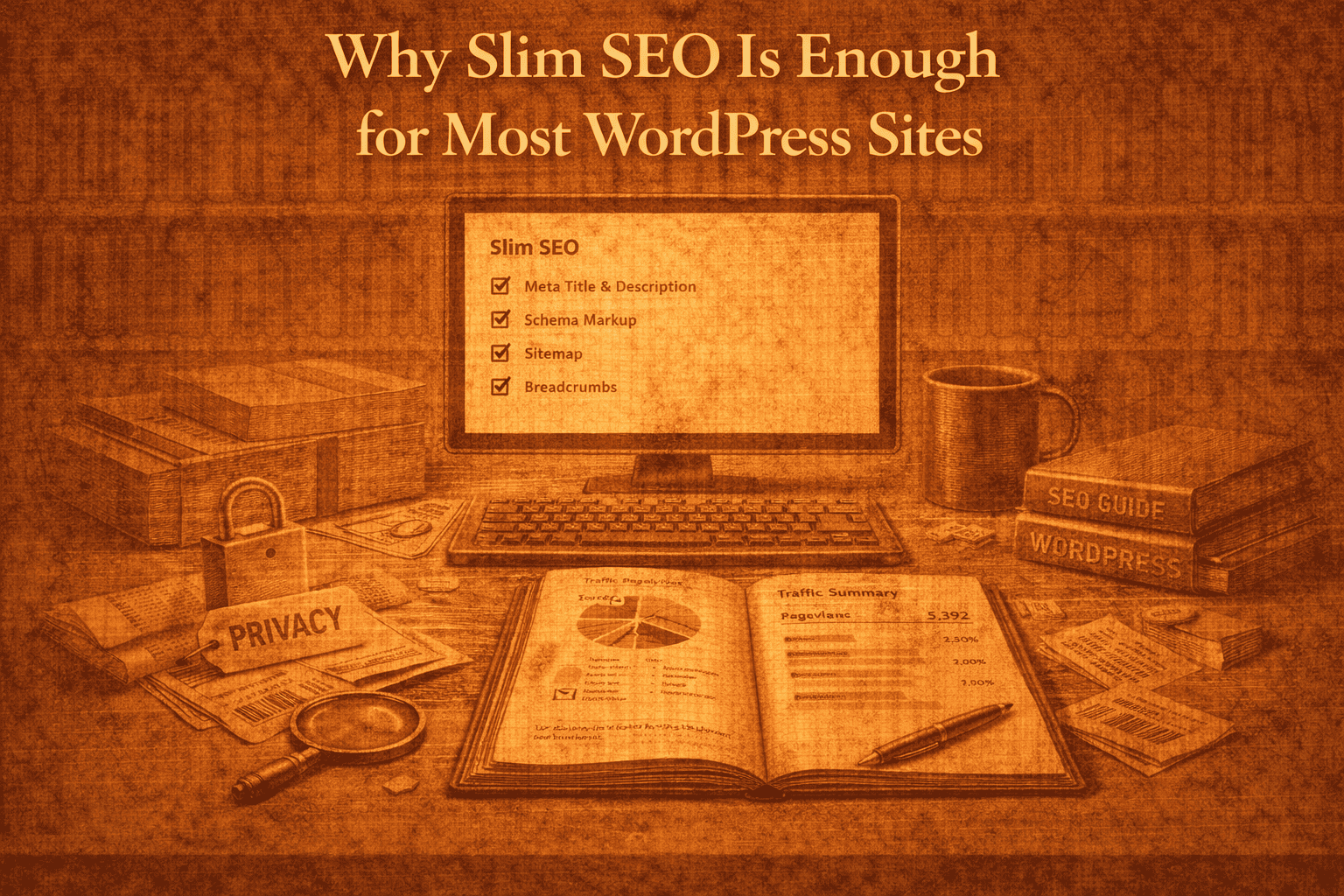
When I build a website, I am not trying to build an SEO laboratory.
I am trying to build something stable, fast and commercially useful.
That distinction matters.
Most WordPress sites start with an SEO plugin that promises control over everything. Slim SEO takes the opposite approach by focusing only on the essentials.
I use Slim SEO. Not because it does more. Because it does less.
This is not a feature comparison or configuration tutorial. It explains why Slim SEO is the plugin I use when building simple, commercial WordPress sites.
What Slim SEO Actually Does
Slim SEO handles the technical SEO layer most sites require by default.
It manages titles, meta descriptions, sitemaps and basic schema without turning SEO configuration into an ongoing task.
Slim SEO manages the technical SEO layer of the WordPress stack I run.
The Real Job of an SEO Plugin
An SEO plugin has one primary responsibility:
- Control meta titles
- Control meta descriptions
- Generate a sitemap
- Handle basic schema
- Stay out of the way
That is it.
Everything beyond that is either:
- Editorial judgement
- Structural architecture
- Or optimisation theatre
Slim SEO handles the essentials quietly.
It does not try to manage your strategy.
Complexity Is Not Strategy
Many website owners install heavier SEO plugins and then spend time:
- Adjusting green lights
- Tweaking keyword density
- Editing readability prompts
- Managing multiple configuration panels
This creates the illusion of control.
But search performance is not driven by plugin dashboards. It is driven by:
- Clear positioning
- Intent alignment
- Strong titles
- Internal structure
- Commercial clarity
No plugin can replace that.
If your structure is weak, more plugin features do not fix it.
They hide it.
Architectural Restraint
Every plugin you install expands your system.
- More code.
- More updates.
- More potential conflicts.
- More surface area.
Slim SEO is intentionally minimal.
It does not demand configuration rituals.
It does not push upgrade prompts aggressively.
It does not require constant tuning.
That fits how I design websites.
Finite stack.
Controlled expansion.
Minimal dependencies.
If a tool becomes a control panel you feel obligated to monitor, it has become technical drag.
I apply the same approach to performance tools as well. I explain how that works in my Perfmatters performance plugin review.
Decision Clarity Over Dashboard Feedback
Heavier SEO plugins often introduce:
- Keyword scoring systems
- Readability grades
- Traffic integration overlays
- Internal linking suggestions
For many small operators, this creates second-guessing.
You start writing for a plugin score instead of writing for:
- Search intent
- Buyer clarity
- Commercial positioning
Slim SEO removes that feedback loop.
It forces you to rely on:
- Structural thinking
- Clear headlines
- Logical internal linking
- Commercial intent
That is healthier for long-term website building.
When Heavier SEO Plugins Make Sense
There are scenarios where advanced SEO plugins are useful:
- Large content teams
- Technical schema requirements
- Complex redirection logic
- Large-scale taxonomy management
If you are running a high-volume content site, you may need those features.
If you are building a focused commercial website, you likely do not.
The more constrained the site, the simpler the tooling can be.
Mistakes Website Builders Make With SEO Plugins
- Installing multiple SEO plugins over time
- Using plugin feedback as editorial authority
- Obsessing over minor scoring differences
- Confusing configuration with progress
SEO performance comes from:
- Content-market alignment
- Structural coherence
- Clean internal architecture
- Commercial intent
Plugins support that. They do not create it.
Where Slim SEO Works Best
Slim SEO works particularly well for websites that prioritise clarity and restraint.
It suits:
- Single-author websites
- Small commercial sites
- Focused content businesses
- Websites that do not require complex schema configuration
- Sites built with lightweight themes such as GeneratePress
Where Slim SEO May Not Be Enough
Slim SEO is intentionally minimal.
That simplicity is the point, but it also means it will not suit every type of website.
You may need a more complex SEO plugin if you:
- Run a large editorial team with structured workflows
Need advanced schema customisation
Manage complex redirect logic
Operate a large multi-author publishing site - In those situations a heavier plugin can provide useful operational controls.
For focused commercial websites, however, those features are rarely necessary.
My Recommendation
If you are building a WordPress site with:
- A clear niche
- Controlled content scope
- Defined monetisation path
- Clean internal structure
Slim SEO is enough.
It handles the technical layer quietly.
It does not try to become your strategy.
Tools should support the site.
They should not become the centre of it.
If your SEO plugin is consuming mental energy, it is too heavy for the website you are trying to build.
Simplicity scales better than control panels.
If you want to see exactly what Slim SEO does and how it fits into a lightweight WordPress stack, you can explore the plugin on the official site.