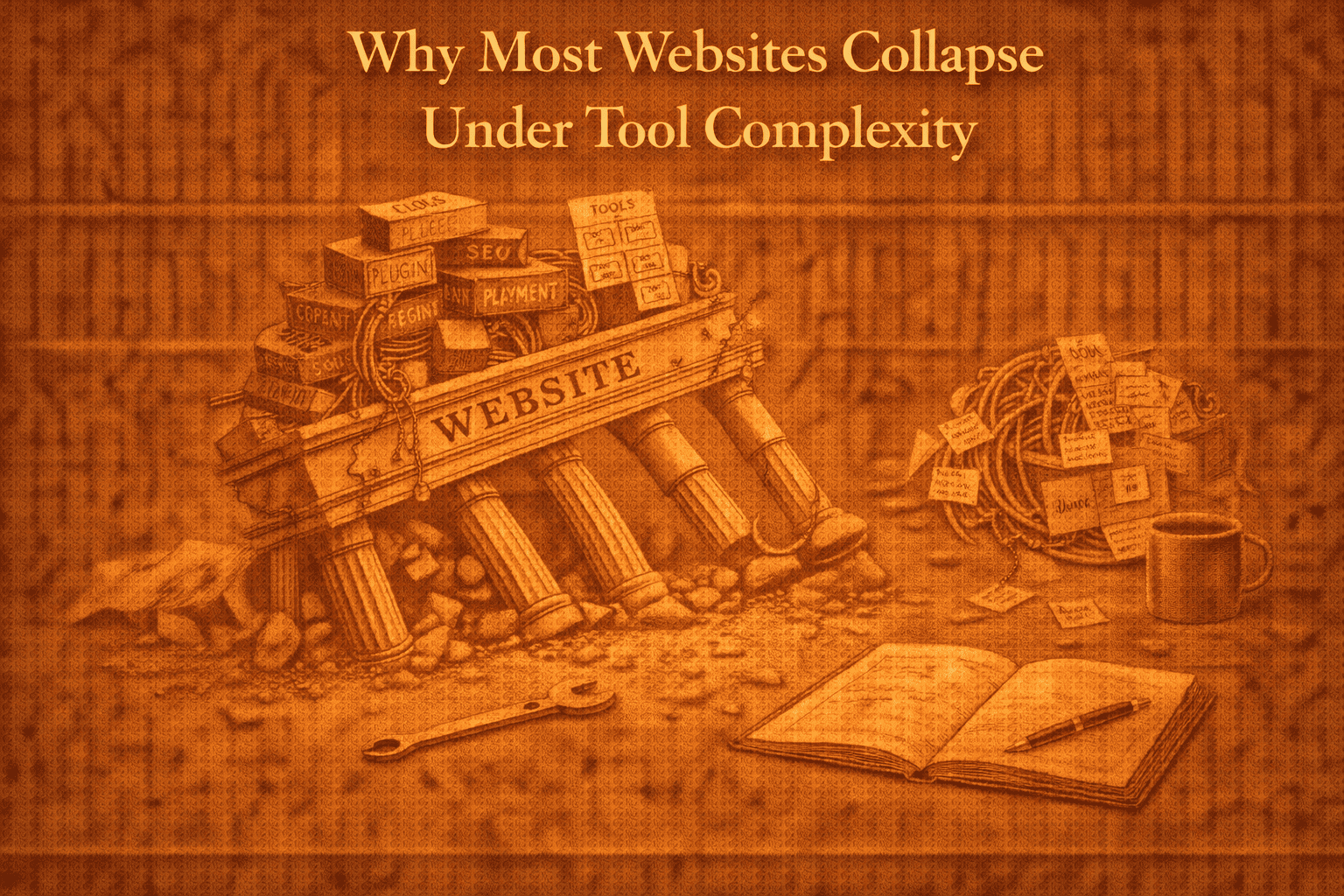
Websites rarely fail because of one dramatic mistake.
They fail because of accumulation.
A new plugin is installed.
A tracking layer is added.
An optimisation tool is layered on top.
A new integration connects everything together.
Each decision feels reasonable on its own.
Over time, the system becomes fragile.
Complexity compounds quietly.
Collapse Is Gradual
No one sets out to build a bloated website.
The decline happens in stages:
- Tools are stacked instead of replaced
- Features overlap
- Dashboards multiply
- Configuration grows
Nothing breaks immediately.
Performance declines slowly.
Maintenance increases.
Confidence drops.
Eventually, the website requires constant supervision.
At that point, it is no longer a stable commercial system.
It is infrastructure that demands attention.
Every Tool Adds Risk
Every additional tool introduces:
- Code that must be updated
- Compatibility risk
- Security exposure
- Performance overhead
- Dependency on external decisions
When tools depend on other tools, fragility increases.
A small update in one layer can affect everything.
This is manageable for large teams.
It is dangerous for small operators.
The Illusion of Improvement
Tool complexity often grows during slow periods.
Traffic dips.
Revenue stalls.
Engagement feels flat.
The instinct is to add something.
- A new SEO plugin
- A conversion tool
- A performance enhancer
- A new analytics dashboard
These actions create movement.
But movement is not progress.
If positioning is unclear or the offer is weak, infrastructure changes do not solve the problem.
They delay the real decision.
Maintenance Becomes the Work
A complex website demands:
- Frequent plugin updates
- Compatibility checks
- Performance monitoring
- Debugging sessions
- Configuration reviews
You shift from building value to maintaining systems.
This shift happens slowly.
By the time you notice it, the stack is already heavy.
A website that consumes your attention is not stable.
It is fragile.
Simplicity Is Structural Strength
A restrained stack offers:
- Fewer failure points
- Faster troubleshooting
- Predictable behaviour
- Lower mental overhead
Simplicity improves:
- Stability
- Speed
- Decision clarity
When the structure is clean, weaknesses are visible.
When the structure is complex, weaknesses hide behind tools.
Signs Complexity Is Taking Over
- You hesitate to update plugins
- Small changes break unrelated features
- Performance varies unpredictably
- You monitor dashboards more than revenue
- The admin panel feels crowded
These are architectural signals.
They indicate tool complexity is overtaking structure.
How to Prevent Collapse
- Define your core stack early.
- Add tools only when a clear problem exists.
- Replace instead of stacking.
- Audit plugins regularly.
- Remove what is not essential.
Complexity grows by default.
Simplicity requires discipline.
My Recommendation
Treat every new tool as a structural decision.
Ask whether it strengthens stability or increases fragility.
Websites collapse slowly under accumulated complexity.
They endure when the stack remains controlled.
Build deliberately.
Protect the structure.
Resist unnecessary expansion.
Simplicity compounds more reliably than complexity ever will.