Position in the System
This sits across Dispatch → Tools and general operational setup.
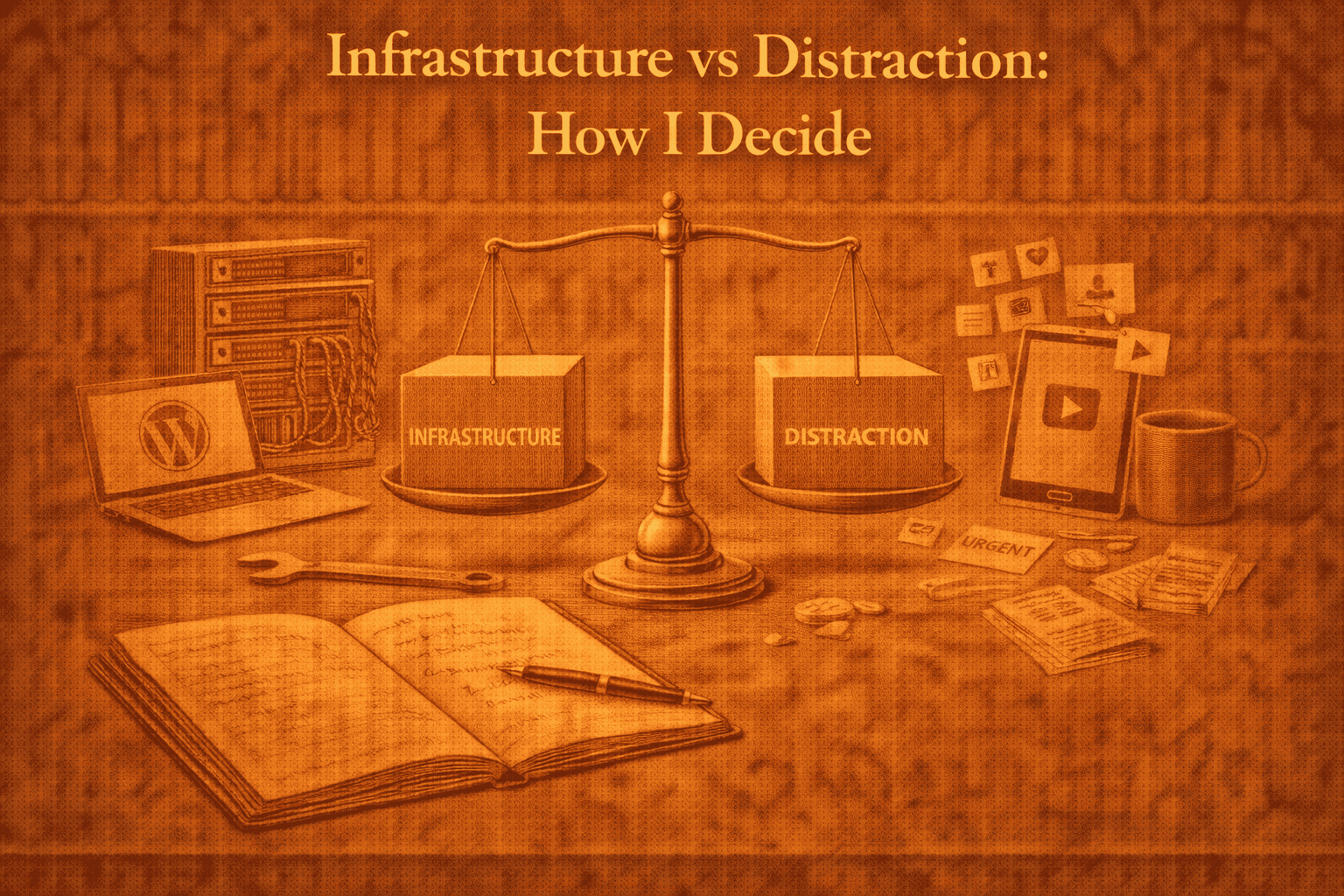
I am deciding what tools actually improve how I run listings, and which ones create unnecessary complexity.
The Reality of Adding Tools
Most tools look useful at first.
They promise better insight, more control, or improved performance, and they often appear at the point where something feels slow or unclear.
In practice, not every tool improves how the business runs. Many of them add layers of monitoring and configuration without changing the underlying outcome.
What I Treat as Infrastructure
Infrastructure is anything that makes the business easier to run without ongoing attention.
In my own setup, that includes:
- reliable hosting
- simple SEO setup
- image compression
- listing and dispatch tools that reduce manual work
Once these are in place, they tend to disappear into the background.
If something needs constant checking or adjustment, it is usually not infrastructure.
What Distraction Looks Like
Distraction often appears as optimisation.
It shows up as:
- additional analytics tools
- deeper dashboards
- conversion tracking layers
- performance tweaks
These feel productive, but if they do not improve how listings perform or how decisions are made, they do not change the outcome.
In most cases, they increase mental overhead without increasing revenue.
The Test I Use
Before adding anything new, I look at it in practical terms.
- Does this reduce friction in how I list, ship or manage stock?
- Does this improve clarity around what is selling and what is not?
- Will this simplify the system, or add another layer to manage?
If the answer is unclear, I do not add it.
Where This Shows Up in Practice
This pattern appears most clearly when something slows down.
If sales drop or listings underperform, the instinct is often to add:
- another analytics tool
- a conversion plugin
- some form of optimisation layer
In most cases, the issue is not tools.
It is:
- demand
- pricing
- listing quality
Changing infrastructure does not fix those.
The Cost of Getting This Wrong
The main cost is not money, it is attention.
Each additional tool:
- adds another dashboard
- adds another decision layer
- increases the time required to understand what is happening
Over time, this makes the system harder to run rather than easier.
When Adding Tools Makes Sense
There are points where expansion is justified.
This usually happens when:
- order volume increases
- manual work becomes repetitive
- a clear bottleneck appears
At that point, a tool can remove friction and make the system more stable.
The difference is that the tool solves a defined problem rather than creating new activity.
How This Connects to Listings
The same thinking applies to how listings perform.
If something is not selling, the cause is rarely a missing tool.
It is usually a combination of:
- demand
- pricing
- presentation
Tools can support the process, but they do not replace it.
Final View
A simple system is easier to run, easier to understand, and more stable over time.
Most improvement comes from better decisions, not more tools.
The role of infrastructure is to support the work, not to replace it.