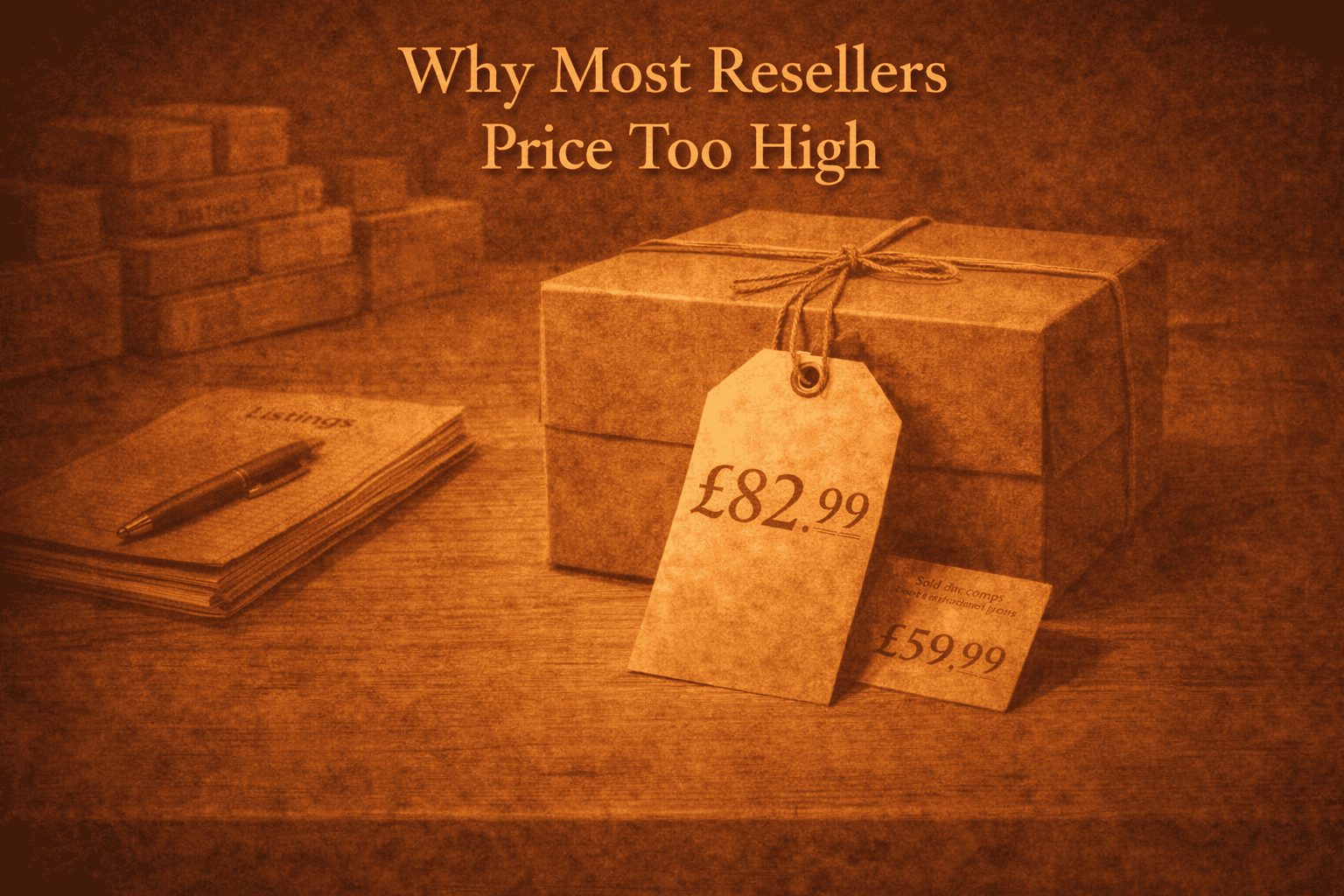
Why Pricing High Feels Safe (But Isn’t)
When I price an item, there is always a pull toward the highest number I can justify, because it feels like the safest way to protect the outcome before the listing has had a chance to compete.
That decision carries a certain logic, since pricing higher appears to leave room for offers, avoids the feeling of underselling, and keeps open the possibility of a better result.
At the point the price is set, nothing looks wrong, because it sits within the range of sold listings and matches what other sellers are asking.
This is why pricing too high rarely feels like a mistake.
It feels like protecting margin.
The problem is that the price is being set against what is possible, not against where most sales are actually happening. I talk about this more in How I Think About Pricing on eBay.
Position in the system
This sits inside the pricing stage. The full structure is mapped in the UK Marketplace Reseller Manual.
Source → Price → List → Diagnose → Dispatch → Returns → Repeat
By the time I reach this point, I have already decided that the item is worth buying and that demand likely exists.
The pricing decision is what determines where the listing will sit once it enters the market, and whether it will be chosen against competing items.
If that position is too high, the listing does not fail immediately, but it sits outside where most transactions are actually happening, which makes everything that follows slower and less predictable.
Why Resellers Default to Higher Prices
When I look at sold listings, the highest outcomes naturally draw attention, because they define what the item can achieve at its best.
That number becomes the anchor, even when most sales are happening lower down.
The rest of the range is still visible, but it carries less weight, because it does not represent the best outcome.
What is not immediately obvious is how often those higher prices are achieved, or how many listings sit at that level and do not sell.
The result is that the price reflects the top of the range rather than where the market is actually clearing. This is the same gap I describe in What Is a Good Price vs a Sellable Price.
What Overpricing Looks Like on a Live Listing
A listing that is priced too high still receives activity, which is why it is easy to misread.
Views increase, watchers appear, and the listing looks like it is doing something.
At the same time, similar items priced closer to where sales are actually happening continue to sell.
The listing is not invisible. It is being passed over. The pattern is consistent, which is often misread as a listing problem, something I break down in Why Your eBay Listing Isn’t Selling.
Activity builds, but conversion does not follow, and the listing begins to age while comparable items continue to move around it, which starts to affect performance over time as I explain in Why Listing Age Matters on eBay.
Watchers increase, but offers do not arrive at a level that closes the gap.
Why Overpricing Is Hard to Spot
The price still looks correct when it is judged on its own.
It sits within the range, matches previous sales, and aligns with what other sellers are trying to achieve.
There is no clear signal at the point of listing that the decision is wrong.
The only signal comes from behaviour, and that takes time.
By the time it becomes clear, the listing has already spent time sitting in a weaker position than expected, even though nothing about the price appeared obviously wrong at the start.
What Happens When You Price Too High
Pricing too high moves the listing away from where most transactions are actually happening and increases the reliance on a buyer choosing it over stronger options.
In strong demand, the item may still sell, but it usually takes longer than comparable listings.
In weaker demand, it does not move at all, which is where it becomes difficult to separate pricing from demand without diagnosing it properly, something I cover in How to Tell If You Have a Demand Problem or a Listing Problem.
The listing remains visible, but it is not positioned to be chosen consistently.
It exists in the market without participating where sales are actually happening.
How Overpricing Reduces Margin Over Time
The intention behind pricing high is to protect margin.
What actually happens is delay, followed by adjustment.
The item sits, activity does not convert, and eventually the price is reduced or an offer is accepted to create movement.
The sale still happens, but it happens later and usually at a lower level than would have been required if the listing had been priced closer to where items were already selling.
Across multiple listings, this becomes a pattern.
Time is lost, prices are adjusted after the fact, and margin is reduced in small, repeated steps, which are rarely visible until you look at what actually remains after a sale, something I break down in What Actually Remains After a Sale.
Why Resellers Keep Pricing Too High
Each decision can be justified, the price sits within the range, the listing looks fine, and the item still has a chance to sell, so nothing appears broken.
What changes is how efficiently the system works.
Listings take longer to move, offers become more common, and price reductions happen after time has already been spent waiting.
Because sales still happen, the behaviour is easy to ignore.
The pattern repeats without being recognised as the cause.
How I Think About It Now
I no longer treat the highest visible price as the target.
I treat it as one outcome within a range where most sales are happening lower down.
The decision is not about what the item can achieve at its best.
It is about where it needs to sit to be chosen against what is actually selling.
A price that is too high rarely fails in a clear way.
It reduces the likelihood of being selected, which delays the sale and increases the chance that the price will be adjusted later.
That is where margin is lost, not in a single mistake, but in the time between listing and sale, where the listing was never positioned where buyers were actually choosing.