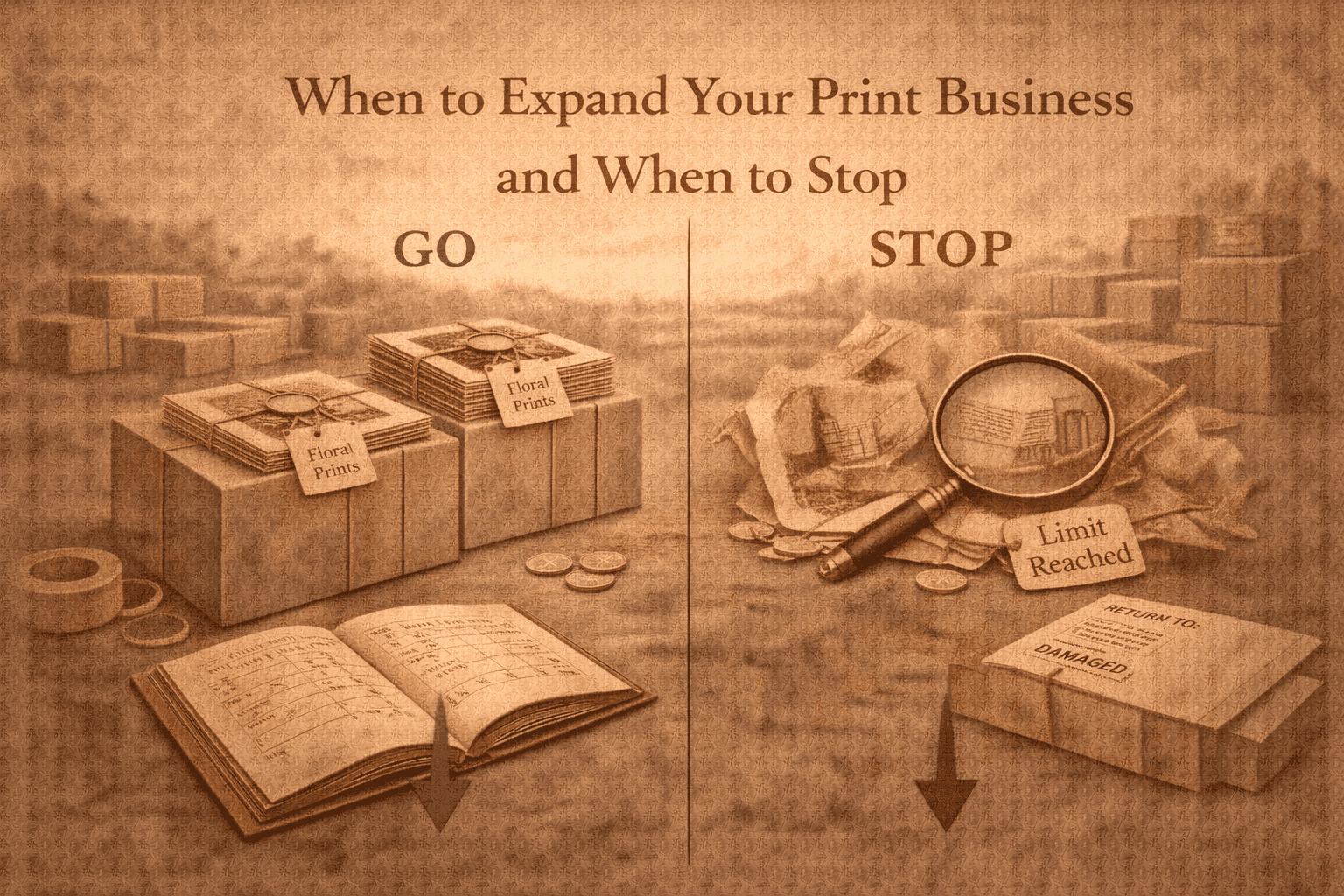
Expansion feels productive even when it is not improving anything.
- It feels like momentum.
- It feels like commitment.
When you are building a public domain print business from home, adding more designs or widening to another platform can feel like the obvious next step.
The difficulty is not knowing how to expand.
It is knowing when to hold back.
The wider structure behind that order is explained in how to grow a public domain print business without burning out.
Expansion Is Not Continuous by Default
In a spare-room business, expansion should not be constant.
- There are periods for building.
- There are periods for watching.
- There are periods for cutting.
Many sellers expand automatically. Sales dip, so they add more listings. Traffic feels slow, so they test a new theme. One platform feels quiet, so they open another.
Expansion becomes the default response to uncertainty.
That is where problems start.
Expand When Something Is Clearly Working
Expansion makes sense when you are widening strength.
That looks like:
- A theme that is clearly repeating in views and sales
- More than one listing inside that theme performing steadily
- New additions gaining traction faster than unrelated tests
- Pricing that holds without heavy discounting
- Managing your current catalogue feeling under control
When those conditions exist, you are not guessing. You are adding to something that is already paying attention back.
That is when doubling down makes sense.
If you are unsure how to recognise whether a theme is genuinely working, read how to identify public domain art themes that sell.
Do Not Expand to Escape Stagnation
It is easy to confuse movement with progress.
If nothing in your shop is clearly repeating, adding more listings rarely fixes that. The mechanics behind that are explained in why more listings do not increase print sales.
It spreads effort across more directions. If you are unsure what is working, adding another theme increases confusion.
Expanding to escape stagnation avoids the harder decision, which may be trimming weak themes or narrowing focus.
If you cannot point to a direction that is clearly working, expansion is too early.
More exposure on a weak foundation just makes the weakness visible in more places.
Signs You Should Pause Instead
Pause expansion when:
- You cannot clearly say which theme is strongest
- New listings perform randomly
- You are discounting more to create activity
- Managing your current listings already feels messy
- You feel pressure to upload just to feel productive
More listings mean more small decisions every day. If you are already stretched, adding more multiplies the noise.
These are not signs you need more reach. They are signs you need more clarity.
Stopping is not failure. It is consolidation.
Consolidation Builds Strength
Consolidation means:
- Trimming weak themes
- Refining titles and presentation
- Standardising production
- Watching which themes actually repeat
It can feel slower than expansion. It often feels less exciting. But when structure is unclear, consolidation usually improves results more reliably than adding more.
In a spare-room business, consolidation protects time and energy.
A Clear Boundary
Before expanding, ask:
What exactly is working well enough to deserve more attention?
If the answer is vague, do not expand.
If nothing is clearly working, you stop expanding.
Prove it before you expand it.
When nothing is clearly repeating, the right move is often to stop adding and start strengthening.