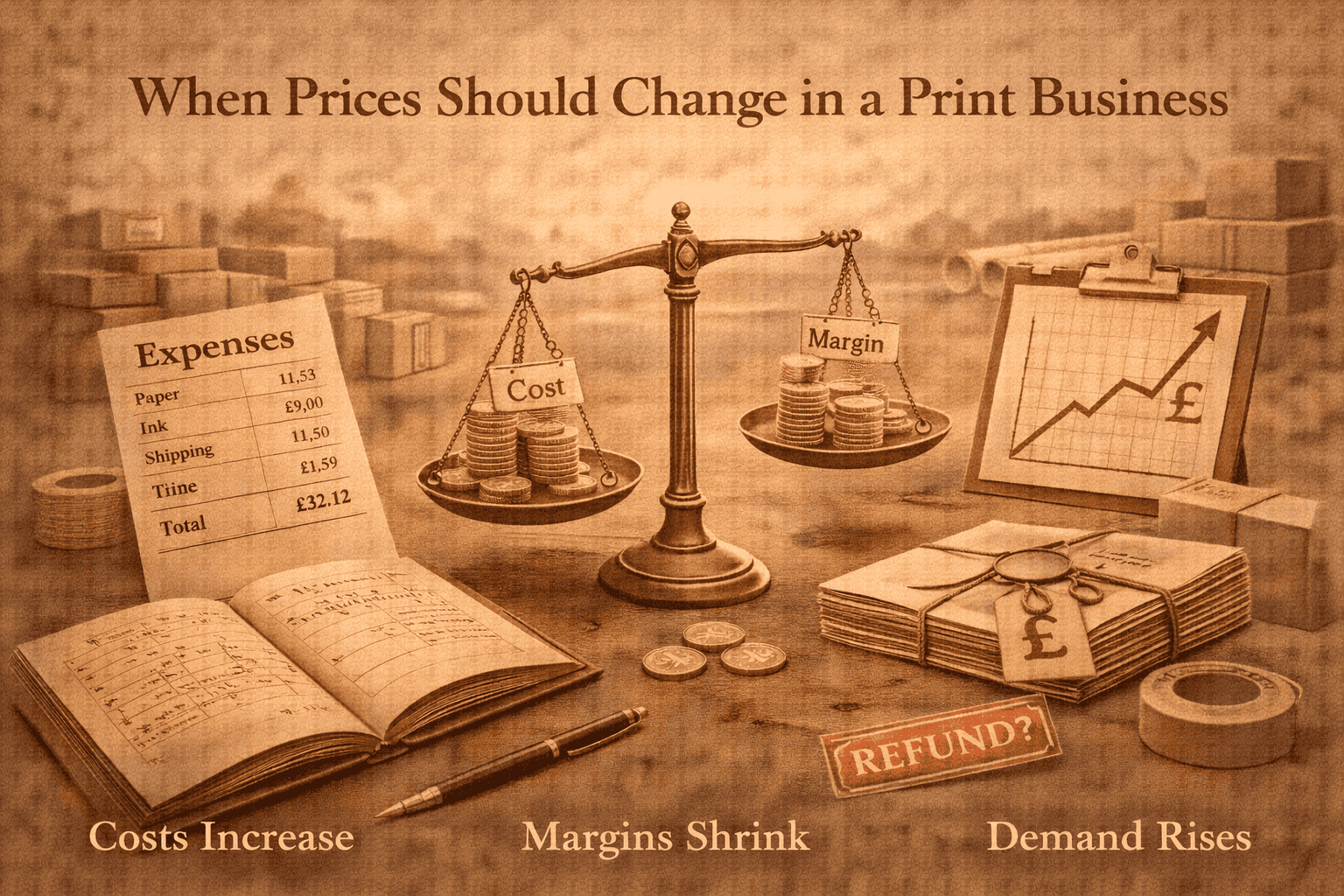
Price Changes Should Be Structural, Not Emotional
In a home-based public domain print business, price movement should be deliberate.
It should not be reactive.
- A slow week is not a structural signal.
- A competitor reducing their price by £0.20 is not a structural signal.
- A temporary dip in visibility is not a structural signal.
Prices should move when the structure underneath them has shifted in a sustained way.
Pricing discipline means separating noise from structural change. That discipline only works inside a profitable public domain art print business built on clear structural boundaries.
The wider boundary this discipline protects is set out in The Pricing Discipline Behind Public Domain Prints.
Structural Shifts That Justify Adjustment
There are clear conditions that may justify revisiting price.
- Permanent postage increases.
- Sustained increases in paper or ink cost.
- Changes to platform fee structure.
- A measurable and persistent rise in replacement frequency.
These factors alter what stays in the business per order. What that retained portion represents is explained in What Actually Remains After a Sale.
If an A5 at £3.99 previously left a modest but workable retained portion, and sustained cost increases narrow that portion materially, the boundary may no longer hold.
The key word is sustained.
One month of higher ink spend is not enough. A temporary promotion cost is not enough. A single week of clustered replacement is not enough.
Structural shifts reveal themselves over time.
Ignoring sustained structural change in order to preserve a visible price is not discipline. It is avoidance.
Temporary Pressure Does Not Require Repricing
Weeks fluctuate.
- Some weeks include more accepted offers.
- Some weeks include more replacements.
- Some weeks feel tighter than others.
This does not automatically mean prices are wrong.
- Replacement clustering is normal.
- Small cost spikes are normal.
- Seasonal variation is normal.
If pricing is structurally sound, short-term pressure can be absorbed. How retained portion narrows gradually before becoming visible is examined in Where Margin Quietly Disappears in Print Sales.
Changing prices in response to temporary strain creates instability. It also increases decision fatigue and disrupts consistency across listings.
Pricing should not move simply because a week felt uncomfortable.
Repricing to Match Competitors
Marketplace competition encourages reactive behaviour.
A competitor lowers A5 from £3.99 to £3.79.
Another lists A4 at £5.49 instead of £5.99.
It is tempting to follow immediately.
Before adjusting, the question must be asked:
Has the structure of my retained portion changed?
If your material costs, replacement rate and fee structure remain stable, lowering price simply narrows your own tolerance.
Competitors may operate with different suppliers, lower material standards or thinner margins.
Matching their price does not change your cost base.
Reactive matching reduces buffer without improving structural resilience.
When the Boundary Has Clearly Shifted
There are moments when repricing becomes necessary.
- If postage increases permanently and materially.
- If paper cost rises across multiple months.
- If platform fees are revised upward.
When what stays in the business per order has been consistently reduced across several months, ignoring the shift weakens the boundary.
In these cases, adjustment is not aggressive. It is corrective.
The goal is not expansion.
It is restoration of tolerance.
If an A5 must move from £3.99 to £4.19 to maintain what previously stayed in the business, that adjustment reflects structural change, not ambition.
Adjusting Without Destabilising the Catalogue
When repricing is required, it should be measured.
- Frequent micro-adjustments create inconsistency.
- Listings feel unstable.
- Internal price logic becomes difficult to maintain.
It is better to review structure periodically and adjust deliberately than to shift pricing repeatedly in response to minor pressures.
Stability supports clarity.
A price that moves rarely but intentionally reinforces discipline.
Price Increases Do Not Fix Weak Discipline
Raising prices impulsively does not solve structural weakness.
- If discounting remains casual,
- if replacement handling remains inefficient,
- if cost drift is ignored,
a higher headline price may briefly widen buffer but will not correct underlying behaviour.
Price change should follow structural awareness, not replace it.
Pricing is not a lever for solving every operational issue.
It is one boundary among several.
Knowing When to Leave Price Alone
One of the more difficult disciplines is restraint.
- If what stays in the business remains stable across months,
- if replacement levels are predictable,
- if cost inputs are steady,
there is no requirement to adjust price.
Stability is valuable.
Constant adjustment introduces uncertainty for both seller and buyer.
A stable price that protects tolerance should remain stable.
Movement should reflect genuine structural change, not competitive anxiety or temporary discomfort.
Pricing as Ongoing Awareness
Pricing is not set once and forgotten.
Nor is it adjusted constantly.
It is reviewed with awareness of:
- What stays in the business
- Replacement sensitivity
- Cost drift
- Fee changes
When these elements shift materially and persistently, the boundary may need correction.
When they do not, restraint is discipline.
Price should change rarely, and only when the structure underneath demands it.