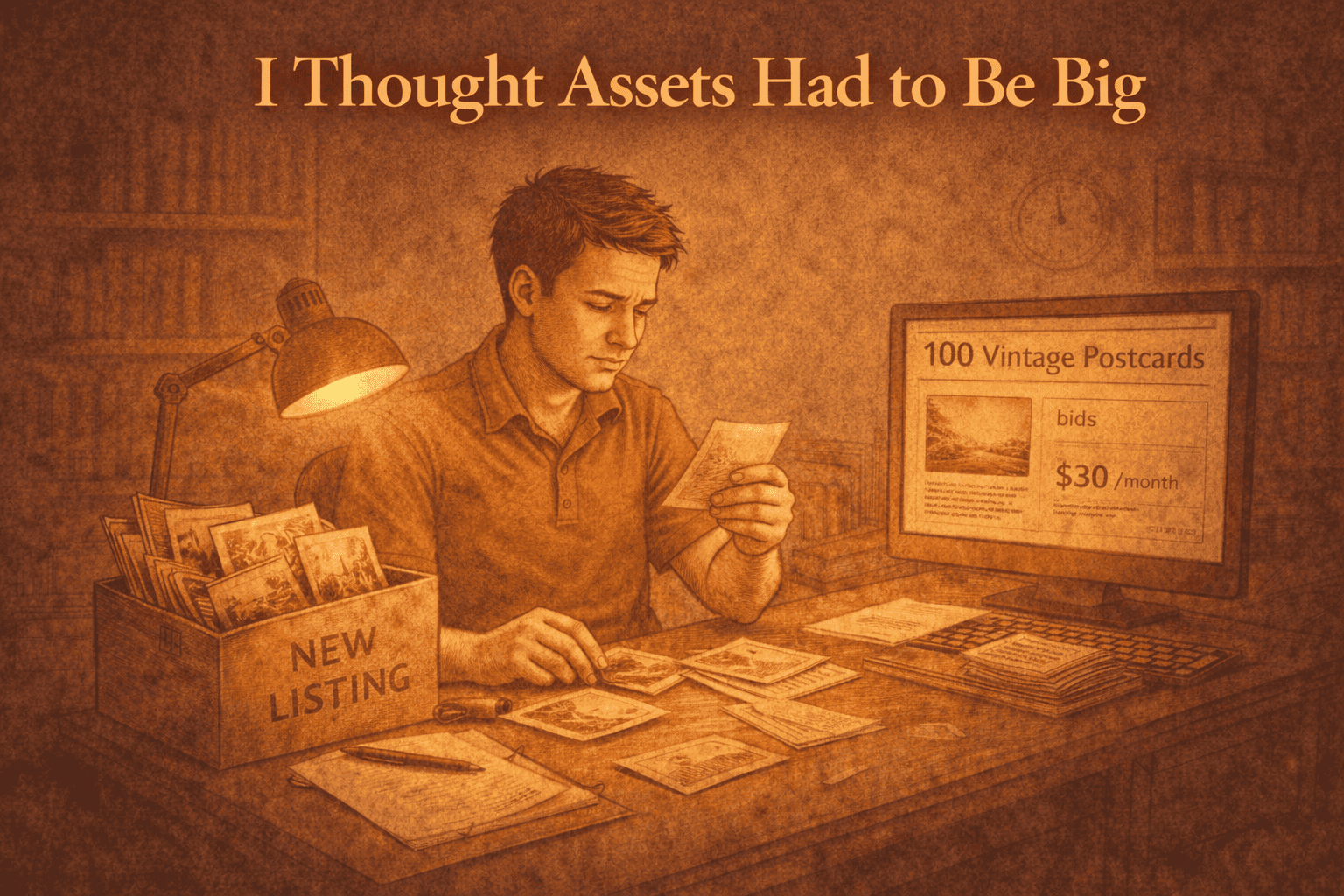
When an eBay Listing Became an Asset
For a long time, I thought I understood what people meant when they talked about “building assets”.
I just didn’t think I was doing it.
In my head, assets were big things.
- Courses.
- Software.
- Memberships.
- Something with a landing page and a lot of implied ambition.
Building assets felt like a separate mode of work, heavier, riskier, and easy to postpone.
Which meant that for years, I quietly avoided it.
The mistake was assuming that format was the defining feature.
What I eventually realised is that an asset isn’t defined by how impressive it looks.
It’s defined by one thing only: Does it keep contributing without requiring me to stay involved?
Once I looked at it that way, something obvious, and slightly embarrassing, became clear.
I was already building assets. I just wasn’t recognising them as such.
A single eBay listing in my Prints business is a good example.
- It’s finite.
- The work is done once.
- It doesn’t need updates.
- It doesn’t require promotion.
- It doesn’t care whether I’m motivated or not.
It might earn £20 or £30 a month. Nothing dramatic. Nothing screenshot-worthy.
But it keeps doing that whether I’m paying attention or not.
That’s an asset.
In fact, in many ways it’s a better asset than most of the things people rush to build.
The internet tends to frame asset-building as an act of ambition.
- Bigger.
- Scalable.
- Transformational.
What that framing hides is that ambition concentrates risk.
Big assets take longer to build, demand confidence up front, and often come with ongoing obligations:
- updates
- launches
- audiences
- explanations
If they fail, they fail loudly. If they succeed, they often ask for more.
Small, finished assets behave differently.
Each one stands alone.
- If it underperforms, nothing breaks.
- If it performs steadily, it does so quietly.
Over time, they accumulate without asking permission.
The shift for me wasn’t tactical. It was psychological.
Once I accepted that an asset could be modest, boring, and calm, I stopped feeling the need to “gear up” to build one.
Finishing things became easier.
Commitment became lighter.
Instead of asking whether something was big enough to matter, I started asking a simpler question:
If this earned a small amount every month, indefinitely, would I still be glad it exists?
If the answer was yes, that was enough.
Background revenue, at least for me, isn’t built by dramatic moves or clever positioning.
It’s built by accumulation and time.
A finished thing that keeps working beats an ambitious thing that never quite gets done.
Once I stopped waiting to build “real” assets, I realised I already was, one quiet listing at a time.