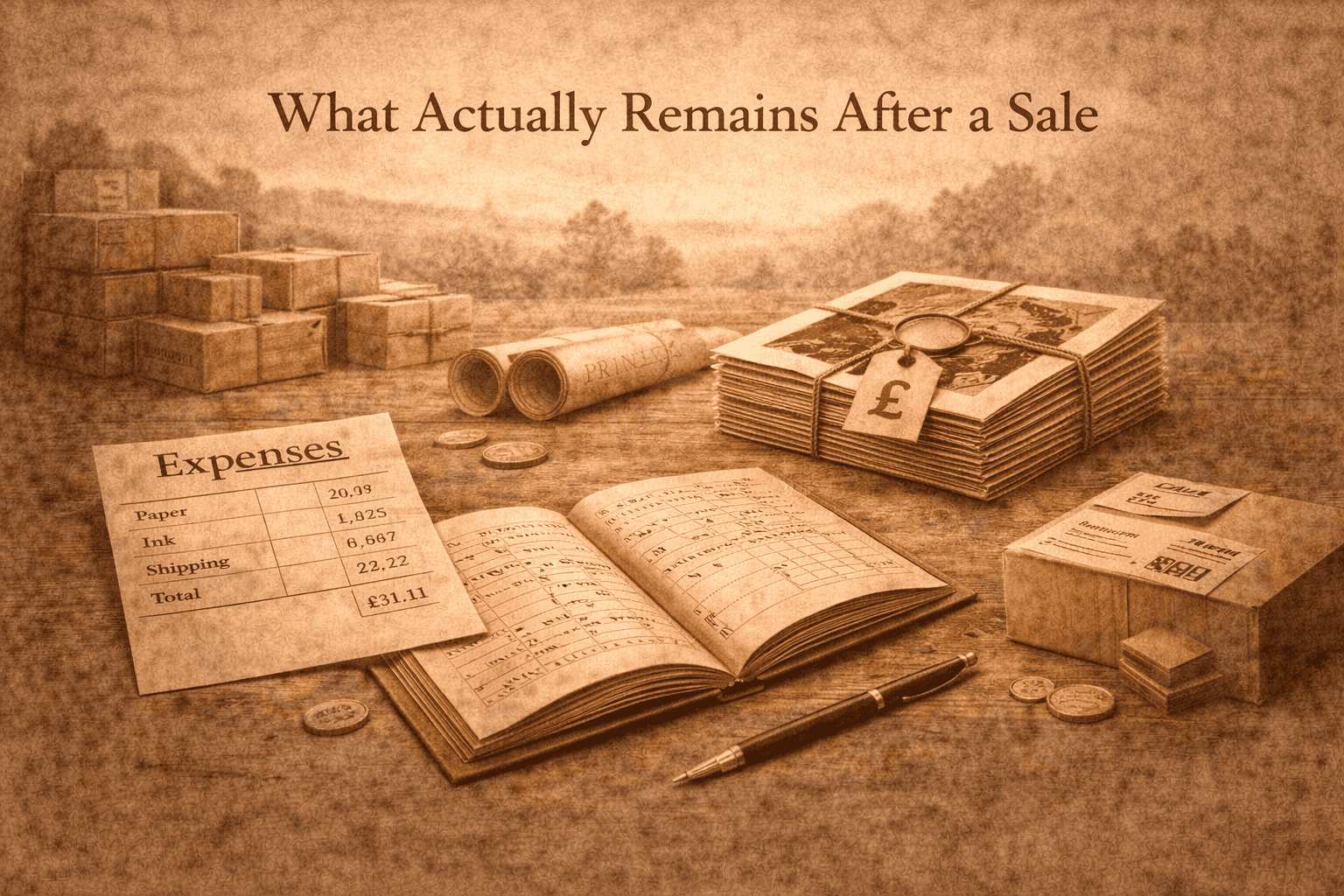
The Sale Price Is Not What Stays in the Business
In a home-based public domain print business, the sale price is visible. What stays in the business is not.
Understanding what actually stays only makes sense inside a structured print business model, which I outline in the main public domain print business guide.
An A5 print listed at £3.99 appears straightforward. The number is clear. The buyer pays £3.99. The platform confirms the sale.
But £3.99 is not what you keep.
The platform removes its fee. Payment processing takes its share. What lands back in your account is already lower than the headline price.
- Before paper is printed.
- Before an envelope is sealed.
- Before postage is applied.
The difference between the sale price and what reaches you is the first narrowing of the boundary.
This is not unusual. It is simply how marketplaces operate.
The problem arises when sellers mentally anchor to the headline number rather than what actually remains after the first deductions.
Pricing discipline starts with this separation. The wider framework for this boundary is set out in The Pricing Discipline Behind Public Domain Prints.
The sale price is the boundary.
What stays in the business is what survives that boundary.
Direct Costs That Leave Immediately
Once the platform has taken its portion, physical production begins.
Using light example figures for illustration:
An A5 sheet of quality paper might cost £0.15 to £0.25 depending on supplier and quantity. Ink per print may add another £0.10 to £0.20. An envelope and backing board may cost £0.30 to £0.50 combined. Postage might sit around £1 or slightly above, depending on weight and service.
The exact numbers vary. Suppliers differ. Bulk buying reduces cost. But the structure remains consistent.
Each of these inputs leaves immediately.
If a £3.99 sale becomes roughly £3.70 after platform and payment deductions, and direct materials and postage remove another £1.80 to £2.20, what stays in the business is significantly smaller than the headline suggests.
That remaining amount must do more than simply exist.
It must absorb everything else the business encounters.
This is where overestimation commonly occurs.
The seller sees £3.99 and subtracts paper and postage. They do not fully account for every direct input, and they rarely pause to consider what that remainder must still tolerate.
Understanding what stays in the business requires following the order all the way through dispatch.
What Still Has to Be Covered
After direct materials and postage are removed, the remaining portion does not automatically become income.
It must still cover:
- Your time
- Printer wear
- Occasional misprints
- Packaging mistakes
- Address corrections
- Replacement orders
- Small cost drift
The direct impact of reprints on what stays in the business is examined in The Cost of Replacing a Print Order.
Time is rarely itemised in small home operations. It is absorbed quietly. Yet printing, trimming, checking, packing and labelling take time. Even a well-practised workflow carries labour input.
Equipment wear is less visible but real. Printers require maintenance. Ink systems degrade. Paper stock sometimes becomes unusable.
Mistakes occur. A sheet prints slightly misaligned. An envelope seals imperfectly. An address is transposed.
Each of these events consumes part of what stays in the business.
The retained portion from a £3.99 A5 sale must absorb all of it.
If that portion is narrow, tolerance is narrow.
Why A4 Does Not Double What You Keep
It is tempting to assume that moving from A5 at £3.99 to A4 at £5.99 materially increases what stays in the business.
The headline difference is £2.00.
The structural difference is smaller.
An A4 sheet uses more paper. Ink coverage increases. Packaging must be larger and more rigid. Postage may increase due to weight or size thresholds.
Each of these inputs consumes part of that additional £2.00.
What stays in the business from an A4 sale is typically higher than A5, but not by the full visible difference in price.
The increase in sale price does not translate directly into a proportional increase in retained portion.
It is partially absorbed by scale.
If this is not recognised, sellers overestimate the protection provided by larger formats.
The same boundary logic applies.
The order must still tolerate friction.
Mounted Prints Carry Different Exposure
Mounted postcards at £5 sit between A5 and A4 in headline pricing, but they carry a different structure.
The mounting board adds cost per unit. It may improve perceived quality and reduce flex, but it increases material input before the order even leaves the workspace.
If a mount costs £0.40 to £0.60 and requires additional packaging protection, the direct cost base rises.
If the mount is damaged during transit, the replacement requires not just paper and ink, but a new board and additional packaging.
The material exposure per incident is higher than with a simple unmounted sheet.
The headline price of £5 may appear comfortably above £3.99, but the retained portion can narrow quickly once mounting cost is included.
Each format carries its own exposure profile.
The price alone does not reveal it.
Why Per-Order Reality Matters
Each order must be sustainable on its own. If it cannot absorb minor friction independently, pricing is misaligned.
It is easy to look at a month in aggregate and feel reassured.
If 100 orders generate a positive overall result, the assumption is that the pricing structure works.
But per-order discipline matters more than monthly averaging.
Within those 100 orders, there may be 10 that require replacement. There may be several that were discounted. There may be a handful that absorbed packaging errors or reprints.
Some individual orders may leave very little in the business. A few may effectively leave nothing once direct and indirect exposure is considered.
If pricing only works when averaged across volume, it is structurally weak. How that weakness develops gradually is examined in where margin quietly disappears.
That broader structural risk is examined further in Why Low Prices Reduce Tolerance in Print Selling.
Each order must protect itself.
An individual A5 at £3.99 must be sustainable even if it experiences minor friction. An A4 at £5.99 must tolerate its own material exposure. A mounted postcard at £5 must cover its board cost and replacement risk.
When sellers assume that “it balances out across 100,” they rely on volume to hide thin pricing.
In a home-based operation with limited daily capacity, volume cannot compensate for structurally weak per-order tolerance.
The boundary must hold at the level of a single sale.
If it does not, the business begins to feel tighter than expected, even when overall numbers appear positive.
That tightening is not mysterious.
It reflects what actually stayed in the business on each individual order.
The Discipline Behind What Stays
Understanding what stays in the business is not an accounting exercise. It is operational awareness.
It forces a shift from asking:
“What did this sell for?”
to asking:
“What survived after everything this order consumed?”
Only that surviving portion protects the business from:
Replacement
Drift
Mistakes
Fatigue
Platform changes
Without clarity at this level, pricing decisions become casual.
With clarity, the boundary becomes deliberate.