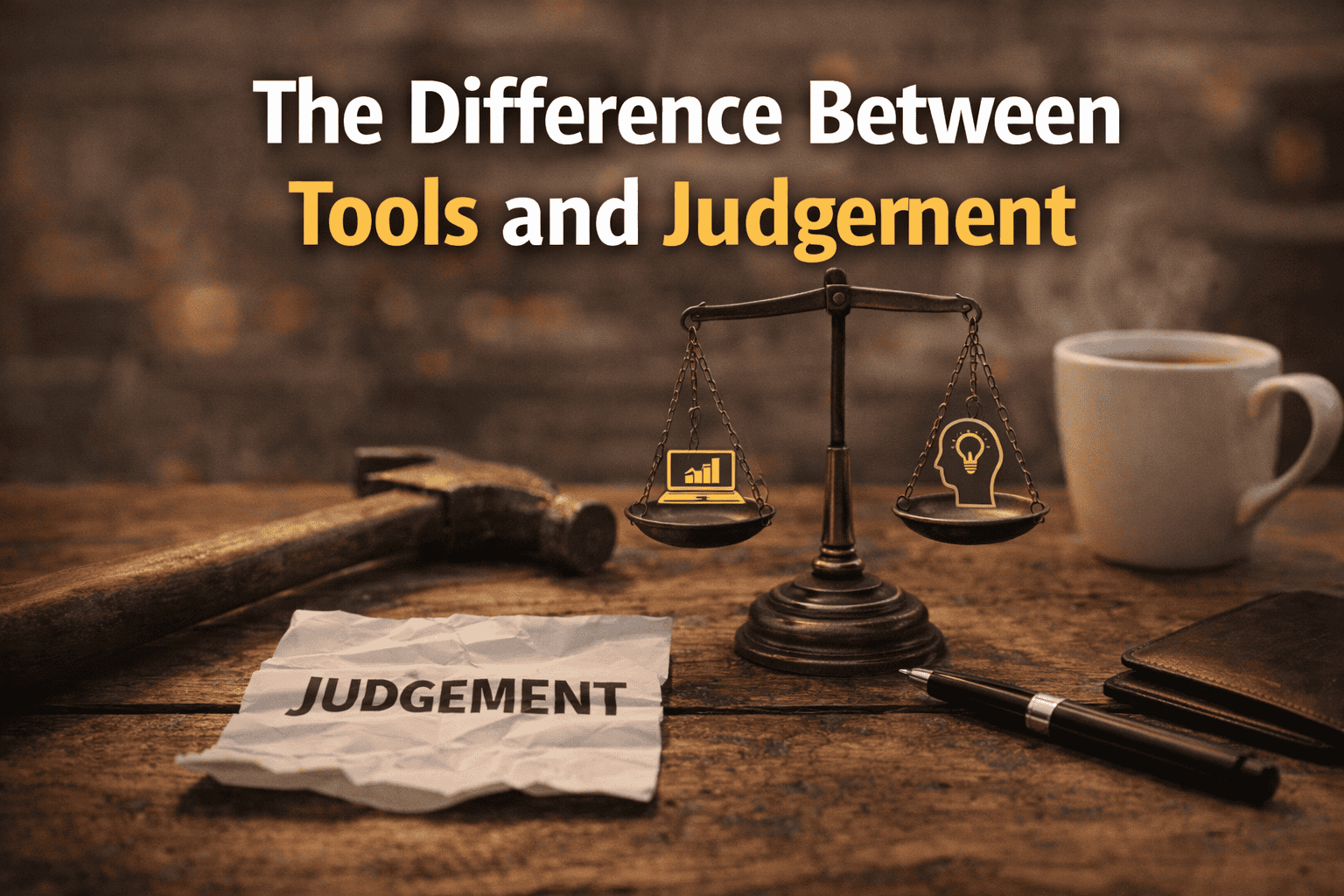
Tools are concrete. Judgement isn’t.
That’s why tools are easier to talk about.
You can list them, compare them, price them, rank them. Judgement resists that kind of treatment. It’s contextual, situational, and often invisible until it fails.
For a long time, I mistook tools for leverage.
Tools Amplify Decisions — They Don’t Replace Them
A tool can make a good decision more effective.
It can also make a bad decision faster.
That’s why the same tool can produce wildly different outcomes for different people. The variable isn’t the software, it’s the judgement behind its use.
Once I saw that clearly, my relationship with tools changed.
Why Judgement Is Harder to Outsource
Judgement can’t be delegated to a platform.
It requires:
- tolerance for ambiguity
- willingness to wait
- acceptance of trade-offs
- the ability to stop even when something is “working”
No tool offers that.
Most tools are built to encourage continuation, more data, more optimisation, more features. Judgement is what tells you when to ignore those prompts.
The Quiet Cost of Over-Tooling
Over time, too many tools introduce noise.
They create more dashboards, more alerts, more settings, more decisions. What started as help becomes friction. The work gets buried under its own infrastructure.
Judgement simplifies. Tools tend to complicate.
The balance matters.
How I Think About Tools Now
Now, I treat tools as temporary helpers.
They earn their place by:
- staying out of the way
- not demanding attention
- not shaping my thinking
- not making promises they can’t keep
Judgement decides direction. Tools support execution, briefly, quietly, and replaceably.
When that balance flips, something needs to be removed.
Usually the tool.