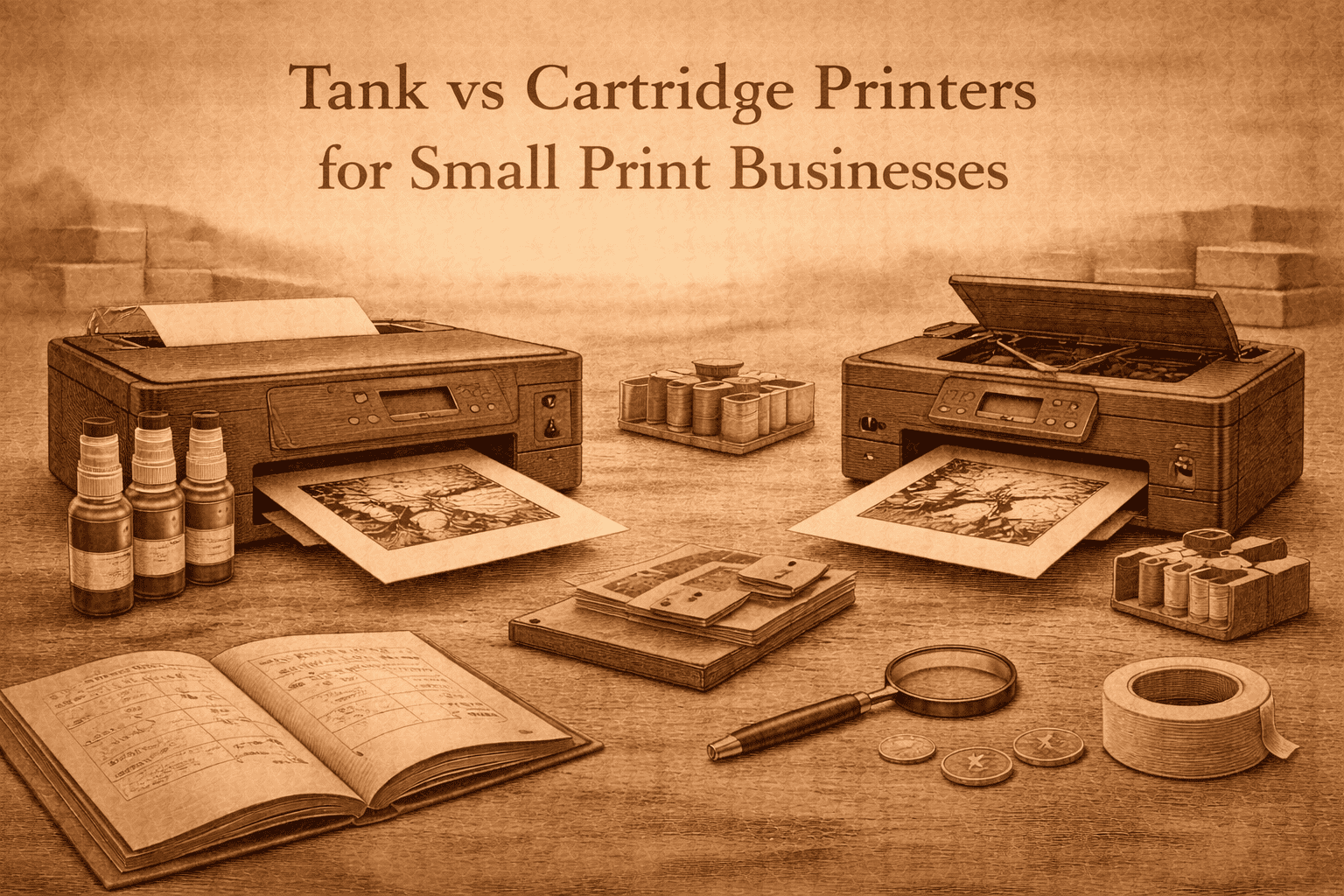
If you are selling art prints from home, the choice between tank and cartridge printers affects how you buy ink, how often you deal with it, and how steady your costs feel from month to month.
Before comparing them, it helps to know what they are.
A cartridge printer uses small, sealed ink cartridges that you replace individually when they run out. This is the traditional home printer model. In practice, it is a replace-and-continue system. When a cartridge empties, you swap it and carry on with the batch.
A tank printer uses larger refillable ink reservoirs that you top up with bottled ink. The ink cost per millilitre is usually lower, but refilling becomes part of your workflow. In practice, it is a refill-and-manage system. When levels drop, you pause, refill carefully, and then resume printing.
Both systems can produce high-quality art prints. The difference is not prestige. It is how much it interrupts you while you are trying to finish a batch.
For a broader overview of how ink systems sit within the full print stack, see tools and equipment for a one-person, home-based print business.
The Real Difference: How You Pay for Ink
Cartridge systems distribute cost over time.
You replace cartridges as needed, usually in smaller increments. The expense feels manageable, particularly when you are ordering ink occasionally rather than stocking bottles.
Tank systems shift cost upfront.
Bottled ink reduces cost per millilitre, but requires larger initial purchases and deliberate storage. Over steady volume, tank systems often reduce cost per print in a way you begin to notice when you are buying ink more frequently.
For many small home print businesses, tank systems begin to show meaningful savings once you consistently exceed roughly 75 to 100 prints per month. Below that level, most sellers do not feel ink cost clearly enough for the savings to outweigh the added handling.
Cost Per Print: When It Actually Matters
Ink cost should be viewed as a percentage of sale price, not in isolation.
If ink regularly exceeds 15 to 20 percent of your average print price, it becomes visible in your month rather than just on a receipt.
In public domain art prints, pricing power is limited because similar imagery is widely available. Small increases in cost are difficult to pass on without affecting demand, which means you absorb them personally.
At low volume, cartridge systems may be perfectly acceptable because ink purchases are infrequent. At steady moderate volume, tank systems can stabilise margin by lowering per-print cost.
What matters is whether you feel ink cost eating into what the month makes, not whether the per-millilitre price looks attractive. A more detailed breakdown of paper and ink exposure is covered in how much does it cost to print art at home for sale.
Workflow Complexity in a Spare Room
Cartridge systems are simple. You replace the cartridge, close the lid, and continue working without reorganising your desk.
Tank systems introduce additional steps. Refilling bottles requires attention, surface protection, and storage space.
In a spare-room setup where trimming, packing, and storage share the same desk, added steps compete with everything else on that surface.
Refilling ink mid-batch changes momentum. You are not just swapping a sealed unit; you are handling open bottles near paper and finished prints.
You may move packaging aside, protect surfaces, and double-check levels before continuing. Ink bottles occupy physical space that could otherwise hold stock or envelopes.
In a one-person workflow, each added handling step increases the chance of small interruptions.
If your volume does not justify the savings, simplicity often protects stability. Many sellers switch to tank systems too early. They see the lower ink price before they feel the handling cost.
Maintenance Behaviour Over Time
Both systems require maintenance, but the experience differs slightly.
If you are printing regularly, tank systems usually behave predictably. However, inconsistent printing schedules can still lead to nozzle checks and cleaning cycles, particularly after idle periods.
If air enters during refilling or ink sits unused, you may find yourself running extra checks before starting a larger batch.
Cartridge printers may appear more expensive per unit of ink, but the sealed format reduces direct handling. For lower volume sellers, that often means fewer small variables to think about before pressing print.
If you print regularly in steady batches, tank systems may align well with your rhythm. If you print sporadically, simplicity may reduce the number of small decisions you have to make.
Longevity and Output Quality
Output quality between modern tank and cartridge printers at similar tiers is generally comparable.
Resolution differences rarely affect wall art viewed at normal distance. Buyers respond to paper feel, consistent borders, and presentation more than to microscopic detail.
Once a print is framed on a wall, consistency across the set matters more than whether the ink came from a cartridge or a reservoir.
If both systems produce clean, consistent colour on your chosen paper, the ink delivery method itself is unlikely to change buyer perception.
It comes down to what the ink really costs and how often it makes you stop mid-batch.
When Tank Systems Make Sense
Tank printers usually make sense when:
- You consistently exceed 75 to 100 prints per month
- Ink cost is becoming noticeable in your monthly totals
- You maintain a steady print rhythm
- You have space to store and manage bottled ink without crowding your workspace
At that point, reduced per-print ink cost becomes something you feel rather than something you calculate.
If you are still deciding which class of printer is appropriate for your volume, see what printer do you need to sell art prints from home.
When Cartridge Systems Make Sense
Cartridge printers are often sufficient when:
- Volume remains under roughly 75 prints per month
- You value simplicity over incremental savings
- Workspace organisation is tight
- You prefer minimal handling steps between prints
For many early-stage art print sellers, cartridge systems provide adequate performance without adding complexity. Being able to start a batch without rearranging your desk is sometimes worth more than small theoretical savings.
Decision Summary
If you are printing occasionally or under moderate volume, cartridge systems are usually sufficient and simpler to manage.
If you are printing consistently above 75 to 100 prints per month and ink cost is visibly affecting your margin, a tank system may reduce per-print cost in a way that becomes noticeable over time.
Choose the system that lets you start and finish batches without unnecessary interruption.
Ink savings matter, but being able to move through batches without interruption matters more.