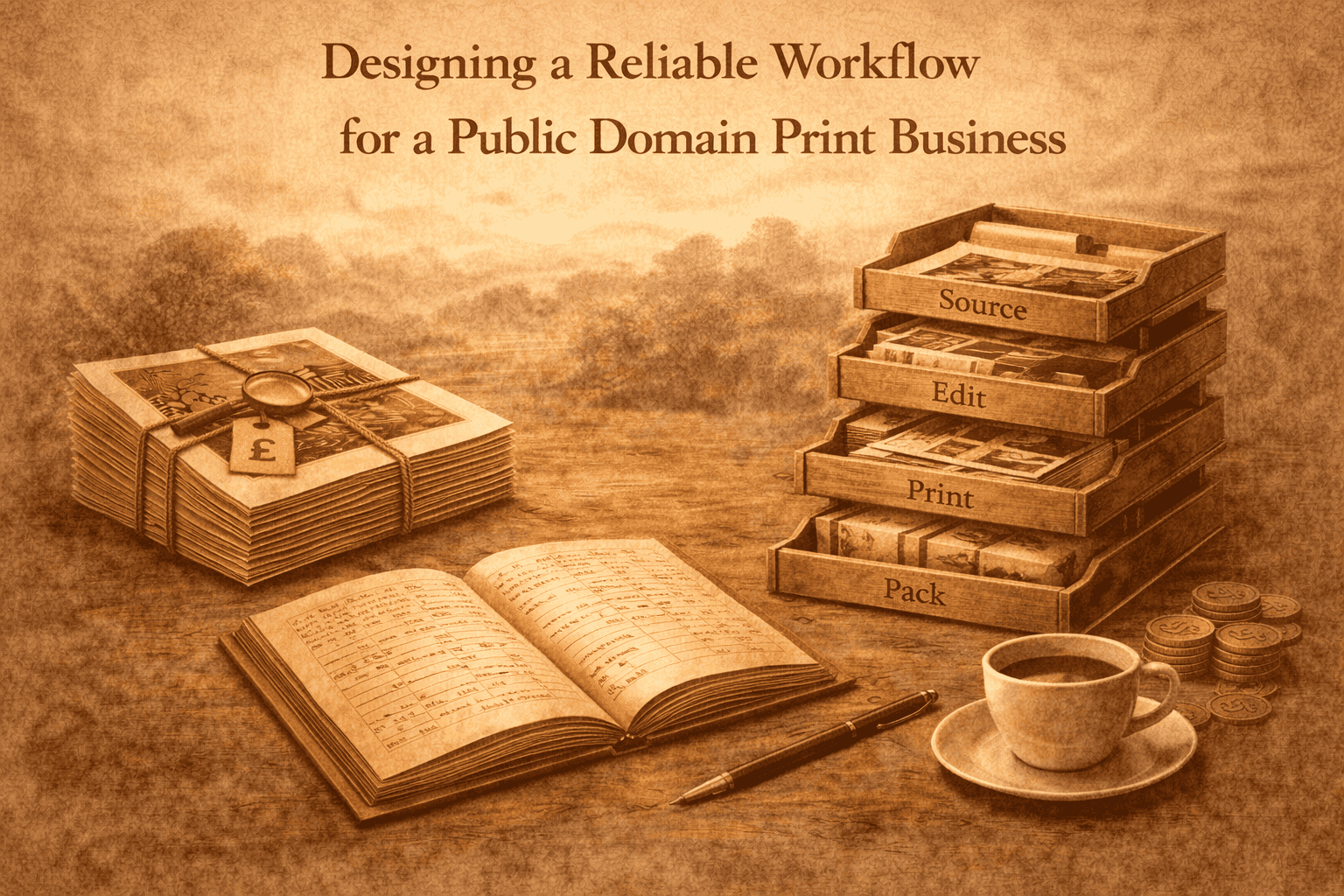
Workflow in a public domain print business is simple in structure and demanding in repetition.
- An order enters.
- The file is prepared.
- The print is produced or submitted.
- The print is inspected.
- It is packaged.
- It is dispatched.
- The order is recorded.
The sequence rarely changes. What determines stability is how consistently it is followed.
This sits within the broader operational context outlined in the operational reality of running a public domain print business.
From the outside, workflow appears straightforward. In practice, it is where most operational friction originates. Not because the steps are complicated, but because they are repeated daily and exposed to interruption.
At low volume, disorder is tolerated. Steps can be rearranged without immediate consequence.
File preparation might happen after packaging.
Messages may be answered in between trimming and inspection.
There is enough slack in the day to absorb inconsistency.
As volume increases, that slack narrows. When steps are performed out of sequence, checks are shortened. When checks are shortened, rework increases. Rework then interrupts the schedule that caused the shortcut.
Workflow stability is less about speed and more about predictability.
Defining the Core Sequence
Every print order moves through a small number of stages:
- Order review
- File confirmation and preparation
- Production or supplier submission
- Inspection
- Packaging
- Dispatch confirmation
- Administrative update
Problems usually arise when one of these stages is implied rather than defined.
Inspection may be assumed instead of structured. Packaging standards may vary slightly between orders. Administrative updates may be delayed until the end of the week.
At low volume, these deviations feel minor. At moderate volume, they become recurring friction.
If file preparation and inspection are not clearly separated, resizing errors are easier to miss. If administrative updates are delayed, tracking uncertainty increases message volume. If packaging materials are not standardised, damage rates fluctuate.
A defined sequence does not eliminate mistakes. It limits where they can occur and makes them easier to detect.
Order Review as a Control Point
Order review often feels routine. It is one of the primary control points in the workflow.
The structure required at this stage is examined in order processing in a public domain print business.
Size, ratio, border preference, finish, and dispatch address need confirmation before production begins. If ambiguity is discovered after printing, correction becomes more expensive in both time and material.
A structured review reduces downstream interruption. Without structure, review becomes casual. Casual review increases the probability of overlooked detail.
As order count rises, the temptation is to shorten review time to protect production windows. That is often where error frequency begins to increase.
File Preparation and Drift
File preparation is repetitive and detail-sensitive.
Resizing, ratio adjustments, border application, and naming conventions follow the same pattern for each order. Minor deviations such as an incorrect crop or inconsistent file naming appear insignificant in isolation.
Under sustained volume, these small inconsistencies accumulate. A file saved under the wrong name may not cause immediate harm. It creates friction during retrieval for reprint or replacement.
Consistent naming conventions and predictable storage structure reduce retrieval time and prevent confusion during busy periods. Inconsistent structure increases search time and oversight risk.
File preparation benefits from focused blocks. Preparing multiple files in a single session reduces context switching. Switching repeatedly between preparation and messaging increases the likelihood of error.
Production and Submission Discipline
Whether printing in-house or submitting to a supplier, the principle remains the same: clarity before execution.
In-house production requires attention to alignment, paper handling, and trimming accuracy. Supplier submission requires precision in file specification and confirmation of order details.
When production is rushed, inspection burden increases. When inspection is shortened, replacement cycles increase.
If submission confirmations are not reviewed carefully, errors may only be discovered after dispatch. At that stage, the cost includes reprint, replacement coordination, and additional communication.
Production discipline is quiet. It is consistency across repetition.
Inspection as a Separate Step
Inspection is often the first stage to degrade under pressure.
How inspection standards are maintained in a small operation is explored in quality control in a home-based public domain print business.
At low volume, each print is handled carefully. Under time compression, inspection becomes abbreviated.
- A border is glanced at rather than examined.
- Surface marks may be missed.
- Alignment may not be checked thoroughly.
Most preventable reprints originate from assumptions rather than formal checks.
Inspection functions more reliably when treated as a separate step rather than something embedded within packaging. When packaging and inspection blur together, errors are easier to overlook.
Separating inspection from packaging creates a pause in the sequence. That pause reduces oversight.
In a small workspace, this may mean clearing the table briefly before sealing a package rather than inspecting while reaching for tape. The difference is minor, but it changes attention.
Packaging Consistency
Packaging appears straightforward. It is a frequent source of avoidable error.
If packaging materials vary, protection levels vary. If folding methods or corner protection differ between orders, damage rates become inconsistent.
At low volume, occasional damage may feel incidental. As volume rises, patterns become visible.
Standardised packaging reduces variation. Variation increases exposure.
Packaging also influences workflow rhythm. If materials are not prepared in advance, production blocks are interrupted to locate supplies. Those interruptions fragment attention.
Workflow stability includes material readiness.
Administrative Closure
Administrative tasks are often postponed.
- Tracking numbers may be entered later.
- Order logs may be updated at the end of the week.
- Replacement records may not be documented immediately.
Deferred administration creates loose ends. Loose ends accumulate.
Accumulation increases mental load and retrieval friction.
When administrative closure occurs immediately after dispatch, the workflow remains contained. When it is delayed, uncertainty expands.
Administrative discipline protects clarity under volume.
Interruptions and Sequence Protection
Workflow rarely breaks because it is poorly designed. It breaks because it is interrupted.
- A customer message arrives during trimming.
- A clarification is required mid-production.
- A supply issue appears while packaging.
Each interruption appears small. The cost lies in breaking sequence.
After interruption, work must be reconstructed mentally. Reconstruction increases the probability of oversight.
Defined communication windows reduce mid-sequence disruption. Grouped production blocks protect inspection standards. The time structure required to protect these blocks is examined in time management for a home-based print business.
When communication, preparation, and packaging are interwoven continuously, checks are more likely to be shortened.
Protecting sequence means grouping similar tasks and limiting switching where possible.
Variation and Surface Area
Adding new sizes, finishes, or process variations increases workflow surface area.
Each variation introduces additional checks, adjustments, and decision points. At low volume, this feels manageable. At higher volume, it increases cognitive overhead.
More decisions increase drift risk.
Controlled variation supports stability. Uncontrolled variation increases fragility.
Workflow remains structurally simple. Its strength depends on consistency across repetition.
As order count rises, tolerance for deviation decreases. The steps do not change. The margin for error does.
A reliable workflow in a public domain print business is not built on complexity. It is built on defined sequence, protected inspection, and disciplined administrative closure.
That is what allows repetition to remain stable rather than unstable.