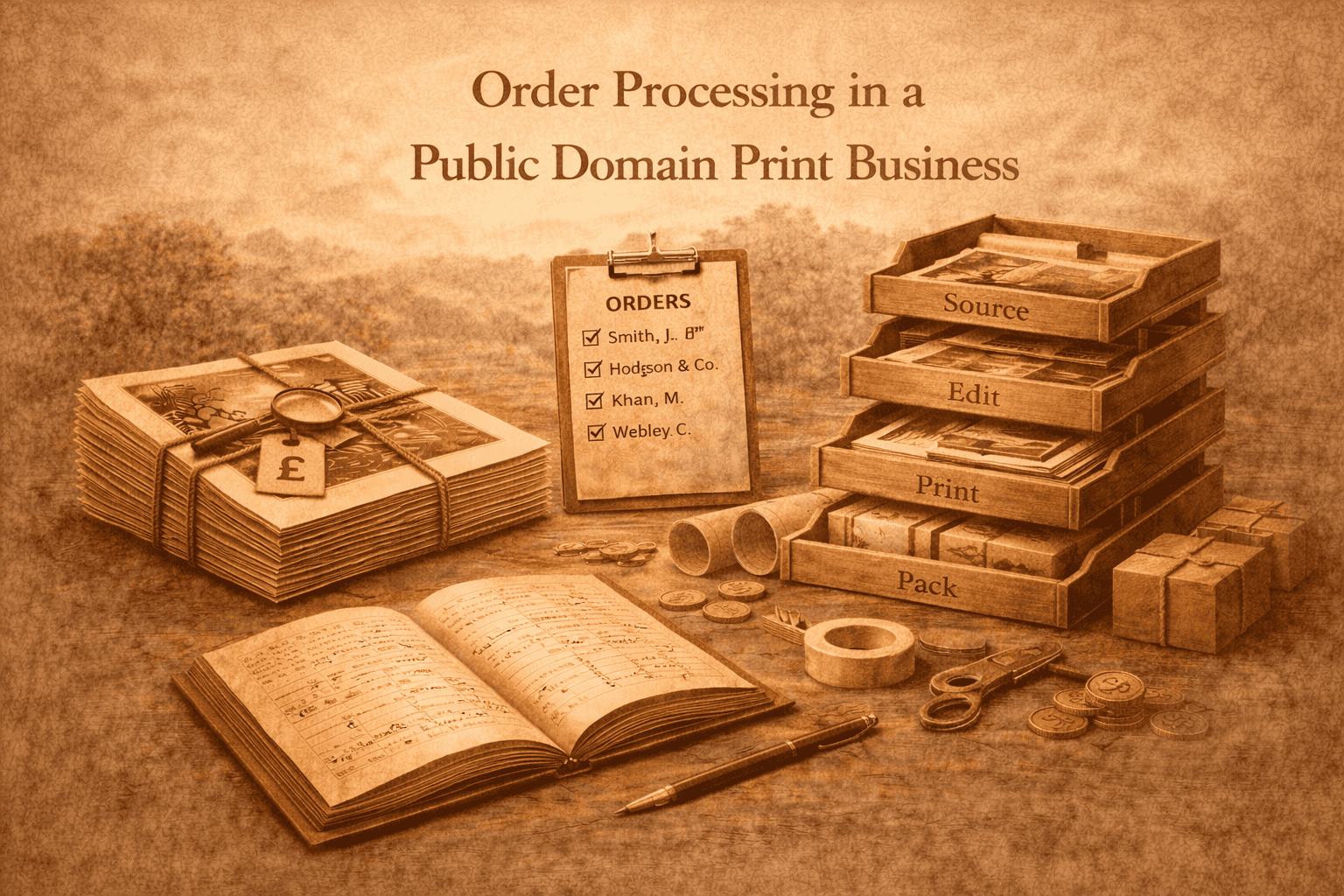
Order processing is where intent becomes obligation.
A listing converts into a paid order. From that moment, ambiguity becomes risk.
In a public domain print business, order processing is not a single action. It is a short sequence of verification, preparation, confirmation, and documentation. When this sequence is defined, downstream friction decreases. When it is informal, small mistakes multiply.
At low volume, order processing feels administrative. At moderate volume, it becomes structural.
This stage sits within the broader structure outlined in the operational reality of running a public domain print business.
The First Review
Every order requires structured review before production begins.
- Size selection.
- Ratio compatibility.
- Border or no border.
- Paper type, if applicable.
- Delivery address formatting.
These details appear routine. Most reprints originate from routine details.
If ratio and size are not verified before file preparation, cropping errors are introduced. If border expectations are unclear, dissatisfaction increases even when technical execution is correct.
The first review is not about speed. It is about preventing correction.
When volume increases, the temptation is to compress review time. That compression often produces delayed rework.
Confirmation Before Execution
File preparation should not begin until order clarity is established.
If a buyer message is pending clarification, production should pause. Producing before confirming creates replacement cycles that consume more time than waiting would have.
Most operators learn this once by printing an order with an unconfirmed size change and having to absorb both the material and the interruption.
Order processing benefits from a rule: no production under ambiguity.
Ambiguity does not resolve itself. It surfaces later, usually after dispatch.
Clear confirmation reduces preventable communication later.
Structuring the Preparation Window
Order processing interacts directly with workflow rhythm. The underlying structure that supports this rhythm is explored in designing a reliable workflow for a public domain print business.
If orders are processed continuously throughout the day, production blocks fragment. If they are grouped into defined windows, preparation stabilises.
For example:
- Morning: review and confirm new orders
- Midday: file preparation
- Afternoon: production and inspection
The exact structure will vary, but the principle remains: grouping reduces switching.
Switching between review, file preparation, packaging, and messaging repeatedly increases oversight probability.
Order processing is most stable when it is batched rather than reactive.
Communication Discipline
Most message volume in a print business relates to clarification, updates, or post-dispatch tracking.
If order review is thorough and dispatch rhythm is predictable, inbound communication reduces.
Clear listing descriptions help, but they do not eliminate buyer uncertainty. Order processing therefore includes structured communication behaviour:
- Respond within defined windows.
- Avoid answering mid-production if possible.
- Use consistent language when confirming specifications.
Communication tone affects perceived professionalism. Communication timing affects workflow stability.
When messaging interrupts production repeatedly, error probability rises.
Handling Modifications
Occasionally, a buyer requests a modification after purchase.
- Size change.
- Border preference adjustment.
- Address correction.
These changes must be processed formally rather than informally.
If modifications are not documented clearly, the original specification may remain in memory while the adjustment is forgotten.
A simple rule protects sequence: modifications must be recorded before file preparation resumes.
Verbal or assumed memory introduces risk under volume.
Payment, Cancellation, and Delay
Order processing also includes managing exceptions.
- Delayed payment.
- Address errors.
- Cancellation requests.
At low volume, these feel manageable. At higher volume, unclear policy handling increases administrative strain.
Defined rules reduce cognitive burden:
- Production does not begin until payment is confirmed.
- Address corrections require confirmation before dispatch.
- Cancellations are processed immediately if production has not begun.
Clarity reduces negotiation time.
Documentation and Traceability
Every processed order should leave a traceable record.
- File name linked to order number.
- Dispatch confirmation logged.
- Replacement, if any, documented.
Traceability reduces retrieval time when issues arise weeks later.
Without documentation discipline, replacement cycles require reconstruction. Reconstruction increases stress and error risk.
How those replacement situations are handled in practice is addressed in managing returns in a public domain print business.
Order processing is not complete when the package leaves. It is complete when the record is closed.
Volume and Fragility
As order count increases, order processing becomes more sensitive to drift.
- If review is shortened, rework increases.
- If modifications are not logged clearly, confusion appears.
- If communication is reactive, production windows fragment.
The steps remain the same at five orders per week and at twenty. What changes is tolerance for inconsistency.
Order processing is one of the earliest stress points under growth. It sits between demand and execution.
When structured carefully, it reduces downstream interruption. When informal, it transfers instability into production, inspection, and dispatch.
The inspection standards that protect against this transfer of instability are examined in quality control in a home-based public domain print business.
In a public domain print business, order processing is not glamorous work. It is repetitive verification and disciplined confirmation.
That repetition protects margin, reduces rework, and stabilises daily rhythm.