Why I’m writing this
I’ve spent most of my working life making decisions alone.
- No manager.
- No career ladder.
- No formal guidance.
Just a long sequence of choices, reversals, experiments, and quiet adjustments made in response to what actually happened.
Recently, I took the time to slow down and look at the system I’ve built, not the individual projects, but the shape of the whole.
This post is an attempt to capture the thinking that emerged from that process.
Not as advice. Not as a framework.
Just as a record of how I’m trying to design a business that produces income without producing anxiety.
The real problem wasn’t income
For a long time, I thought the problem was simply that I wasn’t making enough money.
That was only partially true.
The deeper issue was variability. Volatility. Not knowing which month would be fine and which would tighten my chest.
That uncertainty leaks into everything.
- It affects judgement.
- It pushes you toward reactive decisions.
- It makes you reach for ideas that promise relief rather than stability.
What I needed wasn’t growth. It was a floor.
A level of monthly income that gave me enough peace of mind to think clearly and work properly.
Seeing the system as a portfolio
Once I stopped looking at my work as “projects” and started looking at it as a portfolio, things changed.
Not everything I do needs to grow.
Not everything needs to scale.
Different parts of the business can have different jobs.
- Some things exist to compound slowly.
- Some exist to generate predictable cash.
- Some exist to unwind past decisions and turn sunk effort back into liquidity.
Trying to make everything behave the same way was the source of a lot of unnecessary tension.
The three-shop reality
I run three eBay shops, each with a different role.
One is a catalogue business. Prints and postcards. Visual objects that don’t need explanation and don’t ask for belief. Slow, quiet, but structurally sound.
One is a cash-flow engine. Golf clothing. Known demand, disciplined buying, steady turnover.
One is a managed continuation. Vintage clothing. No longer about aggressive growth, but about better selection, bundling slow movers, and steadily realising value from inventory already purchased.
None of these shops needs to be heroic.
Each needs to contribute roughly £1,000 per month across eBay and Vinted.
That’s enough.
Background revenue as pressure relief
Alongside the shops, I have a growing collection of background assets.
- Websites.
- Writing.
- Finished info products.
- Print catalogues.
These are not designed to impress. They’re designed to exist.
Each one might contribute a small amount. Together, they lift the floor.
This layer isn’t about chasing trends or launching products. It’s about accumulation.
Quiet things left alone to compound.
Finished work vs shiny objects
One of the hardest things I’ve had to come to terms with is this:
Carefully made, complete work often sells worse than noisy, incomplete work.
I’ve seen it repeatedly. My products were more finished, more considered, more honest, and they were outsold by shinier, shallower alternatives.
That doesn’t mean the work was wrong.
It means I was asking it to do the wrong job.
Deep, integrated work rarely functions as an entry point. It works better as a destination.
Trying to sell it to people who just want relief creates frustration on both sides.
The solution isn’t hype. It’s separation.
- Small, finite artefacts can exist to solve narrow problems.
- Larger works can remain intact and complete.
They don’t need to collapse into each other.
Designing for low obligation
A recurring theme in all of this is obligation.
Anything that implies:
- ongoing support
- constant availability
- emotional labour
- open-ended responsibility
…eventually corrodes the quality of my thinking.
So the system I’m building optimises for things that end.
- Products that ship.
- Listings that sit.
- Catalogues that grow quietly.
The absence of obligation is not laziness. It’s a design choice.
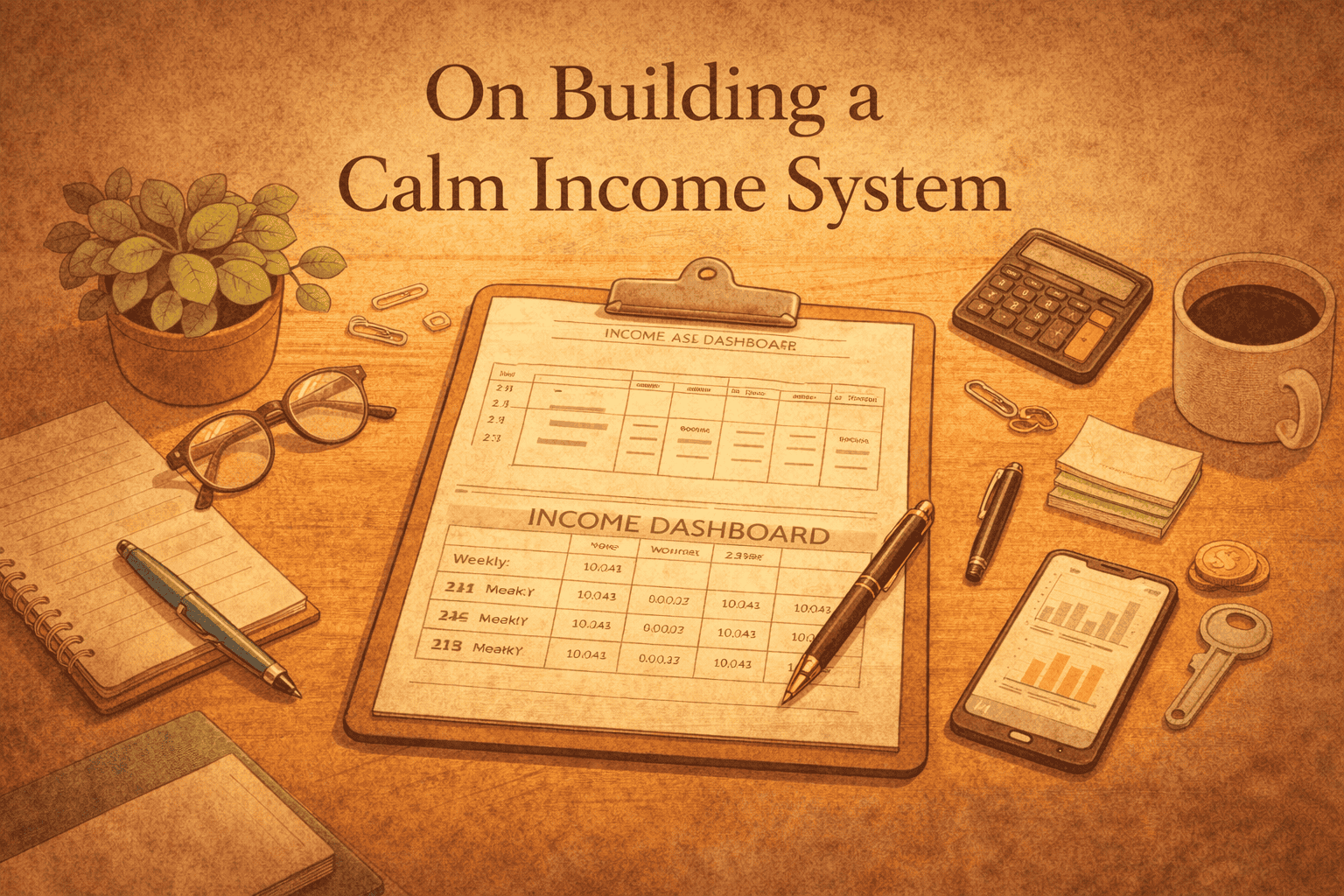
A very light dashboard
One practical outcome of this reflection was the creation of a single-page monthly dashboard.
Nothing clever. No charts. No daily metrics.
Just enough structure to answer three questions:
- Am I safe?
- Which parts are doing their job?
- Do I need to act, or can I leave things alone?
The dashboard exists to hold the worry so I don’t have to.
Where this leaves me
I’m aiming for a specific amount per month.
Not to optimise life. Not to win.
Just to create enough stability that I can work without fear driving the decisions.
I’m already part of the way there.
The task now is not reinvention. It’s stewardship.
- Protect what works.
- Simplify what doesn’t.
- Add new things slowly
and only when they can exist without demanding attention.
Closing
I don’t think there’s a single right path.
But I do think there are paths that respect who you are and paths that quietly erode you.
This post is a record of how I’m trying to choose the former.
Not perfectly. Just deliberately.