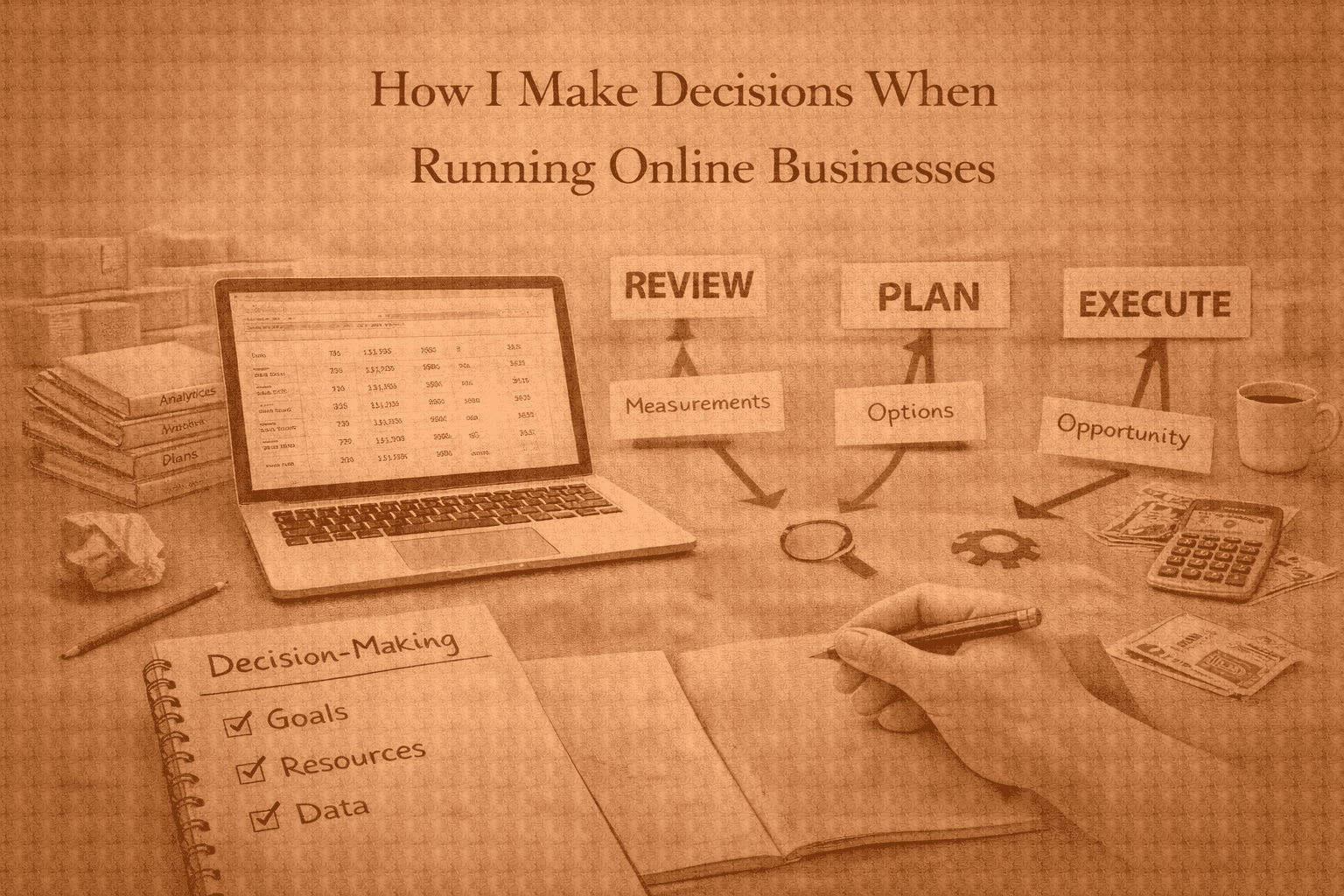
Running an online business involves a constant stream of decisions.
Some are tactical: which item to list next, which product to update or which tool might improve the workflow. Others are structural.
Those decisions determine how the business actually operates over time.
Structural decisions matter more than they first appear. They shape how easy the system is to manage, how clearly results can be evaluated and how much friction accumulates as the business grows.
When the underlying structure is unclear, activity increases without improving outcomes. When the structure is clear, decisions tend to compound in a more useful direction.
Over time I have found that most of the decisions that matter fall into three broad areas.
Structure Before Scale
Growth is often treated as the primary goal of a business. More listings, more products and more traffic are assumed to produce better results.
In practice, scale frequently amplifies problems that already exist. As inventory or content grows, structural weaknesses become more visible. Categories begin to overlap, priorities become harder to evaluate and it becomes less clear what deserves attention.
Before expanding any system, I focus on whether the structure itself is helping or hindering decision-making.
That thinking is explored in Why Structure Matters More Than Scale, where I describe how structural clarity often improves reselling businesses more than simply increasing volume.
Infrastructure Versus Distraction
Tools promise improvement. Analytics platforms, optimisation plugins, dashboards and automation systems all suggest that they will make work easier.
Some tools genuinely strengthen a system. Others simply add layers of monitoring, configuration and maintenance without improving the underlying operation.
The distinction I use is straightforward: infrastructure reduces friction and increases stability, while distraction consumes attention without strengthening the system. I explain how I evaluate that difference in Infrastructure vs Distraction: How I Decide.
Knowing When to Stop
Expansion is easy to justify. Ending something is harder.
Many online projects continue long after they stop making sense because time or money has already been invested. The instinct is to keep adjusting the system in the hope that results will improve.
In practice, knowing when to stop protects both margin and attention. Some projects should be simplified. Others should be closed cleanly so that useful assets can be retained and time can be redirected more deliberately.
The tests I use to make those decisions are outlined in How I Decide When to Stop or Change Direction.
Why These Frameworks Exist
These frameworks are not intended as rules for everyone. They exist to document how I approach decisions when running reselling businesses, digital products and the websites that support them.
Each system becomes fragile when decisions accumulate without structure.
Clear frameworks make it easier to decide what should continue, what should change and what should be removed entirely.
Over time, that clarity tends to matter more than scale.