Most people start with content.
They buy a domain.
Install WordPress.
Write a post.
Publish something.
Then they try to structure it later.
I do the opposite.
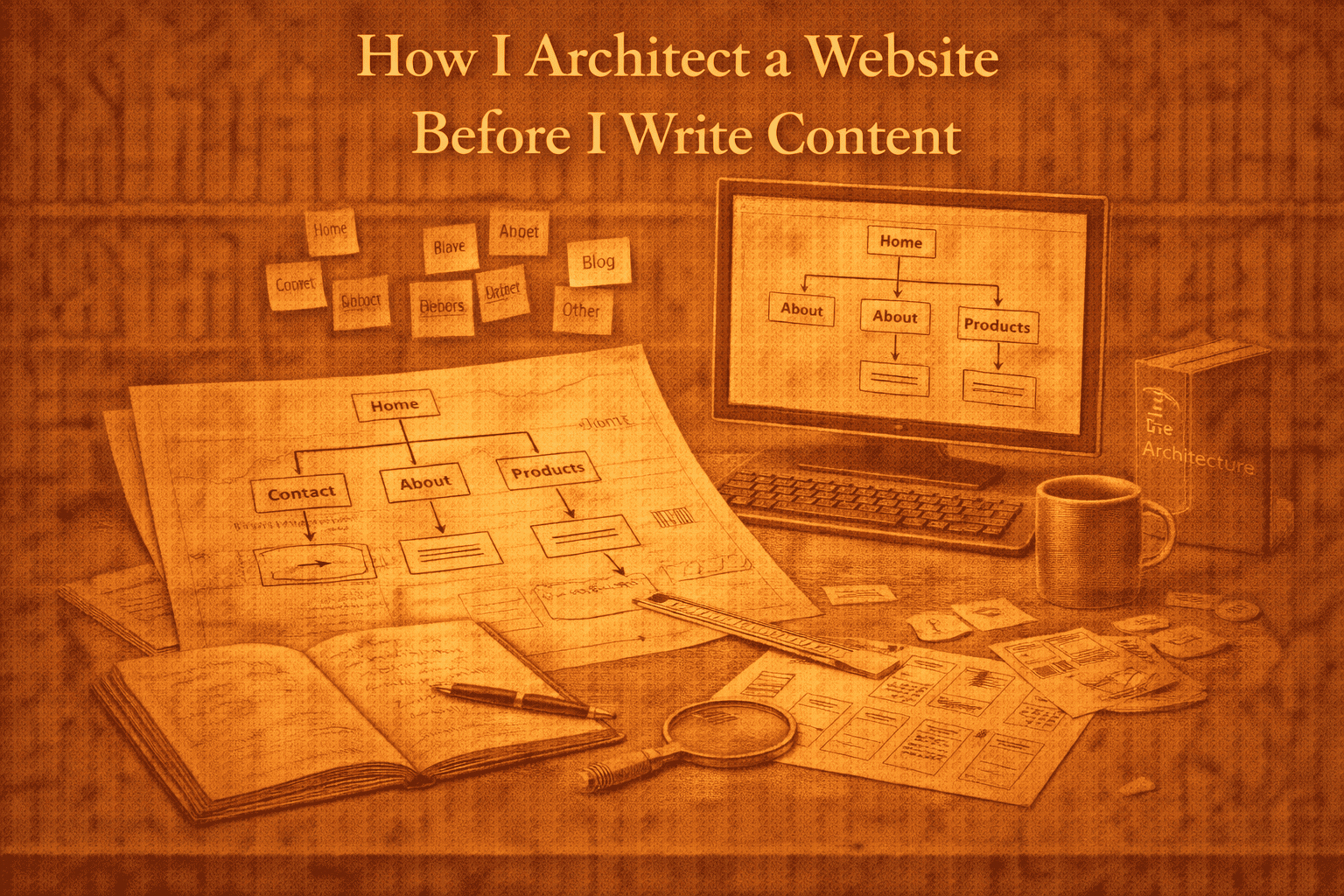
Before I write a single post, I decide how the website will work.
Architecture comes first.
Content Without Structure Creates Drift
When you start writing without defined structure:
- Categories expand randomly
- Topics overlap
- Internal links are inconsistent
- Monetisation is unclear
- Navigation becomes reactive
Over time, the website feels scattered.
That is not a content problem.
It is an architectural problem.
The Questions I Answer First
Before writing, I decide:
- What is the core commercial goal?
- What are the primary content clusters?
- What is the public-facing structure?
- How will posts support monetisation?
- What tools are required, and no more?
If these are unclear, writing becomes noise.
Public Structure vs Internal Logic
A website needs visible simplicity.
Clear sections.
Predictable navigation.
Defined purpose.
Internally, it needs discipline:
- One primary category per post
- Clear cluster alignment
- Controlled expansion
- Defined production priorities
Structure protects clarity.
Clarity protects commercial intent.
Monetisation Path Before Publication
Before publishing content, I decide:
- How will this section generate revenue?
- Is it affiliate-led?
- Is it tool-supported?
- Is it authority-building?
If the monetisation path is undefined, the post risks becoming ornamental.
Ornamental content looks impressive.
It does not support stability.
Stack Decisions Come Early
Architecture includes the technical stack.
Before content, I decide:
- Theme
- SEO plugin
- Analytics tool
- Image optimisation
- Hosting environment
Once chosen, these rarely change.
Changing infrastructure after content is live introduces friction.
Stability early prevents disruption later.
Designing for Containment
A well-architected website feels contained.
Contained means:
- Clear topic boundaries
- Defined expansion limits
- No uncontrolled sprawl
When new ideas arise, they must fit the structure.
If they do not fit, they are either refined or rejected.
This prevents topic dilution.
The Cost of Retrofitting Structure
Retrofitting structure later requires:
- Rewriting categories
- Adjusting internal links
- Updating navigation
- Repositioning monetisation
This consumes time and creates risk.
Architectural clarity before writing reduces future friction.
My Recommendation
Before writing your first post:
Design the structure.
Define:
- The sections
- The revenue path
- The internal categorisation
- The technical stack
Then begin.
Content placed into a defined structure compounds.
Content written into a vague system fragments.
Websites succeed when structure leads and content follows.
Architecture first.
Writing second.