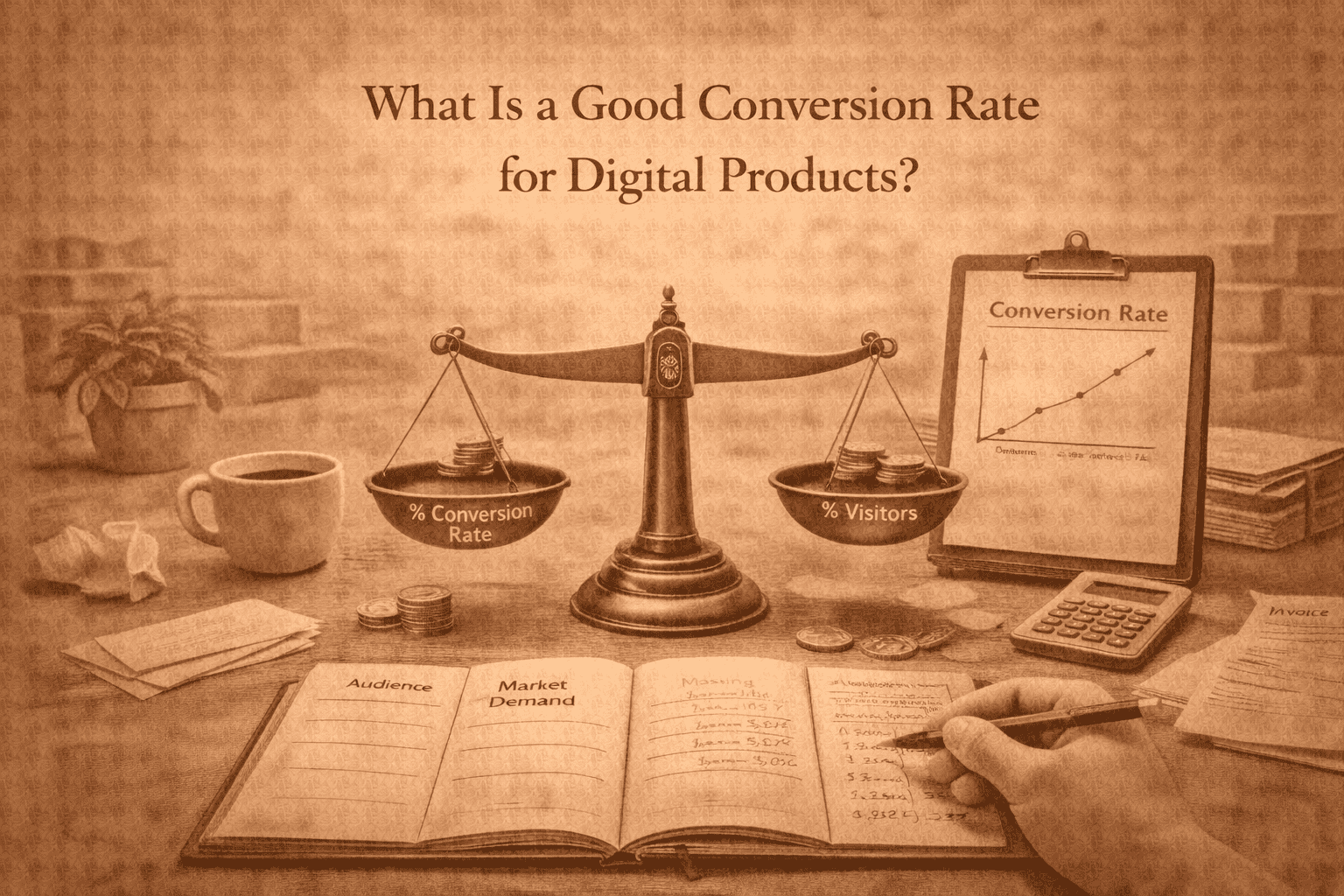
Most discussion about digital product conversion focuses on page tweaks and persuasion tactics.
That treats sell-through as a design problem.
Sell-through is not primarily about button colour or layout. It is a measure of how efficiently demand turns into turnover.
Digital product revenue is governed by three variables:
Traffic × Sell-Through × Price
- Traffic defines available demand.
- Price defines margin per unit.
- Sell-through defines efficiency.
Before asking whether a conversion rate is “good,” the relevant question is whether the required sell-through fits within realistic demand and pricing assumptions.
Conversion Rate Only Makes Sense Inside a Profit Model
Digital product revenue follows a simple structure:
Traffic × Conversion Rate × Price
These are the three levers.
Conversion rate is digital sell-through. It reflects how efficiently traffic turns into revenue at a given price.
- A low conversion rate can still produce strong income at healthy margins.
- A high conversion rate can still fail if pricing is compressed or fixed costs are inflated.
Looking at conversion rate in isolation leads to the wrong optimisation decisions.
You calculate break-even first.
How to Calculate Your Break-Even Conversion Rate
Break-even conversion rate
= (Annual running costs ÷ Price) ÷ Annual visitors
Example:
Annual running costs: £300
Product price: £59
Annual visitors: 10,000
£300 ÷ £59 = 5.08
You need 6 sales to cover fixed costs.
6 ÷ 10,000 = 0.06%
In this structure, the product only needs a 0.06% conversion rate to justify existing.
That is well below common benchmark ranges.
This is why cost control matters. Lean infrastructure lowers the required sell-through rate. High overhead increases conversion pressure immediately.
Break-even is the survival threshold. Most people stop there. Operators continue to income targets.
Before trying to improve sell-through, confirm the niche contains enough real demand to support the turnover required.
How Much Conversion Do You Need to Reach a Real Income Target?
Using the same product:
Price: £59
Annual visitors: 10,000
Income target: £6,000
£6,000 ÷ £59 = 102 sales
102 ÷ 10,000 = 1.02%
Just over 1% conversion produces £6,000 in annual revenue.
That sits comfortably within normal cold traffic ranges.
This is where generic benchmark advice becomes misleading. A “1% conversion rate” means nothing until you know the traffic volume and the income target attached to it.
Conversion rate is not a performance badge. It is a lever inside the three-lever system.
Why Cold Traffic Clusters Around 0.5% to 2%
Cold search traffic includes:
- Comparison shoppers
- Early-stage researchers
- Price-sensitive visitors
- Partially aligned intent
Not everyone landing is a buyer.
That is why 0.5% to 2% is normal.
Warm traffic behaves differently.
- Trust is higher.
- Problem awareness is clearer.
- Friction is lower.
- Conversion increases.
These ranges reflect intent structure, not persuasion quality.
If you are significantly below them on tightly matched search intent, review alignment before optimising copy.
How Pricing Changes Conversion Pressure
Assume:
10,000 annual visitors
£300 annual running costs
£6,000 income target
At £19:
£6,000 ÷ £19 = 316 sales
316 ÷ 10,000 = 3.16%
At £59:
£6,000 ÷ £59 = 102 sales
102 ÷ 10,000 = 1.02%
At £199:
£6,000 ÷ £199 = 31 sales
31 ÷ 10,000 = 0.31%
Lower pricing increases required sell-through. Higher pricing reduces volume pressure.
If your model requires sustained 4%+ conversion just to reach modest income, margin tolerance is thin.
That may work in strong demand markets, but it leaves little room for traffic fluctuation or seasonal softness.
Pricing determines how hard conversion must work.
What a Structurally Fragile Product Looks Like
Example:
Price: £19
Annual software stack: £1,200
Annual visitors: 10,000
Income target: £6,000
Break-even:
£1,200 ÷ £19 = 63 sales
63 ÷ 10,000 = 0.63%
Income target:
£6,000 ÷ £19 = 316 sales
Total required sales = 379
379 ÷ 10,000 = 3.79%
Nearly 4% conversion required.
That is achievable in some markets.
But this structure depends on sustained high sell-through to remain worthwhile. It leaves minimal tolerance for dips in demand or traffic.
This is the structure that produces constant optimisation behaviour.
The pressure is not coming from button colour. It is coming from margin compression and overhead.
Why Most Conversion Advice Focuses on the Wrong Thing
Common advice emphasises:
- Headline adjustments
- Page layout changes
- Psychological triggers
- Button colour tests
These can improve marginal performance.
They do not correct:
- Weak demand
- Misaligned traffic
- Underpricing
- Inflated overhead
Conversion rate is not primarily a persuasion metric. It is a reflection of how well traffic, price and demand align inside the three-lever system.
If alignment is weak, optimisation produces small gains at best.
What Is a Good Conversion Rate in Practice?
A good conversion rate:
- Covers fixed costs
- Produces surplus
- Reaches your income target within realistic traffic levels
For lean digital products selling through search, 0.8% to 1.5% is often commercially healthy.
Below 0.3%, alignment usually needs review.
Above 5% on cold traffic, either demand is unusually strong or pricing may be conservative.
The number itself is secondary.
What matters is whether Traffic × Conversion × Price produces stable margin without requiring constant intervention.
What Sell-Through Actually Controls
Sell-through shows how efficiently demand turns into turnover.
Improving sell-through increases revenue from existing traffic. It does not increase demand, and it does not improve margin per unit.
Traffic determines how much demand is available.
Price determines how much margin each unit carries.
Sell-through determines how efficiently available demand converts into revenue.
If required sell-through is unusually high just to meet income targets, the issue is often pricing or demand depth rather than page wording alone.
Sell-through improves efficiency.
Price protects margin.
Traffic defines demand supply.
All three must align for turnover to be sustainable.