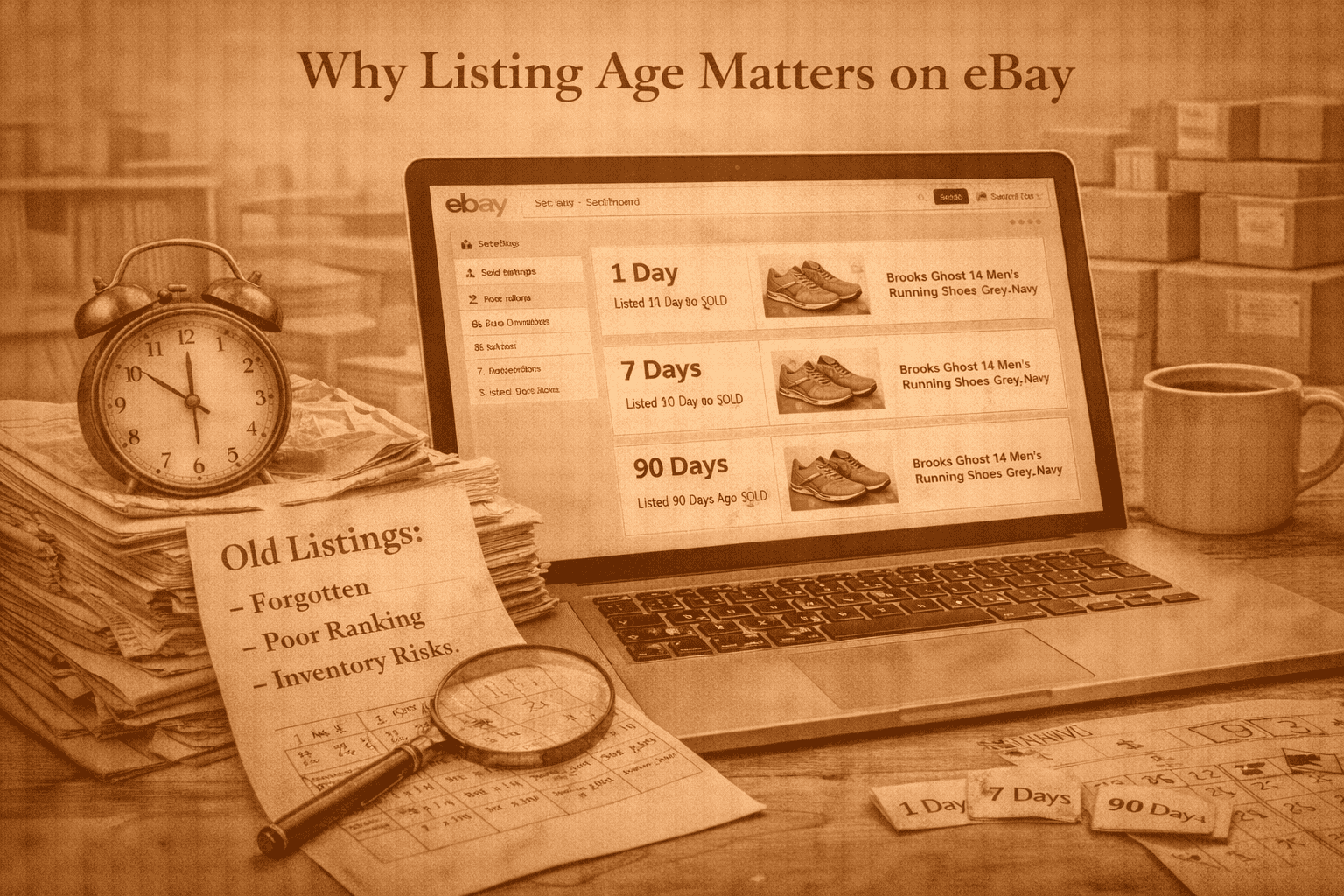
What listing age actually is
When a listing goes live on eBay, it does not stay in one place, it moves around within a pool of similar items, and over time the way it moves begins to change.
Listing age is not just how long something has been live, it is how long it has been sitting in that system without converting relative to similar items that are selling around it.
That distinction matters because eBay does not treat new and old listings the same way. A new listing is still being tested and moved around to find where it fits, whereas an older listing has already shown how it performs and is treated accordingly.
This is why two identical items can behave very differently depending on when they were listed and how they performed early on.
Position in the system
This sits inside the listing step. The full structure is mapped in the UK Marketplace Reseller Manual.
Source → Analyse → Buy → List → Dispatch → Returns
Listing age is what happens after the item has already been placed into the market.
Up to this point, sourcing, analysis, and item specifics determine where the listing sits and how it enters the pool. I break this down further in Why Item Specifics Matter More Than Descriptions.
If a listing performs early, it tends to hold its place within that group. If it does not, it gradually begins to drift away from the main flow.
Once that drift begins, the rest of the system becomes more reactive, and decisions around price, offers, and how long the item sits are all shaped by that change.
What happens to an eBay listing over time
When I list an item, there is usually a short period where it is shown in different positions across similar listings, which is effectively eBay testing how it performs against comparable items.
If the listing gets clicks, watchers, or an early sale, it tends to be shown more often and settle into a stable position. If it does not, it gradually starts to be shown less often against those same items.
Nothing about the listing itself has changed, but how often it is shown has, and that change tends to compound rather than happen all at once.
The longer a listing sits without converting, the more it tends to fall out of view relative to similar items that are moving.
In faster categories this shift happens quickly, sometimes within a few days, while in slower categories it takes longer, but the pattern itself is the same.
How listing age links back to how listings work
In How eBay Listings Actually Work, I described listings as sitting inside an active pool of similar items that are constantly being moved around based on what sells.
Listing age determines how long a listing remains competitive within that pool.
A newer listing still has the opportunity to establish itself within that group, whereas an older listing has already shown whether it can convert at the level required to hold its position.
If it has not, it becomes increasingly difficult for it to start getting shown properly again without some form of adjustment.
Why early performance matters
The first period after a listing goes live carries more weight than most sellers expect, because this is when it is being tested directly against similar items that are already selling.
If it converts early, it tends to stabilise into a position where it continues to be shown. If it does not, it begins to drift away from that position.
I have listed similar items at the same price where one sells within a couple of days and the other sits, and after that initial period the one that did not sell becomes noticeably slower to move, even though nothing about it has changed.
The difference is not in the item itself, it is in how the listing performed during that early window.
What listing drift looks like in practice
Drift is not always obvious at first, because the listing often continues to get occasional views or watchers, which can give the impression that it is still active.
What changes is how often it is being shown compared to similar items that are selling.
Early on, the listing may still appear in enough places to generate some activity, but not at the level required to convert consistently. Over time, that gap becomes more noticeable as similar items continue to sell while the listing sits.
As this continues, the listing is shown less often, the time between activity increases, and offers become more frequent as one of the only ways to create movement.
At that point the listing is no longer sitting in a strong position within its group, it is being shown less often and competing from a weaker place.
Why listing age affects margin
When a listing is new and performing, I can usually hold price because it is still being shown consistently within its group.
When it starts to age without selling, I am forced into a different type of decision, which is usually centred around price.
I might list an item at £25 based on what I see in How to Analyse Sold Listings on eBay Before Buying Stock, and if it sells within a few days that price holds without issue. If it sits for a couple of weeks without movement, I often find myself accepting £20 or sending offers just to create a sale.
The item has not changed, but the listing has lost position within the pool it sits in over time.
This is where time turns into cost, because the longer it sits without converting, the more likely it is that margin is used to compensate.
Why some listings never recover
Not every listing returns to a strong position once it has drifted.
I have had items that sat for weeks, were adjusted, and eventually sold at a lower price, and others that continued to sit even after changes were made.
In most cases, the reason sits earlier in the system. The item either does not fit cleanly into an active group, is priced in a way that does not match how similar items are selling, or sits in an area where demand is thinner and less consistent.
Listing age does not create that problem, it reveals it over time.
In lower demand categories, this tends to show up as longer gaps between sales and less consistent activity, which makes it harder for a listing to hold position even if it is broadly correct.
Some older listings still sell, but they tend to do so more slowly and less consistently, which is where the margin trade-off becomes more visible.
When to adjust an older listing and when to leave it
Not every older listing needs immediate adjustment, especially in slower categories where items naturally take longer to move and the listing can remain aligned with similar items.
The issue is when a listing has clearly lost its position within the group it sits in.
At that point, leaving it unchanged usually extends the time it takes to sell rather than improving the outcome.
This is where I decide whether to adjust price, accept offers, or accept that the item will continue to sit, and it is also where decisions around ending and relisting start to come into play, which I break down in When to End and Relist (and When Not To).
I tend to relist items that have not sold after around 30 days, not because the act of relisting fixes the problem, but because by that point the listing has usually shown how it behaves.
In practice, leaving it longer rarely improves the outcome, and relisting becomes a way of re-entering the market rather than continuing to sit in a weaker position.
I automate this through Flipwise, which allows me to reset listings on a fixed cycle, but the decision comes from how listings behave, not from the tool itself.
eBay also renews fixed price listings on that same timeline, so it becomes a natural point to reassess.
How I think about listing age now on eBay
I do not think about listing age as a number of days, because that on its own does not explain anything useful.
I think about it in terms of whether the listing is still competitive within the group it sits in and whether it is converting in line with similar items.
If it is, then age is largely irrelevant. If it is not, then age becomes a signal that the listing has started to drift.
Once that is clear, the decision becomes simpler, because I either accept the margin change required to move it or accept that it will continue to sit.
Either way, the outcome is tied to how the listing has behaved over time, not how long it has been live.