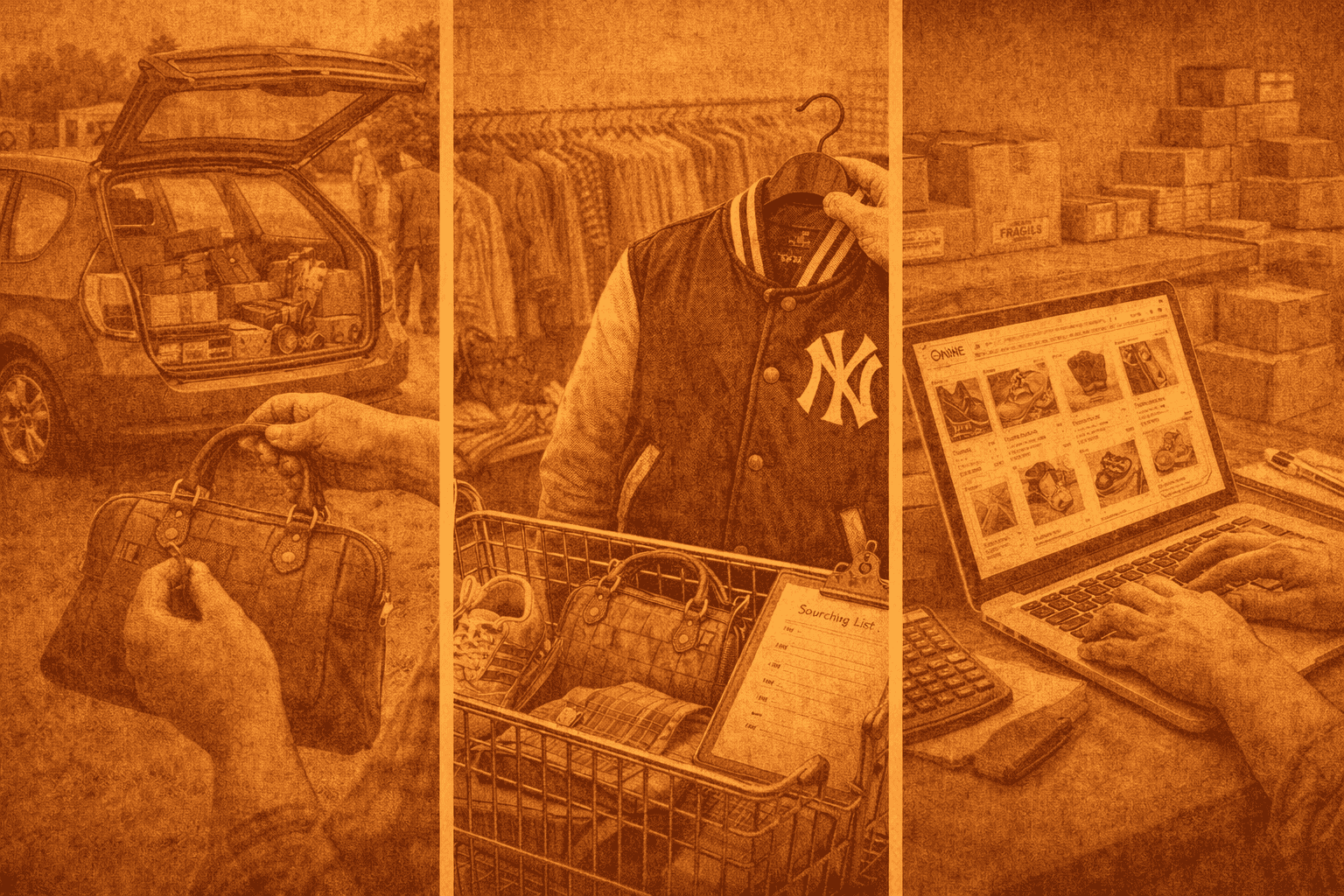
Why Where You Buy Stock From Changes the Buying Decision
When sourcing is discussed, it is often framed in terms of where to find the best items, but in practice the more important factor is how the sourcing environment changes the way decisions are made and what happens after those decisions are made.
Which becomes clearer once you understand how those decisions are made in practice, as I describe in How I Decide What to Buy When Sourcing.
Each environment presents different conditions, and those conditions shape speed, judgement, margin and risk in ways that are not always obvious at the point of buying.
The same item can represent a different decision depending on where it is sourced, because the surrounding context affects how it is evaluated, how much margin is realistically available, and how the item is likely to behave once it moves through the rest of the system.
Position in the system
This sits at the sourcing stage, before individual buying decisions are made. The full structure is mapped in the UK Marketplace Reseller Manual.
Source → Price → List → Diagnose → Dispatch → Returns → Repeat
By the time I reach this point, no inventory has been committed, and what matters is not just what is bought, but the environment in which those decisions take place, because that environment influences what enters the system and how it performs later.
Car boot sales
Car boot sales are defined by volume, speed and limited information, where a large number of items are available but consistency is low and conditions vary from one seller to another.
Items are often unsorted, pricing is inconsistent, and decisions are often made before full context is clear, because hesitation can mean losing access to the item altogether.
That speed can be useful, but it also increases the likelihood of weaker decisions, because items are assessed with less structure and less reliable information.
Friction plays a role as well, because physical handling, inconsistent presentation and variable seller behaviour affect how decisions are made, and those conditions can influence what is accepted or rejected for reasons that are not directly related to value.
Car Boot Sales rewards fast filtering, but it also produces inconsistency in what stock enters your system, which can lead to uneven listing performance and unpredictable margin.
Charity shops
Charity shops operate at a slower pace, with more structured presentation and pricing that is often closer to market levels.
Items are easier to assess, but the margin available is usually tighter, because pricing reflects some level of awareness of value.
This changes the nature of the decision, because the question is less about identifying something clearly undervalued and more about whether enough margin remains after costs, which is closely tied to understanding real demand before buying, as I cover in How to Analyse Sold Listings on eBay Before Buying Stock.
Items can appear safe and reasonable at first glance, which creates a sense of confidence at the point of purchase, but that confidence is often misplaced if the remaining margin is too narrow to absorb fees, shipping and normal friction.
Buying from Charity Shops reduces uncertainty in item condition and presentation, but increases pressure on margin discipline, and weak decisions here tend to show up later as items that sell slowly or leave too little after costs.
Online sourcing
Online sourcing introduces a different set of conditions, where prices are visible immediately, and the same listings can be seen by multiple sellers at the same time.
Items can be evaluated quickly, but so can they be evaluated by others, which compresses the time available to act and reduces the margin available.
Fewer pricing mistakes exist to exploit, because listings are already positioned close to existing demand, which leaves less room for obvious pricing mistakes to be found.
The risk here is not inconsistency, but compression, because margin can narrow quickly when multiple sellers act on the same opportunity, and small miscalculations can remove most of what is left after costs.
This type of buying produces more consistent input, but requires tighter control to ensure that the stock that enters the system still produces profitable outcomes later.
Wholesale and bulk sourcing
Wholesale and bulk sourcing introduce a different structure again, where inventory is acquired in larger quantities at a consistent per-unit price, often without the same level of selection at the individual item level.
This changes the decision entirely, because the focus shifts from evaluating single items to evaluating the batch as a whole, including average cost, expected sell-through and how much variation exists within the items.
Buying Wholesale provides more control over input, because pricing is fixed and sourcing can be repeated with the same supplier, but that control comes with increased exposure, because more money is committed at once and more items of stock enter the system together.
This removes much of the friction seen in more unstructured environments, because items can be processed in a controlled way and on a consistent schedule, but it also reduces flexibility, because decisions are made at the batch level rather than item by item.
The risk here is not inconsistency or competition, but commitment, because weak decisions affect a larger number of items at the same time, and any misalignment in demand or pricing carries through the entire batch.
This does produce more predictable stock, but requires stronger control over margin and sell-through, because the consequences of a poor decision are multiplied across everything that has been bought.
How These Sourcing Methods Actually Differ
Each sourcing method changes what good looks like, because it alters the balance between speed, margin, control and risk.
- Car boot sales favour speed and filtering, but introduce inconsistency and friction.
- Charity shops favour clarity and structure, but compress margin and create false confidence.
- Online sourcing favours visibility and speed of execution, but reduces margin and increases competition.
- Wholesale and bulk sourcing favour control and consistency, but increase capital exposure and amplify the impact of each decision.
Each one also produces different types of mistakes, and those mistakes only become visible once the items move through pricing, listing and eventually into profit or loss, often showing up later as listings that do not move, as I describe in Why Your eBay Listing Isn’t Selling.
Why No Sourcing Method Is “Better”
No sourcing method is inherently better than another, because each one introduces a different set of trade-offs that affect how the system behaves.
What matters is not choosing the “best” method, but understanding how each environment changes the nature of the decision and what that means for what happens later.
A method that works well under one set of conditions may create problems under another, and performance improves when those trade-offs are understood rather than ignored.
How I think about it now
I no longer think about sourcing in terms of where to buy, but in terms of how each environment shapes what enters the system and what is likely to happen after that.
The focus is not on finding the right place, but on understanding how the conditions of each environment affect decision quality, margin and downstream behaviour.
Once that becomes clear, sourcing stops being about location and becomes about how the system performs under different conditions.