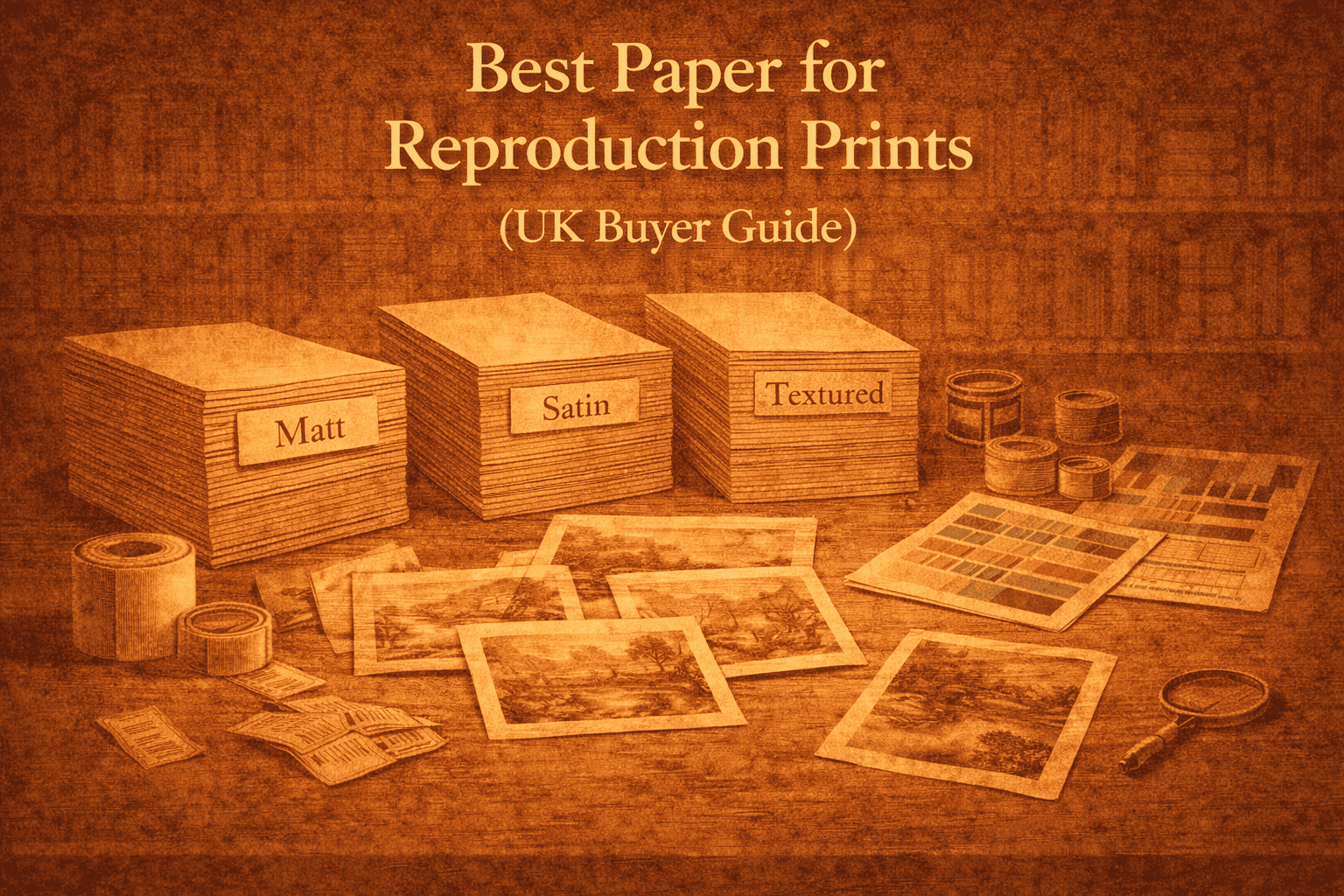
If you sell reproduction prints, your paper choice affects perceived quality more than your printer does.
Most beginners obsess over printer models.
In reality:
Paper determines:
- Weight perception
- Colour depth
- Black density
- Customer satisfaction
- Return rates
I print reproduction artwork for resale in the UK. This guide reflects commercial reality, margin protection, consistency, and scalability.
Not hobby photography.
Quick Recommendation Summary
If you want the short version:
- Safest all-round option: 230–300gsm matte heavyweight paper.
- For richer contrast: Smooth satin/semi-gloss.
- Avoid thin sub-200gsm stock.
For most reproduction sellers starting out, heavyweight matte stock is the correct foundation.
Paper choice needs to match your printer, which is why I break down model tiers in my Epson EcoTank buyer guide for reproduction prints.
Comparison Table
| Paper Type | Finish | Best For | Strengths | Weaknesses | My View |
|---|---|---|---|---|---|
| Matte 230–300gsm | Non-gloss | Artwork, illustrations | Safe, consistent, professional feel | Slightly softer blacks | Best starting point |
| Satin / Semi-Gloss | Light sheen | Photography-style prints | Stronger contrast | Shows fingerprints | Good upgrade |
| Gloss | High shine | Photo-heavy art | Deep blacks, vibrant | Reflective, less “art” feel | Situational |
| Thin 170–190gsm | Any | Budget printing | Lower cost | Feels cheap | Avoid for resale |
I explain how this paper fits into my overall setup in the printers I use in my business.
4. Deep Analysis
1. Weight (GSM) – Perceived Value
This is critical.
Under 200gsm feels like:
- Poster paper
- Home printer output
- Low value
Once you move into 230–300gsm:
- The sheet feels substantial
- It resists bending
- It frames better
- It justifies higher pricing
If you want customers to feel they received something premium, weight matters more than finish.
For reproduction prints, I do not go below 230gsm.
Paper weight only works if it’s packed properly, I show how I handle that in how I pack orders in my business.
2. Matte vs Satin vs Gloss
Matte (Safest Option)
Matte:
- Minimises glare
- Works well in most home lighting
- Looks “art appropriate”
- Reduces handling marks
Blacks are slightly softer compared to gloss, but for illustration and vintage reproduction work, matte is usually correct.
For catalogue-building, matte is the safest default.
Satin / Semi-Gloss
Adds:
- Slight sheen
- Improved contrast
- Slightly deeper blacks
Better suited for:
- Photo-based prints
- Modern artwork
- Higher vibrancy needs
Downside:
Shows fingerprints and minor handling marks more easily.
Gloss
Strong contrast and black depth.
But:
- Highly reflective
- Less “fine art” feeling
- Can look commercial rather than curated
Gloss has its place but is not the default for reproduction artwork.
3. Paper Surface Texture
There’s also a distinction between:
- Smooth matte
- Textured fine-art paper
Textured papers:
- Increase perceived sophistication
- Slightly reduce sharpness
- Increase cost
For margin-sensitive reproduction prints, smooth heavyweight matte is usually the better balance.
Texture makes sense if:
- You’re charging higher price points
- You want differentiation
- You are positioning closer to fine art
4. Compatibility With Epson EcoTank
EcoTank printers perform best when:
- Paper profiles are correctly selected
- Heavier stock is supported by the rear feed (if available)
Important:
Not all EcoTank entry models handle very thick art papers well.
Before buying heavy 300gsm stock in bulk, test small packs.
Paper choice should match printer feed capability.
5. Packaging & Damage Considerations
Heavier paper:
- Reduces corner curl
- Resists bending in board-backed envelopes
- Feels more durable on arrival
Thin paper increases:
- Warp risk
- Transit damage
- Customer complaints
Packaging and paper work together.
You cannot fix thin paper with better envelopes.
6. Cost Per Sheet vs Pricing Strategy
Heavier premium paper costs more.
But the key question is:
Does it allow higher pricing?
If moving from 180gsm to 250gsm allows a £2–£4 price increase per print, the economics are obvious.
Paper is a margin lever, not just a cost.
My Decision Framework
Use this filter:
Are you testing demand?
Use 230gsm matte.
Are you scaling catalogue volume?
Move to 250–300gsm matte.
Are you selling photo-heavy prints?
Consider satin.
Are you positioning as premium art?
Test textured fine-art stock.
Start simple.
Let demand justify upgrades.
My Recommendation
For most UK reproduction print sellers:
Start with heavyweight matte paper between 230–300gsm.
It:
- Feels premium
- Minimises glare
- Works across art styles
- Protects perceived value
- Pairs well with EcoTank printers
Avoid thin stock.
Paper choice signals quality before the customer even inspects the image.