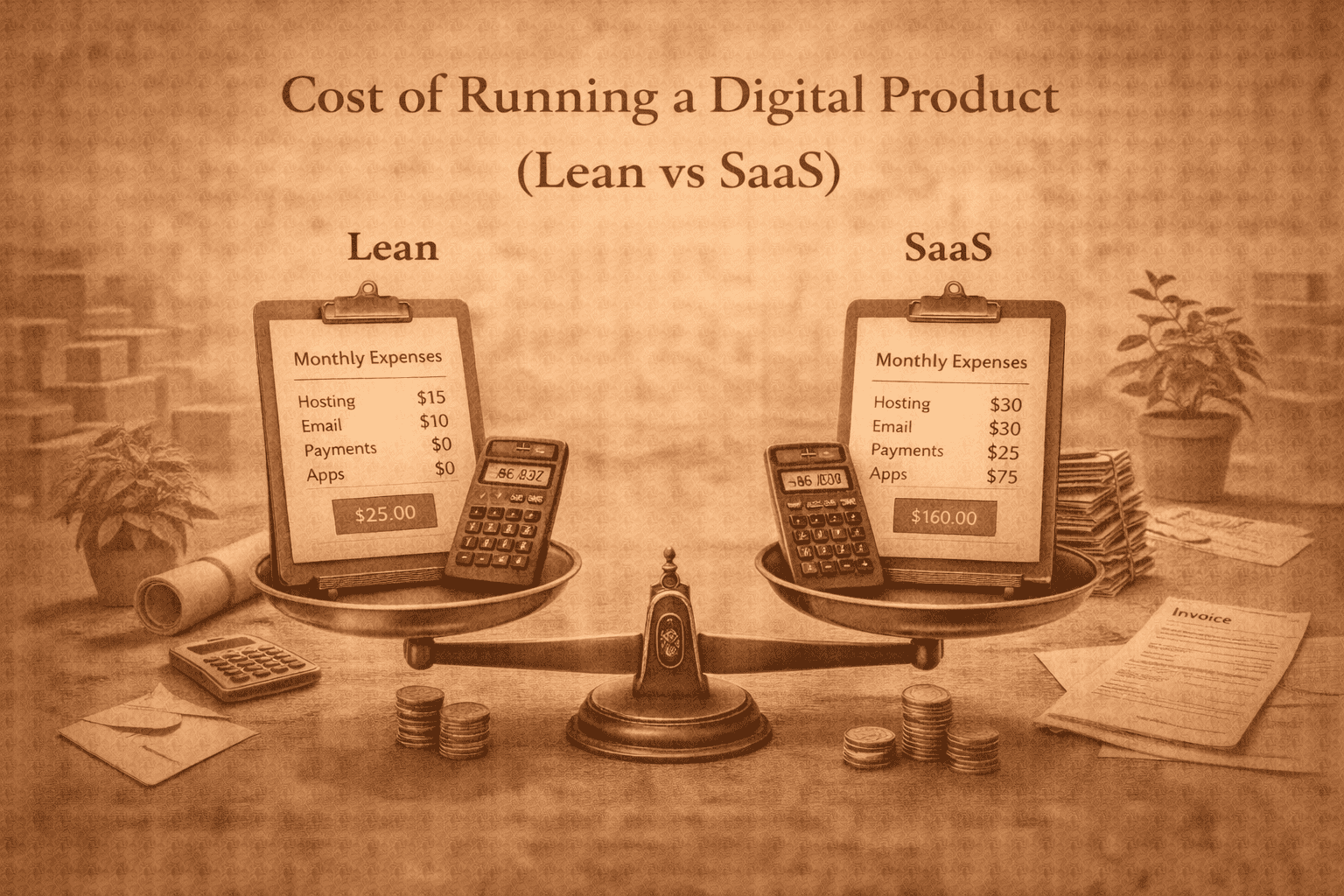
Many small digital products don’t fail because there is no demand. They fail because the software bill grows faster than the sales.
Digital products remove stock, storage and postage. They replace those with hosting, tools, payment processing, refunds and time. The costs are quieter, but they are still there. If they are underestimated, the product can feel fragile even when sales are coming in.
The real question is not whether digital products are cheap. It is how much revenue is required before the structure pays for itself.
Before worrying about tools or platforms, ask whether the product should be built at all. See Is Your Digital Product Idea Worth Building?
If you want the full profitability model that connects traffic, conversion and pricing to income, read Are Digital Products Actually Profitable?
This article focuses specifically on the ongoing cost of running a digital product.
This post includes affiliate links. If you use them, I may receive a commission at no additional cost to you.
How Much Does It Cost to Run a Digital Product?
A small, controlled digital product built on a lean WordPress setup can run on roughly:
£250–£350 per year
(about £25–£30 per month depending on usage)
A typical SaaS-heavy creator stack can easily cost:
£150–£300 per month
(£1,800–£3,600 per year)
This is not the structure I build with.
Both approaches can work. The difference is how much traffic and conversion you need just to stay above water.
My Lean Setup (What It Actually Costs Me)
This site runs on a deliberately small setup:
- GeneratePress Premium
- GenerateBlocks (free)
- Perfmatters
- Slim SEO (free)
- ShortPixel
- Cloudflare (free)
- WishList Member (content protection and membership levels)
- Bunny.net for member video hosting
- Standard WordPress hosting
Hosting choice affects long-term margin more than most people expect. I compare proportionate hosting options for small UK digital product businesses here:
→ Best WordPress Hosting for Small UK Digital Product Businesses
There is no course platform subscription, no funnel builder and no layered automation stack.
Total annual paid cost sits between £250 and £350 depending on renewals and usage, which works out at roughly £25–£30 per month.
I use GeneratePress Premium because it keeps the site flexible without pushing me into an additional builder subscription.
Perfmatters keeps the site fast without adding another heavy optimisation framework..
Bunny’s usage-based pricing keeps video costs aligned with revenue instead of locking in a fixed monthly fee.
WishList Member handles content protection and membership levels without forcing the product into a full course platform subscription.
There are other WordPress membership plugins available, but this is the one I use because it fits the controlled, low-cost structure I want.
If you want a direct structural comparison between containment and expansion at the plugin level, see WishList Member vs MemberPress for Small Digital Products.
The aim is not minimalism for its own sake. It is to keep the break-even point low so the product does not need heavy sales volume just to cover tools.
Most small digital products do not need a £200 per month software stack.
What a Typical £200+/Month Digital Product Stack Looks Like
It is common to see digital products built on multiple subscriptions:
- Course platform — about £99 per month
- Email platform — about £79 per month
- Community platform — about £39 per month
- Funnel builder — about £97 per month
Add those together and you are at roughly £300 per month before payment processing fees.
Annualised, that approaches £3,600–£3,800.
For an established business producing consistent revenue, that may be acceptable. For a single-product builder still proving demand, it raises the break-even line quickly.
Hosted platforms like Kajabi bundle many of these costs into a single monthly fe
How Many Sales You Need Just to Cover Software
Assume:
Product price: £29
Conversion rate: 1%
Revenue per visitor:
£29 × 0.01 = £0.29
Now calculate visitors required just to cover tools.
Lean stack (£30/month)
→ 30 ÷ 0.29 ≈ 104 visitors per month
SaaS stack (£200/month)
→ 200 ÷ 0.29 ≈ 690 visitors per month
Same product. Same conversion. Very different pressure.
What This Looks Like With 10–20 Sales a Month
Consider a modest month with 20 sales at £29.
20 × 29 = £580 gross revenue.
After payment fees and a few refunds, perhaps £530–£550 remains.
With a lean £30/month stack, software is covered comfortably and there is margin left to recover build time.
With a £200/month stack, the same month barely covers tools and may run at a loss once refunds or support time are included.
The product has not failed. The cost base is too heavy for the level of sales.
I have run products where £25/month in tools felt invisible, and others where £150/month felt heavy because sales were inconsistent. The cost didn’t change. The pressure did.
Payment Fees and Refunds
Even the leanest setup includes unavoidable friction.
Payment processing typically absorbs 3–5%.
Refund rates often sit between 2–5% depending on pricing and alignment.
On £1,000 in gross revenue:
3% processing → £30
3% refunds → £30
That is £60 gone before fixed costs are considered. When margins are thin, that matters.
Build Time Is Still a Cost
Software is visible. Time is not.
If a product requires 80–100 hours to build, those hours must be earned back from net income.
A product clearing £400 per month net recovers that build far faster than one clearing £75 per month net.
Digital products remove inventory risk, but they do not remove the need to earn back your time.
The Cheapest Way to Run a Small Digital Product (Example Stack)
If you were starting today with a single product, a lean setup might include:
Hosting: £60–£120 per year
Theme: £60 per year
Performance plugin: £50 per year
Membership/content protection (WishList Member) £100 per year
Image optimisation: £40 per year
Video hosting (light usage) £60 per year
Total: roughly £300–£350 per year.
This setup replaces the need for a course platform subscription while still allowing controlled membership products.
There are other membership plugins available, but this approach keeps fixed costs predictable and low.
Why Cheap Pricing Makes Software Costs Hurt More
Cost is not only about tools. Pricing decisions shape how quickly those tools are covered.
A £9 product converting at 1% produces £0.09 per visitor. Even a £30/month stack then requires nearly 333 visitors per month just to cover tools.
A £39 product converting at 1% produces £0.39 per visitor, allowing tools to be covered with far less traffic.
Low pricing forces you to rely on either high traffic or heavier infrastructure. Most small digital products have neither, which is why pricing and cost decisions cannot be separated.
Hidden Costs That Show Up After Launch
Software subscriptions are only the visible layer of cost.
Refund spikes, tool creep, processor holds, tax handling and migration effort all add pressure over time.
Many products move from £30/month in tools to £150/month within a year through small incremental decisions rather than one large commitment.
Low fixed costs absorb shocks. High fixed costs amplify them.
When It Actually Makes Sense to Pay for Bigger Tools
Upgrading tools should follow revenue, not precede it.
Higher-cost platforms make sense when revenue is stable, conversion holds steady and automation saves meaningful time.
Before adding any subscription, add its cost to your fixed monthly total and recalculate how many visitors are required just to cover tools.
If the number becomes unrealistic, delay the upgrade.
How to Work Out If a Digital Product Is Worth Running
Before building, run a quick calculation:
- Choose a conservative price.
- Assume a conservative conversion rate (1% if no data).
- Calculate revenue per visitor.
- Add monthly fixed costs.
- Divide monthly costs by revenue per visitor to find break-even traffic.
- Confirm conservative net income exceeds fixed costs by at least two times.
If the numbers are tight before launch, they will feel tighter once refunds and slower months appear.
The Practical Takeaway
Digital products are low-inventory businesses, not no-cost businesses.
A £300-per-year setup allows you to test ideas and absorb slower months without immediate strain. A £3,000-per-year setup demands consistent performance from the start.
Keeping fixed costs contained early gives you space to refine pricing, improve conversion and recover build time before pressure builds.
Margin begins after subtraction.
Most digital product problems are not demand problems. They are structure problems.
Structure only matters if the niche has enough real demand to support it in the first place.