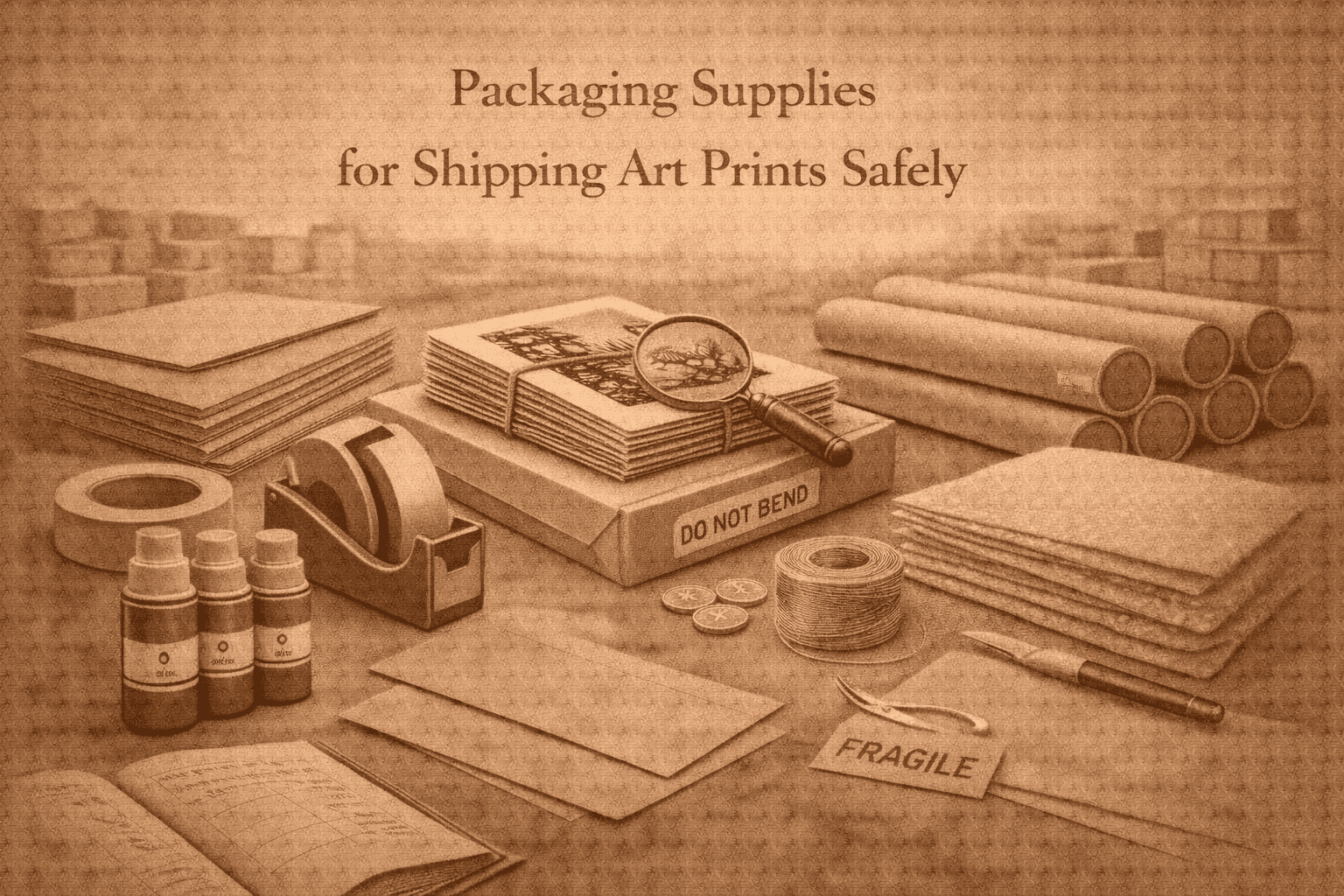
Packaging is not a dispatch problem. It is a replacement problem.
In a home-based public domain print business, damaged deliveries do not just cost postage. They cost paper, ink, time, and momentum. A replacement means printing the same job again without earning anything extra.
This page looks at packaging as a way to reduce reprints and protect what the month makes. A broader overview of how packaging fits into the full print stack is covered in tools and equipment for a one-person, home-based print business.
What Packaging Is Really Protecting
When you ship an art print, you are protecting:
- The paper surface
- The corners
- The border balance
- The print staying flat
In reproduction wall art, borders are visible once framed. A bent corner or light crease is not minor. It changes how the print looks on the wall.
Two replacements in a week can remove more from what you keep than a small increase in paper cost.
Good packaging reduces how often you have to print the same order twice.
Flat Mailers vs Tubes
For A5 and A4 prints, rigid flat mailers are usually more predictable.
Flat packaging reduces rolling stress and corner pressure. It also makes batch packing simpler in a spare-room setup.
Tubes can seem cheaper or easier to store, but rolling prints introduces curl. Lightweight stock can hold that curve, which buyers then have to flatten before framing. Choosing paper that resists curl and feeds predictably is discussed in choosing the right paper for public domain art prints.
In modest price bands, fewer replacements are usually more important than saving a small amount on materials.
Backing Boards and Stiffeners
Adding a rigid insert increases per-order cost slightly but reduces bend risk significantly.
For A5 and A4 prints, a firm backing inside a flat mailer prevents flex and protects corners.
In my own setup, I often use clean cardboard from retail boxes that would otherwise be discarded. Cut to size, it functions as a reliable stiffener and reduces material cost without reducing protection.
The key is not where the board comes from. It is whether it is flat, clean, and rigid enough to prevent movement.
Mounted prints carry even more exposure. A damaged mount cannot be corrected once it leaves your workspace.
Corners Fail First
Corners are usually the first point of damage.
If prints move inside the mailer, even slightly, dents appear.
Tight internal fit reduces movement. Oversized packaging increases the chance of shifting.
Packaging that feels easier to load is not always safer once it enters the postal system.
Handling Time and Batch Flow
Packaging is part of your production rhythm.
If you are constantly adjusting boards, repositioning tape, or re-folding envelopes, your packing time increases.
Packing time is cost, even if it does not appear on a receipt.
Simple, repeatable packaging reduces mistakes and keeps batches moving.
In a one-person setup, steady packing rhythm matters more than clever packaging tricks. How layout and room flow affect handling and error rate is covered in setting up a small home print workspace.
Storage and Material Drift
Packaging materials also need storage space.
Stacks of mailers or boards stored against walls can warp or bend, introducing damage before the print is even inserted.
Bulk buying to save a few pence per unit only makes sense if you can store materials flat and protected.
If storage causes defects, the savings disappear in replacements.
Replacement Exposure
If 2 out of 100 A5 prints require replacement due to transit damage, that is 2 additional prints, 2 additional sets of packaging, and 2 additional postage payments.
At narrow price bands, replacement exposure matters more than shaving a few pence off mailers.
Reducing replacement frequency from 2 percent to 1 percent often protects more margin than small packaging savings.
You feel that difference at the end of the month.
How small cost differences compound over a month is examined in how much does it cost to print art at home for sale.
A Practical Approach
For most home-based art print sellers:
- Use rigid flat mailers for A5 and A4
- Include a stiff backing board
- Make sure the print cannot move inside the envelope
- Keep the packing process simple and repeatable
Packaging should protect borders and corners without slowing your workflow.
The goal is not to minimise packaging cost at all times. It is to minimise how often you have to print and send the same order again.
In a one-person public domain print business, fewer replacements protect what you keep more reliably than marginal savings on materials.