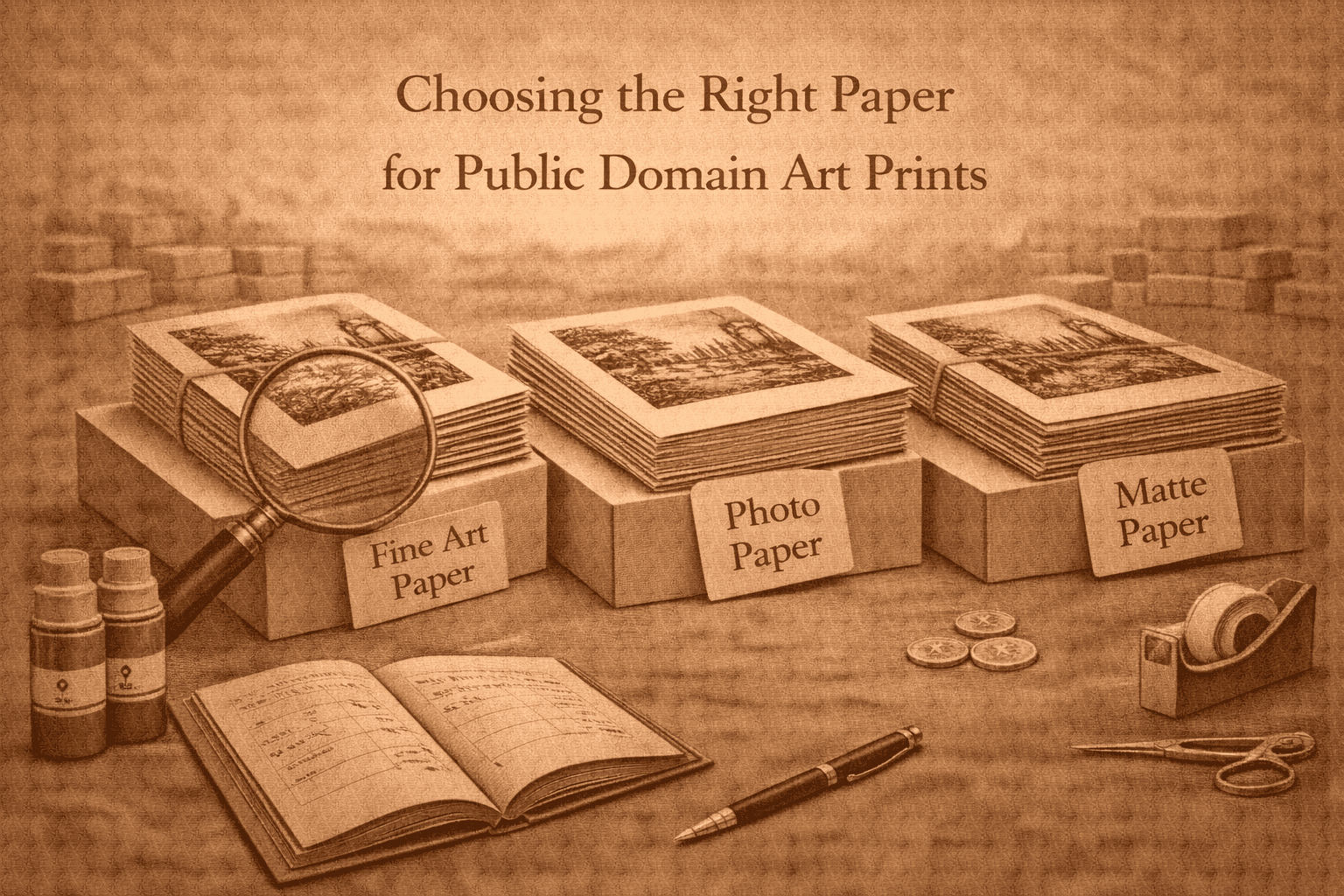
Paper is not just a printing surface. It becomes part of the product.
In public domain wall art, the image may be widely available. What differentiates your listing is consistency, presentation, and perceived finish. Paper plays a visible role in that perception.
The goal is not to choose the most impressive stock available. It is to choose paper that feeds reliably, produces consistent borders, and supports the price band you operate within. A broader overview of how paper fits into the full print stack is covered in tools and equipment for a one-person, home-based print business.
Start With Buyer Expectation
Most buyers compare art prints by size and appearance, not by paper specification.
An A5 at £3.99 is expected to feel light but not flimsy. An A4 at £5.99 is expected to feel slightly more substantial. Mounted prints are expected to feel finished.
Buyers rarely ask for specific gsm numbers. They respond to weight in hand and overall finish once framed.
Choose paper that meets expectation without exceeding what the price band can realistically support. Heavier and more expensive paper does not automatically make a £3.99 print feel premium. It often just reduces what you keep.
Paper Weight: What Actually Works
For most home-based art print sellers, 230–300 gsm is a practical range.
Below 200 gsm can feel thin, particularly once framed. It may also crease more easily when moving between printing and packing.
Above 300 gsm, feeding becomes less predictable in many entry level printers, and trimming requires more pressure. Heavier stock also increases cost per sheet and handling care.
In a one-person workflow, small increases in resistance slow batch momentum and increase trimming fatigue.
A consistent mid-to-heavy weight that feeds reliably is often better than pushing toward maximum thickness.
Matte, Satin, or Gloss?
Finish affects perception more than most sellers expect.
Matte paper tends to align well with public domain art, especially botanical, architectural, and illustration-style prints. It reduces glare under household lighting and presents a calm surface once framed.
Gloss can increase colour vibrancy but also increases reflection. In wall art, glare under room lighting can reduce perceived quality.
Satin or lustre finishes sit between the two, offering some vibrancy without full gloss reflection.
In most resale contexts, matte or lightly textured finishes are safer and more consistent with buyer expectations.
Printer Feeding Reliability Matters More Than Brand
Brand names matter less than feeding consistency.
If your chosen paper:
- Misfeeds occasionally
- Skews slightly during intake
- Requires repeated alignment
Then trimming borders increases and border consistency becomes harder to maintain.
In reproduction wall art, the border is not background. It is part of what the buyer sees once the print is framed. If the paper feeds slightly off and you compensate with trimming, that asymmetry shows up on the wall. At that point it is not a design issue. It is a feeding issue.
Practical guidance on maintaining consistent borders in a home setup is covered in how to trim art prints accurately at home.
Choose paper that your specific printer handles predictably.
Paper Texture and Surface Feel
Light texture can enhance perceived quality, particularly for vintage illustrations or classical artwork. However, texture can also affect ink absorption and colour appearance.
Before committing to a new stock, print a small batch and review it carefully, including the borders and edge finish. Make sure to check not only the image but the edge finish and handling feel.
Texture should enhance perception without increasing reprint frequency.
If switching stock requires repeated colour adjustments, testing cost increases.
Storage and Environment
Cold weather can affect paper more than many sellers expect. I have had stock that fed perfectly in summer begin to misalign after being stored against a cold wall. The printer was not the problem. The paper was.
Paper stored near radiators or windows can warp subtly. Even slight curvature can affect feeding alignment and increase the chance of misfeeds.
Handling and transit protection are discussed in packaging supplies for shipping art prints safely.
Store paper flat, away from heat and moisture. Rotate stock rather than accumulating large quantities that may sit unused.
Bulk buying to reduce per-sheet cost only makes sense if storage conditions protect the material.
Matching Paper to Price Band
Paper selection should reflect the price boundary you operate within.
If your A5 sells at £3.99, moving to significantly more expensive stock without adjusting price narrows what remains after costs.
A fuller breakdown of how paper and ink costs affect what you keep is covered in how much does it cost to print art at home for sale.
If buyers are not explicitly paying more for the upgrade, you are paying for it instead.
Similarly, upgrading A4 stock to premium art paper may increase perceived quality slightly, but if the market price remains anchored near £5.99, the economic benefit may be limited.
Choose paper that supports consistency and perceived finish within the existing price band.
A Practical Approach
If you are uncertain, begin with:
- A mid-weight matte paper in the 230–280 gsm range
- A stock that feeds reliably in your printer
- A finish that minimises glare under home lighting
Print several designs and assess how they look and feel once handled and framed, paying attention to border consistency and edge finish.
Stability in feeding, trimming, and appearance is more important than theoretical prestige.
In a one-person public domain print operation, paper should support workflow, not complicate it.