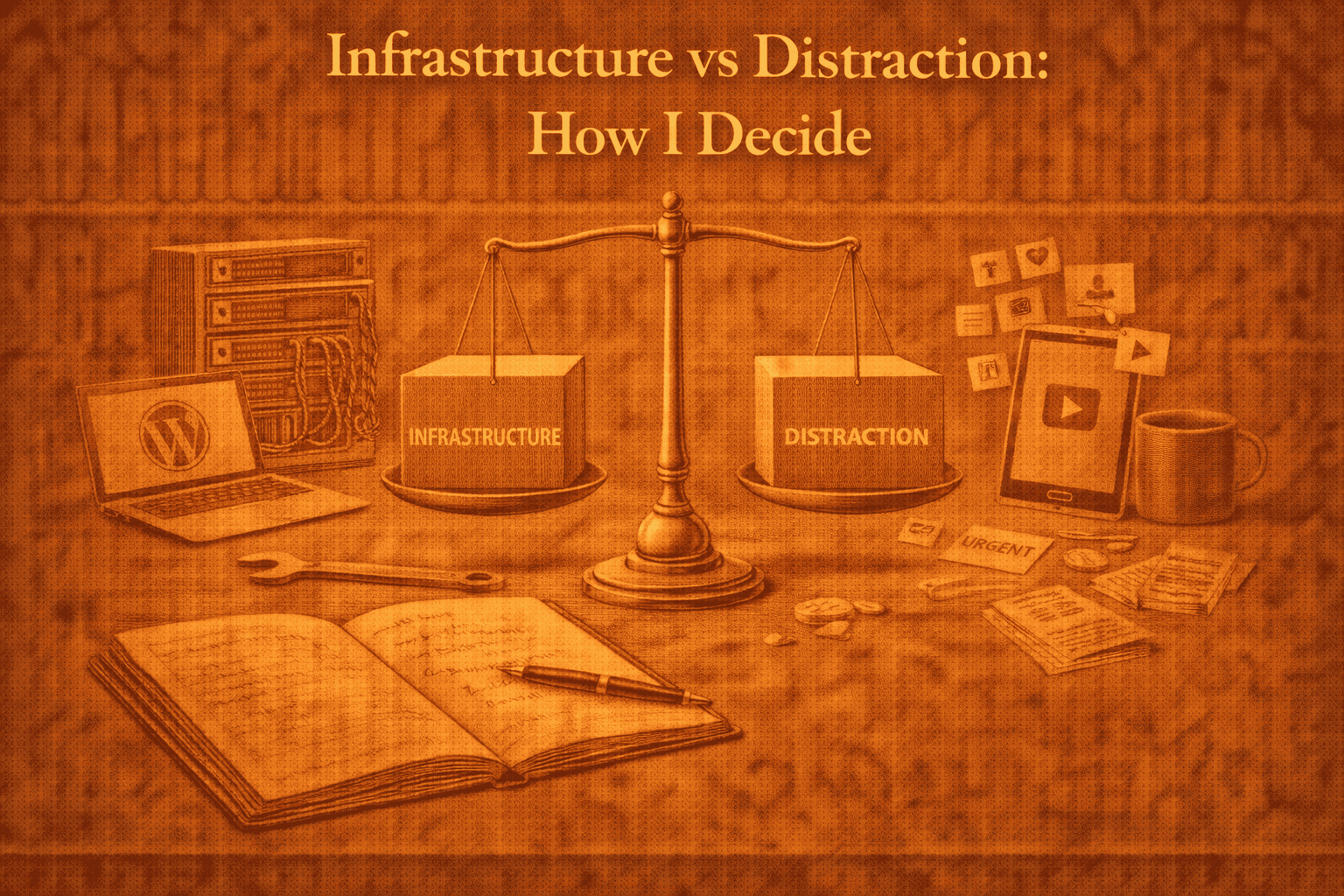
Every tool looks like infrastructure at first.
It promises improvement.
It promises efficiency.
It promises insight.
But not every tool strengthens your website.
Some simply distract you from the real work.
The difference is not in the tool itself.
It is in what it changes.
What Infrastructure Actually Means
Infrastructure is anything that:
- Reduces friction
- Improves stability
- Protects margin
- Simplifies workflow
- Supports long-term reliability
Good infrastructure is quiet.
It works in the background.
You rarely think about it once installed.
Hosting is infrastructure.
Backups are infrastructure.
A clean SEO plugin is infrastructure.
If something demands constant attention, it is probably not infrastructure.
What Distraction Looks Like
Distraction often appears productive.
It comes in the form of:
- New dashboards
- Deeper analytics layers
- Advanced optimisation features
- Conversion tweaks
- Growth hacks
These feel strategic.
But if they do not improve:
- Revenue clarity
- Operational stability
- Decision speed
They are distraction.
Distraction consumes attention without strengthening structure.
The Test I Use
Before adding any tool, I ask three questions:
- Does this reduce friction in my workflow?
- Does this increase clarity around revenue or performance?
- Will this simplify or complicate my stack long-term?
If the answer is unclear, the tool is refused.
If the tool adds monitoring, configuration and decision fatigue without solving a defined bottleneck, it is distraction.
The Trap of Reactive Infrastructure
Distraction often enters during slow periods.
Traffic dips.
Revenue stalls.
Engagement feels flat.
The instinct is to add something.
- A new analytics platform
- A conversion plugin
- A heatmap tool
- A performance optimiser
This creates the feeling of movement.
But movement is not progress.
If the core issue is positioning, offer clarity or demand alignment, infrastructure changes will not fix it.
Infrastructure Should Be Boring
Boring infrastructure is a good sign.
It means:
- It works
- It requires minimal intervention
- It does not demand constant optimisation
If you feel the urge to “improve” your infrastructure frequently, it may not be infrastructure at all.
It may be disguised distraction.
Signs a Tool Is Distraction
- It duplicates existing functionality
- It requires constant dashboard checking
- It promises marginal gains without solving structural issues
- It was installed during a period of uncertainty
- It increases mental overhead
Distraction compounds.
Each additional tool makes the next one easier to justify.
When Expansion Is Legitimate
Expansion is justified when:
- Revenue requires automation
- Scale creates operational strain
- Legal or compliance obligations demand change
- A clear bottleneck has been identified
Infrastructure grows when necessary.
It does not grow by habit.
My Recommendation
Treat infrastructure as structural.
Treat new tools with suspicion.
If a tool strengthens stability and reduces friction, it belongs.
If it adds complexity and requires supervision, it is distraction.
Websites grow fragile through accumulation.
They grow strong through restraint.
Control the stack.
Protect your attention.
Build infrastructure that supports work, not replaces it.