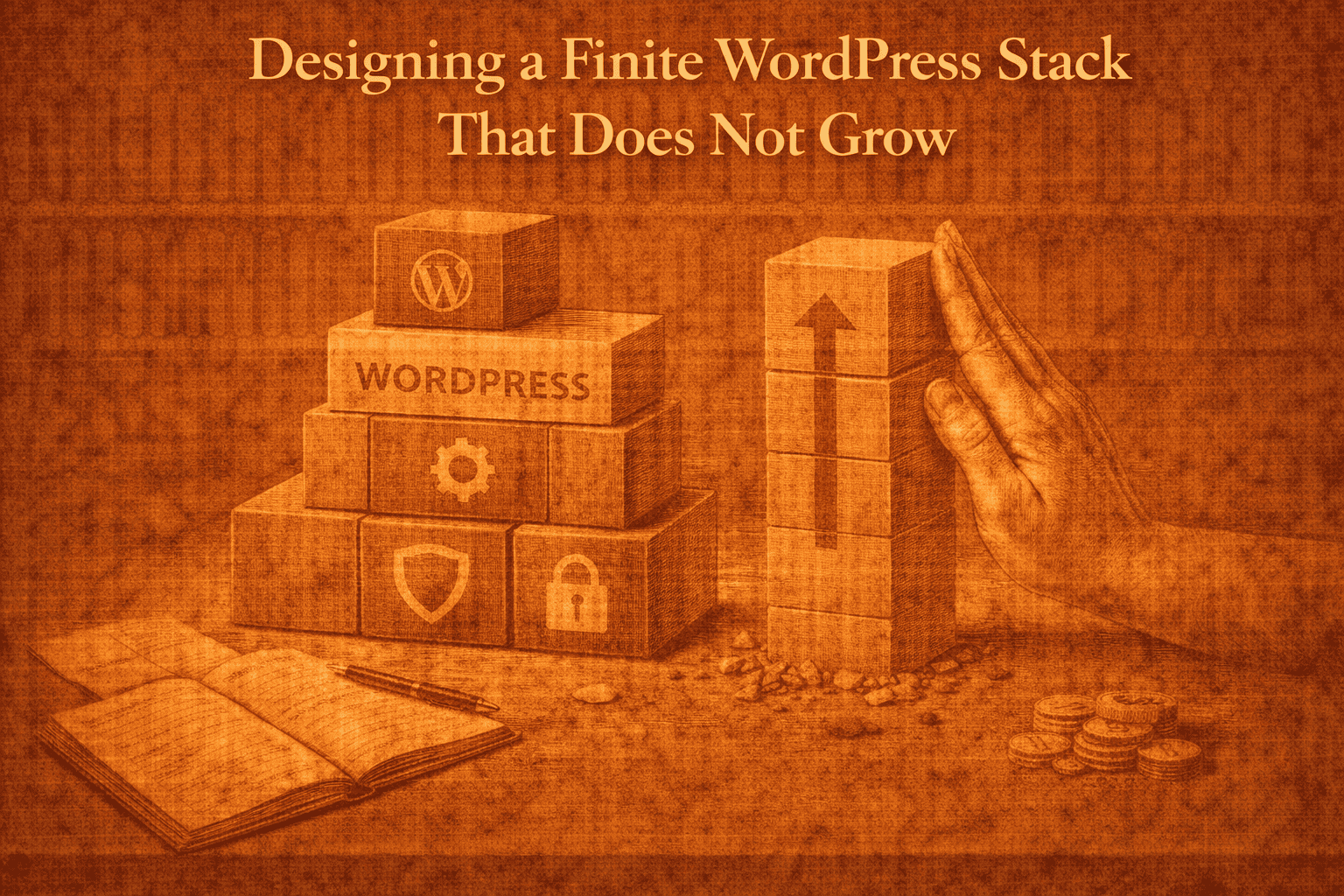
Most WordPress websites do not collapse suddenly.
They expand slowly.
A new plugin here.
A new tracking layer there.
A new tool added “just in case.”
Over time, the stack grows beyond its original purpose.
I design websites to be finite.
Finite does not mean small.
It means controlled.
What a Finite Stack Means
A finite WordPress stack has:
- A defined purpose
- A limited plugin set
- A clear hosting decision
- No experimental layers running in the background
It is built to serve a specific commercial outcome.
It is not built to accommodate every future idea.
That is the difference.
Growth Is the Default Failure Mode
Left unchecked, websites grow in predictable ways:
- More plugins
- More integrations
- More scripts
- More tracking
- More configuration panels
Each addition feels harmless.
Collectively, they create drag.
Drag reduces:
- Performance
- Stability
- Focus
- Clarity
The website becomes something that must be managed rather than something that produces value.
Designing for Constraint
When I build a WordPress site, I decide early:
- Which theme I will use
- Which SEO plugin
- Which analytics tool
- Which image optimisation tool
- Which backup or migration tool
That stack is chosen deliberately.
After that, additions are rare.
Every new tool must justify its existence.
Constraint protects structure.
The Problem With “Just in Case”
Many site owners install tools for scenarios that do not exist yet.
- A pop-up system before traffic exists
- Advanced schema plugins before revenue
- Complex CRM integrations without customers
This introduces complexity before validation.
Complexity should follow revenue.
Not precede it.
Replace Instead of Add
If I need new functionality, I ask:
Can something be replaced instead of added?
For example:
- Swap analytics tools rather than stacking them
- Change hosting instead of adding performance layers
- Replace a bloated plugin with a simpler one
Replacement maintains finite boundaries.
Addition expands them.
Architectural Discipline
A finite stack requires discipline.
Before adding a tool, I ask:
- Does this increase revenue clarity?
- Does this solve a real operational limitation?
- Will this require ongoing maintenance?
- What is the long-term cost of keeping this installed?
If the answer introduces recurring overhead without clear benefit, the tool is not added.
Websites degrade when decisions are made reactively.
They stabilise when decisions are made structurally.
When Expansion Is Justified
There are legitimate reasons to expand a stack:
- Revenue justifies automation
- Operational scale demands tools
- Legal compliance requires functionality
- Platform requirements change
Expansion is not forbidden.
It must be earned.
Mistakes Website Builders Make
- Adding tools during slow revenue periods
- Mistaking activity for progress
- Treating infrastructure changes as strategic improvement
- Copying large-stack setups from larger businesses
Large businesses can afford complexity.
Small operators often cannot.
My Recommendation
Design your WordPress stack as if it must remain stable for years.
Choose tools deliberately.
Set boundaries early.
Replace when necessary.
Avoid incremental expansion.
A website that does not grow in complexity is easier to manage, faster to maintain and more commercially reliable.
Finite systems produce better long-term results than expanding ones.
Control the stack.
Protect the structure.