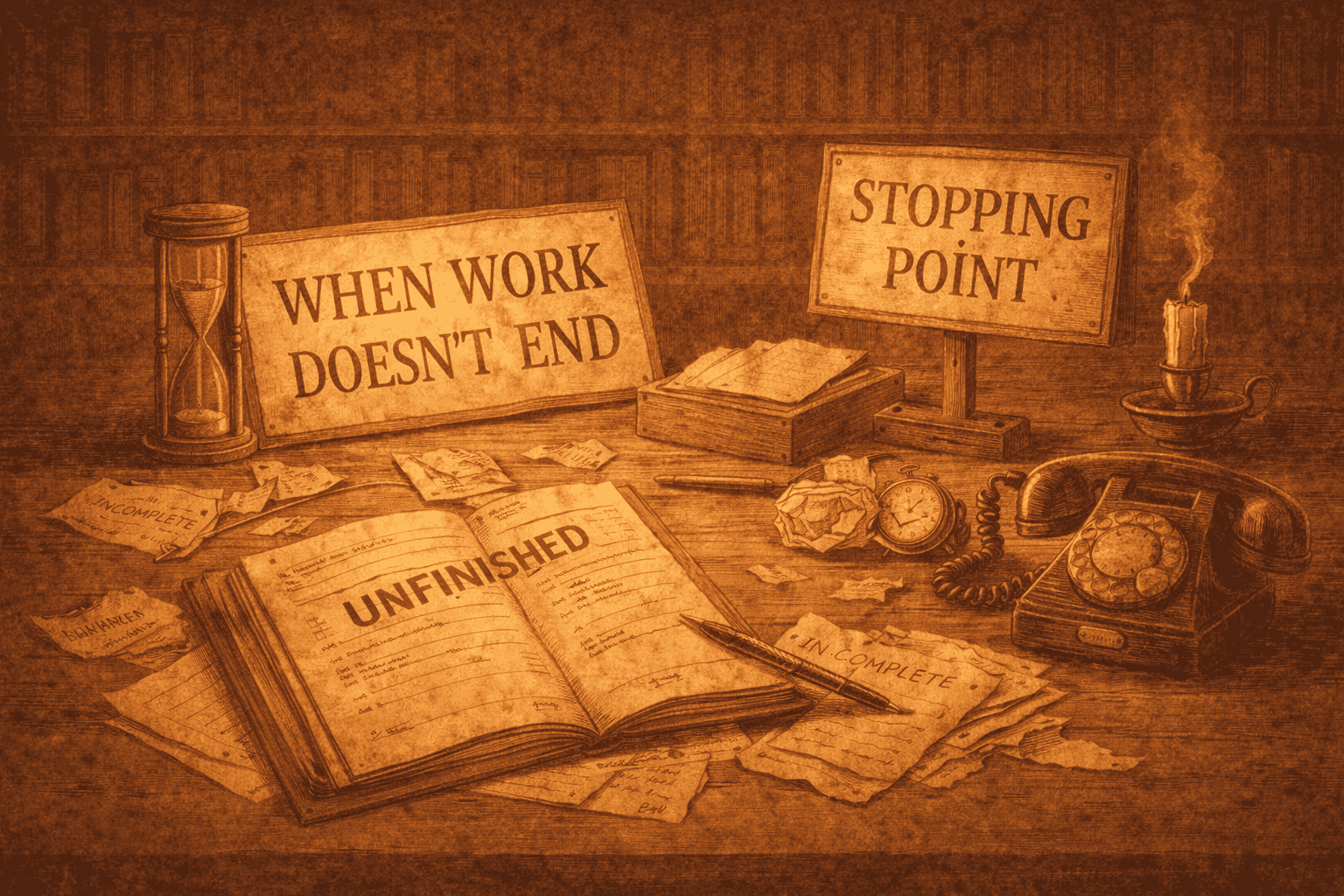
The Work That Wouldn’t End
I wasn’t burnt out in the way people usually mean it.
The work was competent. Clients were reasonable. Projects shipped.
Nothing was obviously wrong.
There were no crises, no dramatic failures, no clear signal that something needed fixing.
And yet, the work never seemed to end.
Every delivery resolved something temporarily, but it never closed anything fully.
Each project left behind a residue: small follow-ups, clarifications, adjustments, expectations.
Not urgent. Not unreasonable. Just present.
I didn’t feel exhausted because I was working too hard. I felt exhausted because I was never finished.
The exhaustion that didn’t look like a problem
What made this harder to see was that this kind of exhaustion looks like responsibility.
- It looks like being available.
- It looks like caring about outcomes.
- It looks like professionalism.
From the outside, it reads as doing a good job.
From the inside, it feels like carrying unfinished edges everywhere.
I could take time off, but the work came with me.
Not as tasks, but as vigilance.
A sense that something might come back. That something probably would. That I should stay reachable, just in case.
There was no moment where the system registered completion. No clean stop. Just quieter periods between requests.
The more competent the work became, the worse this got.
Good clients didn’t push boundaries aggressively. They assumed flexibility because nothing signalled finality.
Politeness slowly hardened into expectation. Expectation became ambient scope.
Nothing anyone asked for was unreasonable on its own. That was part of the problem.
Why fixing the work didn’t fix the problem
Once I noticed the pattern, my instinct was to fix the work.
That felt sensible. If the work wasn’t ending, then something about how it was structured or managed must be wrong.
So I did what most competent people do. I tried to improve it.
- I tightened scopes.
- I clarified deliverables.
- I documented boundaries more carefully.
- I refined processes so fewer things slipped through cracks.
None of that solved the problem.
It changed the texture of the work, but not its shape. The edges were cleaner, but they were still open.
In some cases, improvement made things worse.
Clearer processes reduced friction, which made continuation easier.
Professionalism smoothed over the very signals that might have forced an ending.
I also tried changing the container rather than the details.
I rebuilt. I rebranded. I adjusted positioning. I assumed that if the work looked more intentional from the outside, it would behave differently on the inside.
It didn’t.
The work still followed me after delivery.
Not loudly, not aggressively, but persistently.
It remained reachable.
It remained reopenable.
It still relied on memory and tone rather than structure to stay closed.
I kept asking how to manage the work better, when the real question was why it was allowed to continue at all.

Rebuilding My Web Design Offering
Rebuilding my Web Design Business felt like a sensible response at the time.
The business worked. Clients came through referrals. Income was stable enough.
But the unease hadn’t gone away, and I wanted to see whether a cleaner structure would finally resolve it.
So I rebuilt it deliberately.
I simplified what was offered. I tightened language. I made the work look more bounded from the outside.
I was careful about how projects were framed, what was included, and how handover was described.
For a while, it looked like it had worked. Projects ran more smoothly. Conversations were clearer. The work felt calmer.
But the underlying pattern didn’t change.
Even in its cleaner form, the work still had no real ending. Delivery didn’t close the loop. It marked a transition into a quieter phase of availability.
The relationship didn’t conclude. It softened.
Requests didn’t stop.
They arrived later, framed as continuity rather than change.
Small things. Reasonable things.
The kind of things you say yes to without thinking because saying no would require explanation.
That was the uncomfortable realisation.
The problem wasn’t that the work was poorly designed. It was that the type of work I was doing could not end cleanly by default. No amount of refinement changed that.
I had rebuilt the same structure, just with better materials.
What I misunderstood about products
At that point, I started thinking in terms of products and assets.
Like most people doing client work for any length of time, I’d encountered plenty of arguments for productising services.
- Turn repeatable work into something discrete.
- Reduce dependency on availability.
- Regain control of time.
On the surface, it sounded like the answer.
But I was carrying a shallow understanding of what a product actually is.
I thought of products as outputs. Things you sell instead of time. Containers for value. Something you build once so you don’t have to keep doing the same work again.
That framing still assumed continuation. It just shifted where it happened.
Most product advice treats growth as the goal.
More users. More features. More updates.
Even “passive” products tend to accumulate obligation over time through support, maintenance, and expectation.
I noticed that even when services were replaced by products, the work often didn’t end. It just changed shape.
The pressure remained, only now it arrived as feature requests, updates, community questions, or the quiet sense that the product should keep evolving because people were using it.
I hadn’t escaped the problem. I’d moved it.
What I hadn’t understood yet was that a product is not defined by how it’s delivered or sold.
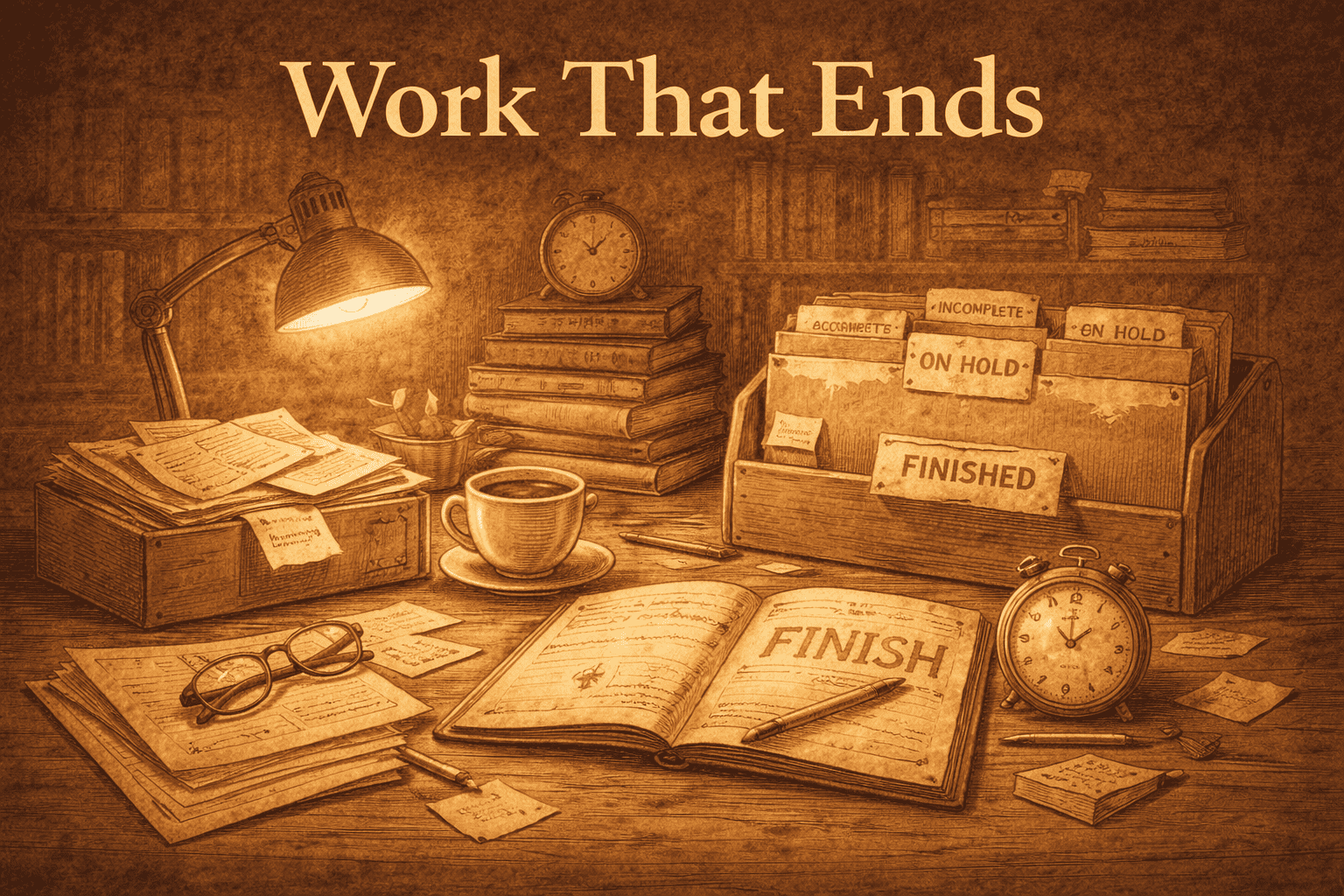
It’s defined by whether it can finish.
The product hiding in the problem
The thing that finally changed wasn’t an idea I added. It was something I stopped avoiding.
The product wasn’t a better version of the service. It wasn’t a replacement offer or a new format. It wasn’t something I needed to invent.
It was already there, embedded in the problem itself.
What I had been carrying for years was unresolved pressure.
The value wasn’t in continuing to help. It was in naming why the help never stopped. In making the boundary explicit rather than managing it indefinitely.
The work didn’t need to be improved. It needed to be concluded.
That’s why the product looked strange when I tried to describe it. It wasn’t instructional. It didn’t offer a system to follow. It didn’t promise to fix anything.
It simply resolved something that had been open.
Once I accepted that, a lot of earlier confusion made sense.
Why better processes hadn’t helped.
Why rebuilding hadn’t changed the outcome.
Why productisation advice always felt slightly off.
I hadn’t been failing to build the right thing.
I’d been resisting the idea that the right thing was an ending.
Designing an ending
Designing an ending wasn’t clever.
It didn’t involve a framework or a better way of packaging the work. It involved removing things I had previously treated as optional, but which turned out to be load-bearing.
The first thing that went was flexibility. Not flexibility in the abstract, but the assumption that the work should adapt itself once it was underway.
Then opportunity had to shrink.
Some possibilities disappeared immediately. Others stopped appearing once the work no longer signalled availability.
Language changed as well. Words that once felt polite turned out to be invitations. Removing them wasn’t about tone. It was about withdrawing permission.
Most importantly, the work itself had to become something that could exist without me.
Not supported. Not maintained. Not defended. Just complete.
There was no sense of momentum or progress in this. No “what’s next” built into it.
There was just a clean stop.
What changed when the work ended
What changed wasn’t what I’d been taught to expect.
There was no sudden freedom. No surge of energy. No feeling of having cracked something.
What appeared instead was absence.
The background noise went away. The low-level vigilance that had accompanied every project simply stopped being necessary. Finished work became inert.
Income changed too, but quietly. There was no escalation built into it. What replaced that was predictability. The work paid once and then released its hold.
Pressure didn’t disappear entirely. Requests still arrived. The difference was that the boundary was no longer negotiated in real time. The structure answered on its own behalf.
What remained wasn’t freedom in the motivational sense.
It was clarity.
Closing
For a long time, I thought the problem was that I hadn’t yet found the right way to manage the work.
I assumed that if I were more disciplined, clearer, firmer, or better organised, the unease would resolve itself.
What I eventually understood was that the work I was inside could not end by design.
No amount of competence fixes a structure that assumes continuation. The exhaustion wasn’t a personal failing. It was a signal that the work itself had no stopping point.
Relief came not from doing more, but from recognising that work can be designed to end.
Not as optimisation. Not as withdrawal.
As a decision.
If you recognise yourself in this, there is nothing wrong with you.
And it is possible for work to end.
This thinking eventually became a finished object.
It lives at Work That Ends.