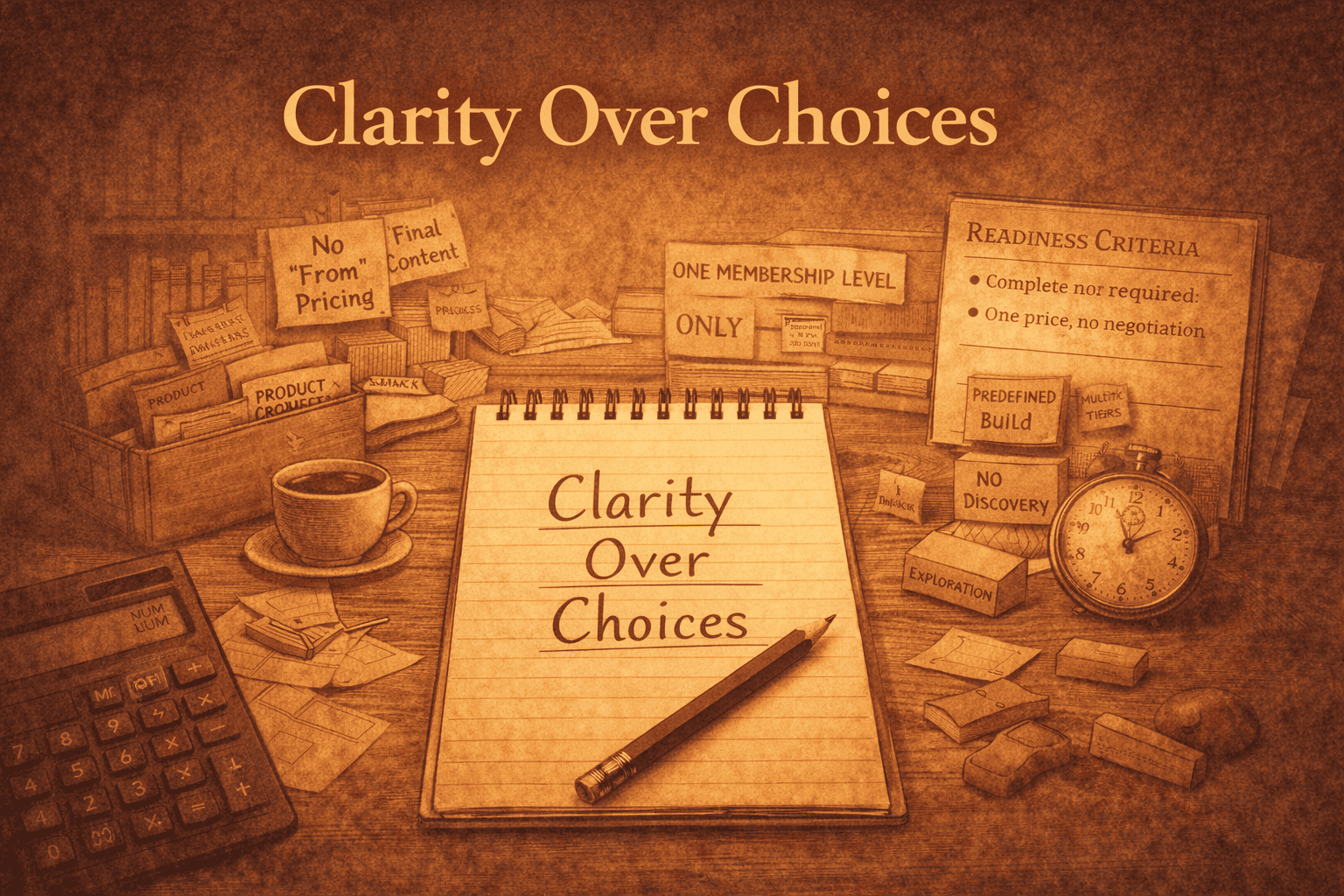
After updating an old asset and reshaping it into a bounded offering, I realised the visible changes were the least important part.
The real work happened in the reasoning.
What looked like a simple exercise in writing pages and forms was, in practice, a series of decisions about boundaries, risk, and where effort should live.
This post is an attempt to document that thinking, while it’s still clear in my head.
Productising isn’t about packages
It’s easy to think productising work means creating tiers, bundles, or clever pricing pages.
That’s not what happened here.
The work was mostly subtraction.
- I removed language that implied conversation.
- I removed options that required explanation.
- I removed flows that allowed work to start before readiness.
What remained were two products that could be described in a single sentence, and defended without apology.
- A predefined website, delivered as complete.
- A predefined membership site, delivered as a finished system.
Everything else had to earn its place.
Pricing is about expectation, not value
I spent more time thinking about what prices signalled than what they were “worth”.
- Low prices invite explanation and negotiation.
- High prices invite reassurance and flexibility.
Neither is what I wanted.
The goal was considered but accessible pricing, set high enough to command respect, and low enough to avoid ceremony.
In the end, the numbers mattered less than the posture.
A single price, stated plainly, with no defence.
- Not “from”.
- Not “starting at”.
- Not “depending on requirements”.
Just a number, and a clear description of what it buys.
Readiness matters more than conversion
The most important decision was where friction should live.
I chose to put friction before commitment, not after.
That meant introducing readiness pages that state, declaratively, what must already be true before someone can proceed.
- Not guides.
- Not FAQs.
- Not encouragement.
Just conditions.
If someone isn’t ready, the system says so quietly and early.
That’s better for them, and significantly better for me.
Forms are boundaries, not interfaces
The onboarding forms were treated as enforcement mechanisms, not user experiences.
Every field had to answer a single question: Does this reduce ambiguity, or does it create it.
Free-text fields disappeared quickly.
Conditional logic wasn’t missed.
What mattered was that someone could only submit if they were prepared to be specific and final.
The form doesn’t decide anything.
It just makes fit obvious.
Default choices reduce cognitive load
One of the more practical decisions was to handle hosting and domain setup by default.
Not as a service, but as procurement.
This removed an entire category of back-and-forth and education that non-technical users struggle with, without creating an ongoing obligation.
Ownership transfers.
Responsibility ends.
That distinction mattered more than the mechanics.
The system ends cleanly
Every path now has a clear end.
Product page → readiness → onboarding → review → payment → delivery → stop.
- No implied continuation.
- No silent support expectations.
- No emotional loose ends.
That was deliberate.
I’ve learned that work which doesn’t end cleanly has a way of following you around.
What surprised me
The surprising part wasn’t how much work this took, but how much mental load disappeared once decisions were locked.
Once something was final, it stayed final.
- No revisiting prices.
- No rewording forms.
- No “maybe we should add”.
That discipline is what made the system viable.
Why this matters going forward
This isn’t a growth play.
It’s background revenue, designed to exist without demanding attention.
More importantly, it’s a reminder that clarity is usually found by removing choices, not adding them.
The asset now works because it can be ignored.
That’s the outcome I was aiming for.