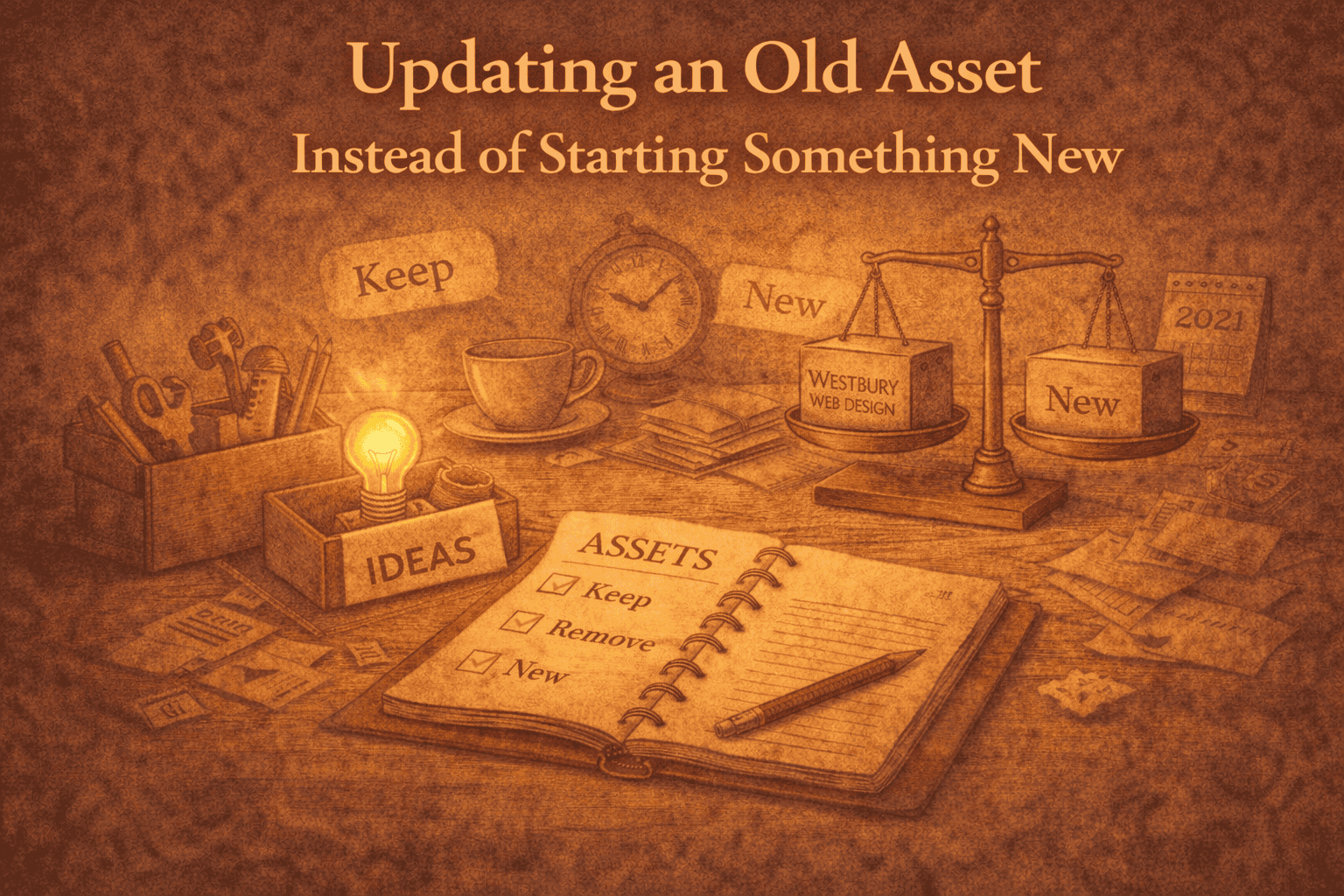
Updating an old asset instead of starting something new
I spent time recently revisiting an old asset, Westbury Web Design, and restructuring it around a different way of working.
This wasn’t a redesign in the usual sense. It was closer to a reset.
The original site reflected a traditional client-services model.
- Bespoke work
- open-ended conversations
- ongoing support
- and a lot of language that implied availability and relationship.
That model worked at one point, but it no longer matched how I want to allocate time or attention.
Rather than abandon the asset, I wanted to see if it could be reshaped into something bounded, finite, and calm.
The starting problem
The site had accumulated years of assumptions.
- Pages implied discovery calls.
- Pricing implied negotiation.
- Support was positioned as default rather than optional.
- Navigation suggested choice before clarity.
Individually, none of this was unusual.
Collectively, it created obligation creep.
The underlying issue wasn’t design or copy. It was the mental model the site was built on.
A different constraint
The shift was simple to state and difficult to enforce.
- Every service had to be finite.
- Every offer had to end cleanly.
- Nothing could imply continuation by default.
That constraint became the filter for every decision.
Pages that couldn’t be reconciled with that model were deleted.
Not archived, not rewritten. Deleted.
This included pricing pages, customer care pages, portfolio narratives, and anything that framed work as collaborative or ongoing by nature.
What remained was intentionally small.
Productising without scaling
Instead of generic services, the site now supports three clearly defined offerings.
- A Starter Site, a predefined public website delivered as complete.
- A Membership Site Starter, a predefined membership build delivered as a finished system.
- Optional Ongoing Support, offered only where it makes operational sense, and never assumed.
Each exists as a separate product. None acts as an upsell path to the others.
This wasn’t about growth. It was about containment.
The goal wasn’t to attract more work. It was to allow specific kinds of work without reopening the failure modes of the old model.
What was removed mattered more than what was added
Most of the work was subtraction.
- Language that implied partnership.
- Pages that existed to reassure.
- Navigation structures that introduced choice too early.
- Policies and tooling that implied scale or constant monitoring.
Once those were gone, the remaining structure became obvious.
- The homepage routes to a single primary offer.
- The Services page acts as a neutral index.
- The Contact page filters rather than invites.
Nothing tries to persuade. Everything tries to clarify.
A useful outcome
The practical result is that an old asset is now aligned with how I actually work.
More importantly, it created an additional revenue stream that is optional, capped, and non-gravitational.
Something that can be turned on or off without consequence.
That was the real test.
If an asset can’t be ignored without breaking something, it owns you. This one doesn’t.
A note to future me
The most important part of this exercise wasn’t the copy or the layout. It was treating decisions as final.
- Once a boundary was set, it wasn’t reopened.
- Once a page no longer fit, it wasn’t salvaged.
- Once an offer was defined, it wasn’t softened.
That discipline is what made the work finite.
If I revisit this later, the question won’t be how to optimise it. It will be whether the model still holds.
For now, it does.