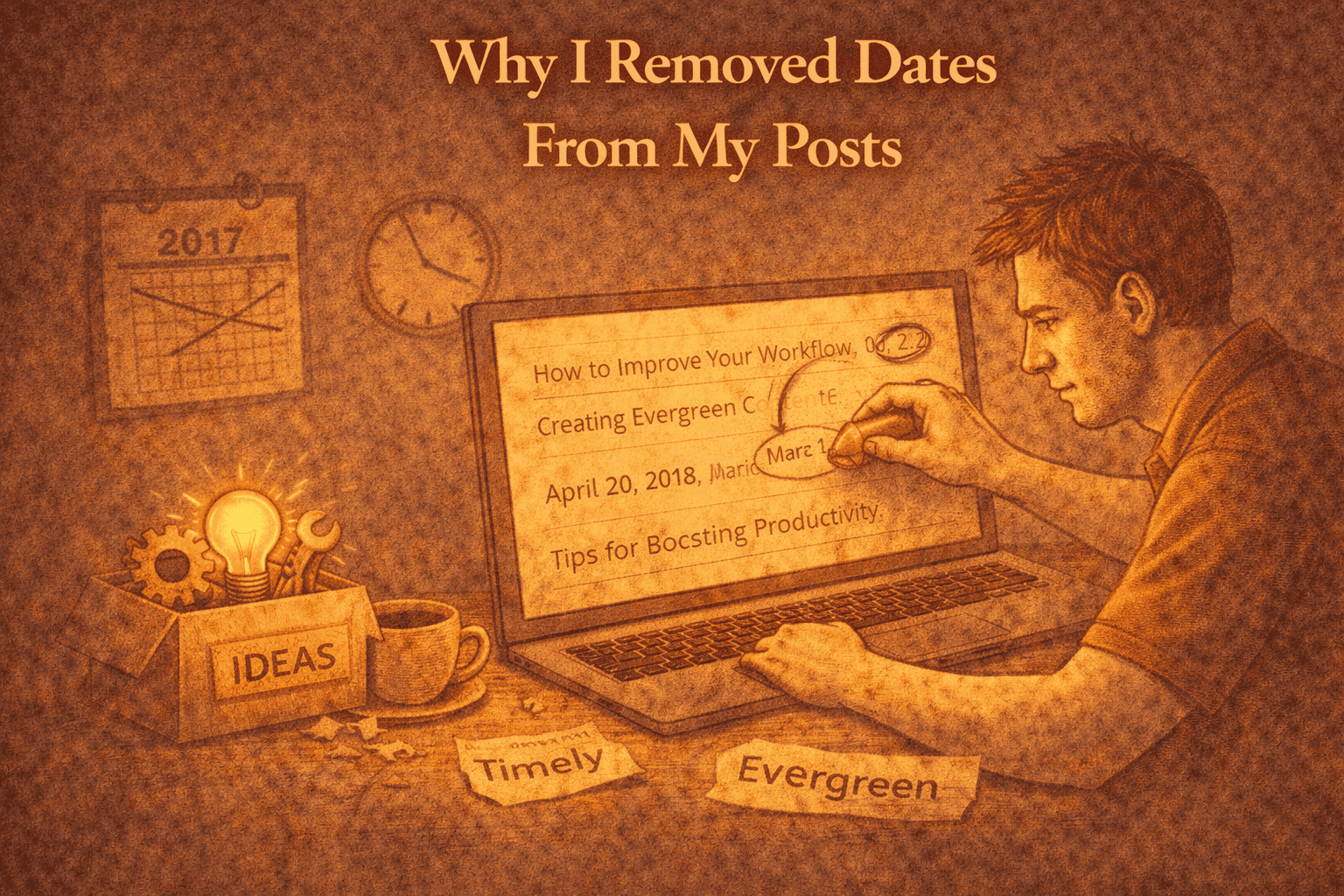
For a long time, dates on posts felt harmless.
They were just there, part of the default publishing machinery. A timestamp, a bit of context, a way of placing something in time. I didn’t question them because I didn’t think I needed to.
It wasn’t until I changed the kind of work I was publishing that the tension showed up.
As SKO became less about updates and more about recording decisions, I noticed a low-grade pressure that didn’t come from the writing itself. It came from the way the posts were framed once they were published.
Dates quietly introduce an obligation.
They ask a question before the reader has even engaged with the content:
- Is this still relevant?
- Is this out of date?
- Does the author still think this?
Those aren’t bad questions in the right context. They make sense for commentary, tutorials, tactics, or anything that depends on current conditions.
But they were the wrong questions for the work I was now doing.
The posts on SKO aren’t instructions.
They aren’t advice.
They’re records of thinking, moments where a decision was made and then left intact.
Their value doesn’t come from freshness. It comes from resonance.
Once I noticed that, the effect of dates became hard to ignore.
Seeing an older date created a subtle pull, not for the reader, but for me. A sense that something might need revisiting, qualifying, or updating. Not because the thinking had changed, but because time had passed.
That’s not a healthy reason to reopen work.
Removing dates wasn’t about pretending the posts exist outside of time. It was about refusing to make time the primary axis on which they’re judged.
That same thinking, treating finished as a decision rather than something that drifts over time, is something I’ve written about elsewhere in finished is a design choice, not a phase
If a piece still holds, it holds.
If it doesn’t, it doesn’t.
The date doesn’t improve that evaluation, it distracts from it.
Once the dates were gone, something settled.
The posts felt more like what they actually are: finished pieces of thinking. Not drafts waiting to be refreshed. Not updates competing for attention. Just records that can be read now, later, or not at all.
The payoff wasn’t just external. It was internal.
Without dates, I stopped feeling the background hum of maintenance. The sense that I should “check in” on old posts, or explain how my thinking had evolved, or signal what was current.
The work was allowed to stand on its own terms.
That’s a small decision, structurally. But it changed my relationship to what I’d already written and to what I’ll write next.
Some things benefit from being anchored in time.
Others benefit from being left alone.
For this body of work, removing dates was the right way to let it be finished.