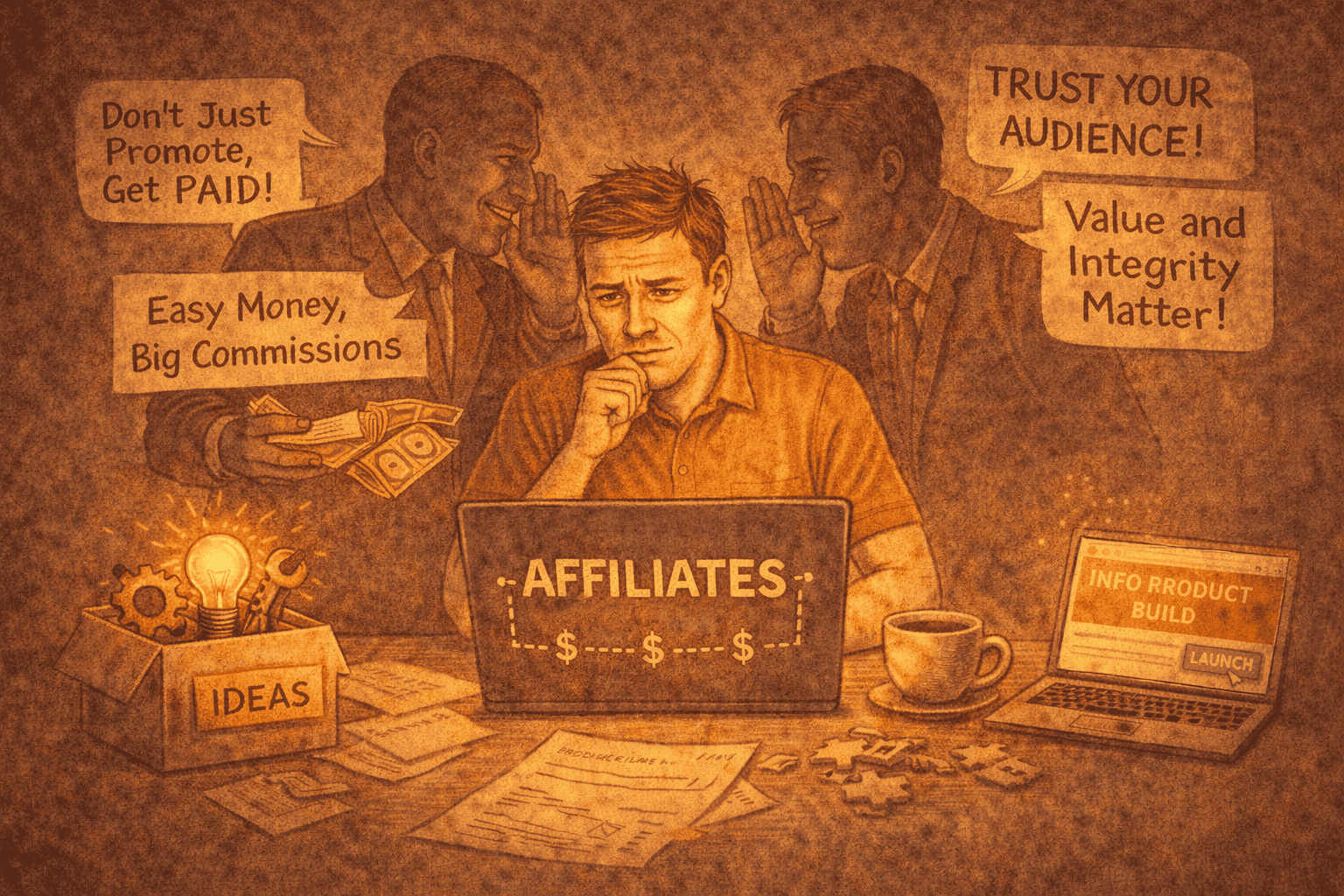
Early in my work with Info Products, I treated affiliates as a neutral distribution layer.
Recruiting Affiliates, that actually promoted for you, was a way to get reach, exposure, and momentum without much thought beyond the usual promotional assets.
That assumption lasted until the point it stopped working for me.
I started noticing something subtle but important: the moment someone else is describing your work to an audience, their incentives shape how they talk about it.
Not because they’re bad actors, but because their goals are different.
- They’re paid to generate interest, clicks, and conversions.
- Their language naturally leans toward outcomes, excitement, and aspiration.
In the context of most Info Products, that’s business as usual.
But in my context, particularly with Info Product Build, it created a tension I wasn’t happy with.
I was building a work that refused outcomes, resisted instruction, and declined to make promises. I didn’t want that work to be described in ways that implied shortcuts, revenue claims, or emotional hooks. Yet that’s the default when affiliates are left to their own devices.
That was the moment I realised: affiliates are not neutral.
- Not in intent.
- Not in language.
- Not in incentive.
Each affiliate’s goal subtly reinterprets what you’ve made, regardless of your own position. Left unconstrained, that reinterpretation will drag your work away from its edges and toward a version that performs rather than exists.
That insight shifted how I treated the affiliate surface:
- I constrained language precisely rather than leaving it implicit.
- I defined what may be said and what must not be said.
- I framed promotion as a verb that carries meaning, not a free variable.
I began to think of distribution not as an afterthought but as a design surface, because the choices made there change the way the work itself is perceived and understood.
I’m not arguing against affiliates. I’m not arguing against reach. I’m not saying distribution is unimportant.
What I am saying is that when someone else describes your work, they reshape it, and that reshape matters. Especially when the work was built to reject conventional tropes like promise, momentum, or optimisation.
That was a significant lesson for me, not because it was new, but because it was true in a way I had previously ignored.
It wasn’t something I could fix with better copy. It required defining boundaries around how the work could be spoken about, and then sticking to those boundaries.
That’s what it means, in practice, to treat affiliates as a design choice rather than a neutral channel.