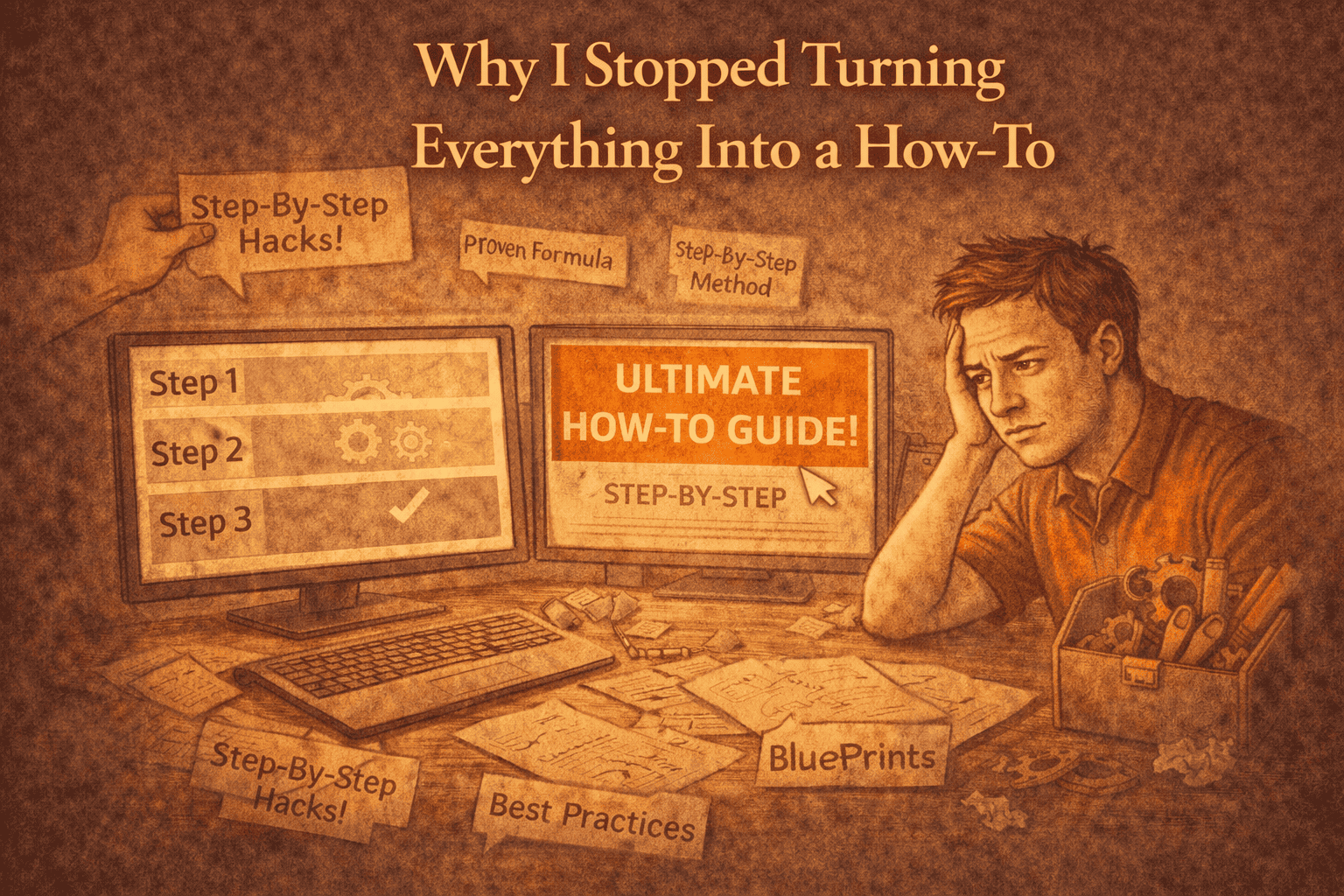
For a long time, I assumed that being useful meant being instructional.
If I understood something, the next step in my head was always to explain how to do it. If I had figured something out, the obligation was to turn it into a sequence others could follow.
When you’re inside that pattern, it feels generous — like sharing what you know is the thing that helps people.
What I didn’t realise at first was that how-to content doesn’t just help readers. It binds the creator.
In my own work, I noticed something uncomfortable: the moment I explained how to do something, I implicitly agreed to stand behind that explanation — forever.
I invited edge cases, questions, test cases, revisions, refinements, updates.
I turned what could have been a discrete piece of thinking into a surface that had to be maintained.
Eventually I began to see a pattern in what aged well.
The pieces that endured were not the ones that explained what to do next. They were the ones that clarified how to decide.
- Those pieces didn’t create dependency.
- They didn’t need updating.
- They didn’t invite optimisation.
- They ended the question rather than extending it.
Somewhere along the way I realised that stopping the automatic conversion of ideas into how-tos was not a restraint against helpfulness — it was an act of honesty.
Not everything I know needs to be turned into a method. Not every insight needs to be operationalised. Some things are more valuable when they remain judgments rather than instructions.
I don’t write how-tos any more because they carry obligations that I no longer want to accept.
Letting work end is not a failure of generosity.
In many cases, it’s the most respectful thing you can do — for both the reader and yourself.