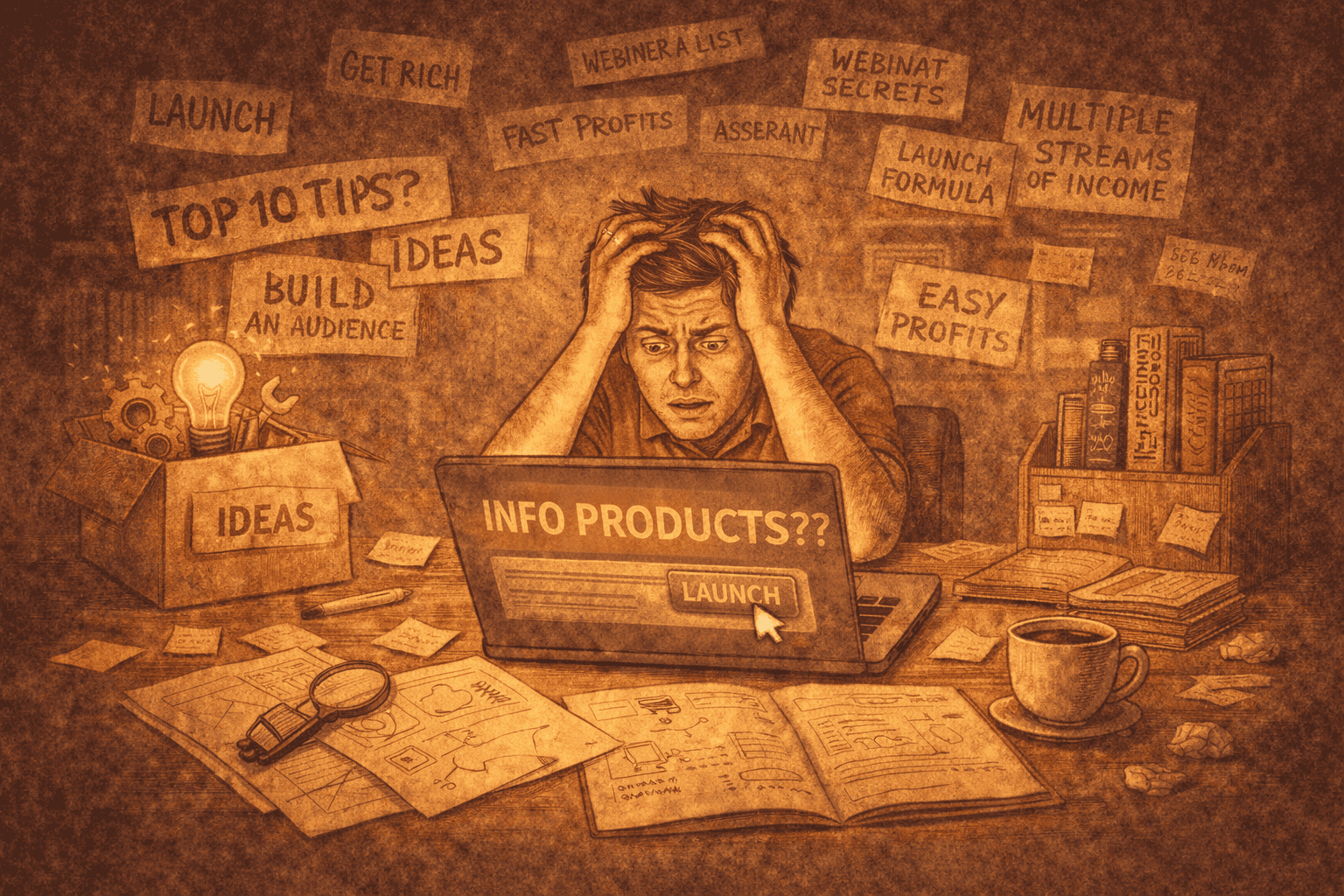
The decision to build finite, judgment-led assets didn’t come from theory.
It came from experience.
Before Info Product Build existed as a named posture, I had already built products.
- Some of them worked.
- Some of them made money.
- Some of them attracted attention.
But almost none of them ever felt finished.
Weekend Golfers is a good example.
It didn’t begin as a single, closed library. It started life as multiple courses, released over time.
- There were funnels.
- Email capture.
- New products introduced as the previous ones settled.
- The system rewarded continuation.
There was always a reason to add something else.
Profit From Prints followed a similar pattern earlier on.
Although the subject matter was narrower, the surrounding expectations were familiar: iterate, expand, update, refine.
Even when the core idea was complete, the product itself didn’t feel done.
There was always an implied “next”.
At the time, this didn’t feel unusual.
- It was simply how info products were supposed to behave.
- Growth was assumed.
- Continuation was treated as neutral, even responsible.
- Stopping was rarely discussed as a design choice.
Over time, that posture started to grate.
The work itself was rarely the problem. The friction came from the lack of an edge.
Products became containers for obligation rather than finished objects.
Completion was deferred by default. Even when nothing was broken, the system created pressure to keep touching the work.
What bothered me most wasn’t the workload. It was the absence of closure.
I realised that many of these products were not unfinished because they were incomplete.
They were unfinished because their structure made finishing impossible. They were designed to stay open.
Info Product Build emerged as a response to that.
Not as an optimisation, and not as a correction for others—but as a way of resolving my own frustration with work that never settled.
I wanted to build things that could be completed, released, and then left alone without guilt or narrative justification.
- A finite asset.
- A closed scope.
- A clear stopping point.
That meant being explicit about what was excluded.
- No memberships.
- No ongoing coaching.
- No update cycles.
- No performance tracking.
- No escalation paths disguised as value.
It also meant accepting that a finished object doesn’t need to defend itself.
It doesn’t need to grow to stay legitimate. It doesn’t need to evolve to remain valid.
Info Product Build exists because I reached a point where I no longer wanted my work to demand continuation as proof of seriousness.
I wanted to make decisions, encode judgment, and then stop.
Everything else follows from that.
The full record of decisions that followed is documented in Building Info Product Build: A Record of Decisions, Not a Method