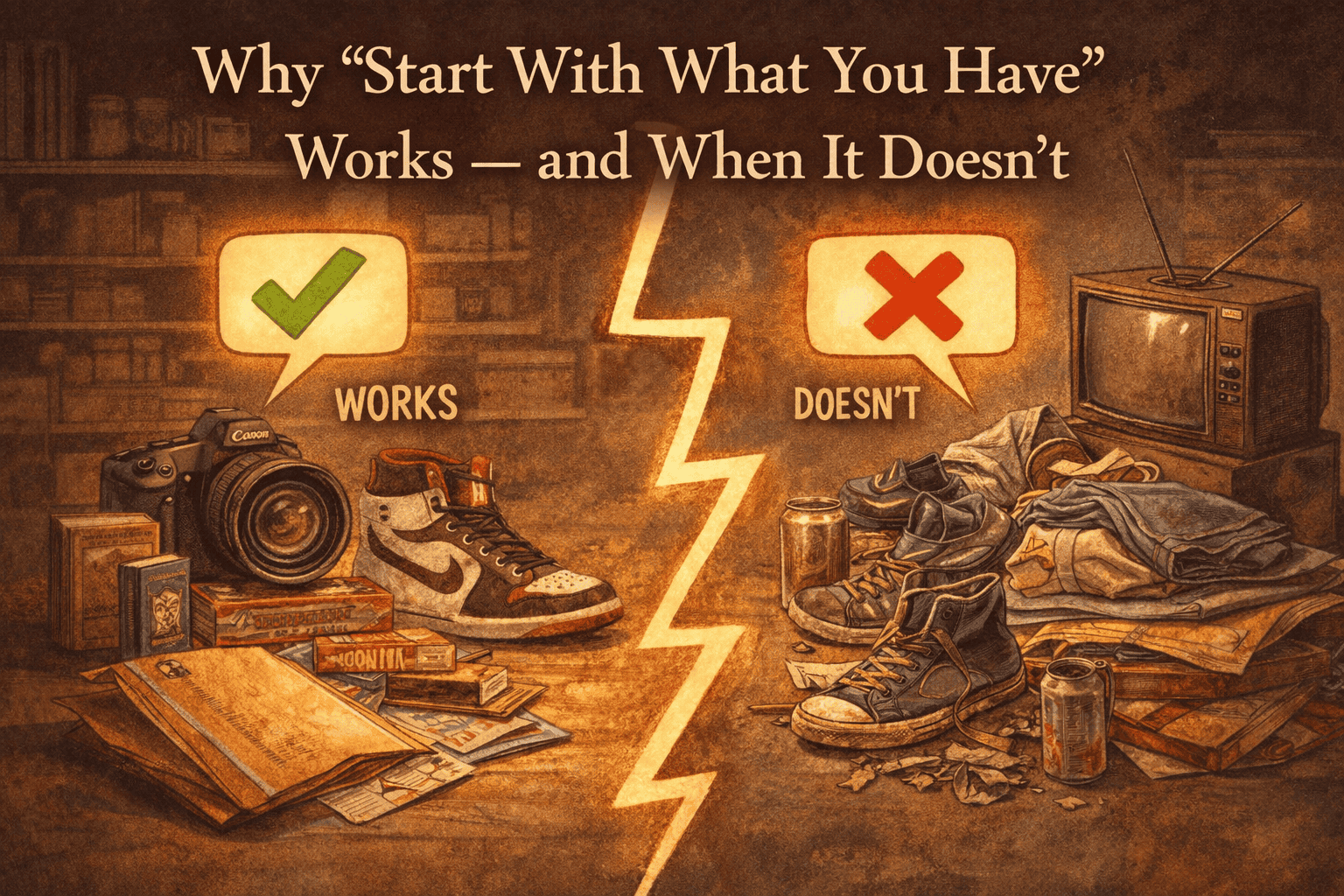
“Start with what you have” is common advice for new eBay sellers.
It’s usually offered as encouragement:
- low risk
- no upfront cost
- no commitment required
And most of the time, it’s good advice.
But it isn’t universally good and beginners are rarely told why it works, or where it quietly stops working.
Why it works
Starting with what you already own removes three major barriers at once.
1. It removes sourcing pressure
Sourcing introduces anxiety.
- What to buy.
- How much to pay.
- Whether it will sell.
When you sell items you already own, those questions disappear.
The inventory is already paid for.
The risk is minimal.
This allows beginners to focus on learning the system rather than second-guessing every decision.
2. It reveals how eBay actually behaves
Early sales are not about profit.
They are about feedback.
Selling your own items teaches you:
- how listings are discovered
- how buyers ask questions
- how returns feel in practice
- how long money actually takes to arrive
This learning is hard to absorb theoretically.
It only becomes real once something you own is involved.
3. It reduces emotional load
When beginners source inventory immediately, they attach expectations to it.
“If this doesn’t sell, I’ve failed.”
“If this returns, I’ve lost money.”
Selling existing items is emotionally lighter. It allows experimentation without self-judgement.
That emotional safety is not trivial.
It keeps people going long enough to understand the system.
Where it quietly stops working
The problem is not the advice itself.
The problem is staying in that mode for too long.
1. Personal inventory is finite
Most people run out of obvious items quickly.
Once the clutter is gone, continuing requires a shift:
- sourcing
- storage
- organisation
- replenishment
Some sellers never make this shift.
They stall, not because eBay failed them, but because the original model expired.
2. Personal items create distorted expectations
Items you own often have:
- sentimental value
- outdated retail pricing in your mind
- unclear market positioning
Beginners sometimes struggle to separate:
“What this meant to me” from “What this is worth to a buyer”
This can lead to:
- overpricing
- reluctance to accept offers
- frustration when items don’t move
eBay does not care about personal history.
It cares about comparables.
3. The learning plateaus
Selling your own items teaches the basics well.
But it does not teach:
- repeatability
- consistency
- margin control
- inventory discipline
At some point, progress requires deliberate friction.
You have to choose:
- what to sell
- why you’re selling it
- and whether the effort makes sense
This is where many casual sellers stop, not because they can’t continue, but because the activity changes character.
The quiet transition most advice skips
The real value of “start with what you have” is not income.
It is calibration.
It helps you answer questions like:
- Do I enjoy this?
- Do I tolerate the interruptions?
- Am I comfortable with buyers?
- Do I want more of this, or less?
Once those questions are answered, the advice has done its job.
Continuing without re-evaluating is where frustration creeps in.
A more accurate framing
A better version of the advice might be:
“Start with what you have but pay attention to how it feels.”
If selling your own items:
- feels manageable
- feels predictable
- feels worth the effort
Then sourcing may make sense.
If it already feels heavy, noisy, or draining, scaling will not fix that.
eBay magnifies whatever relationship you already have with it.