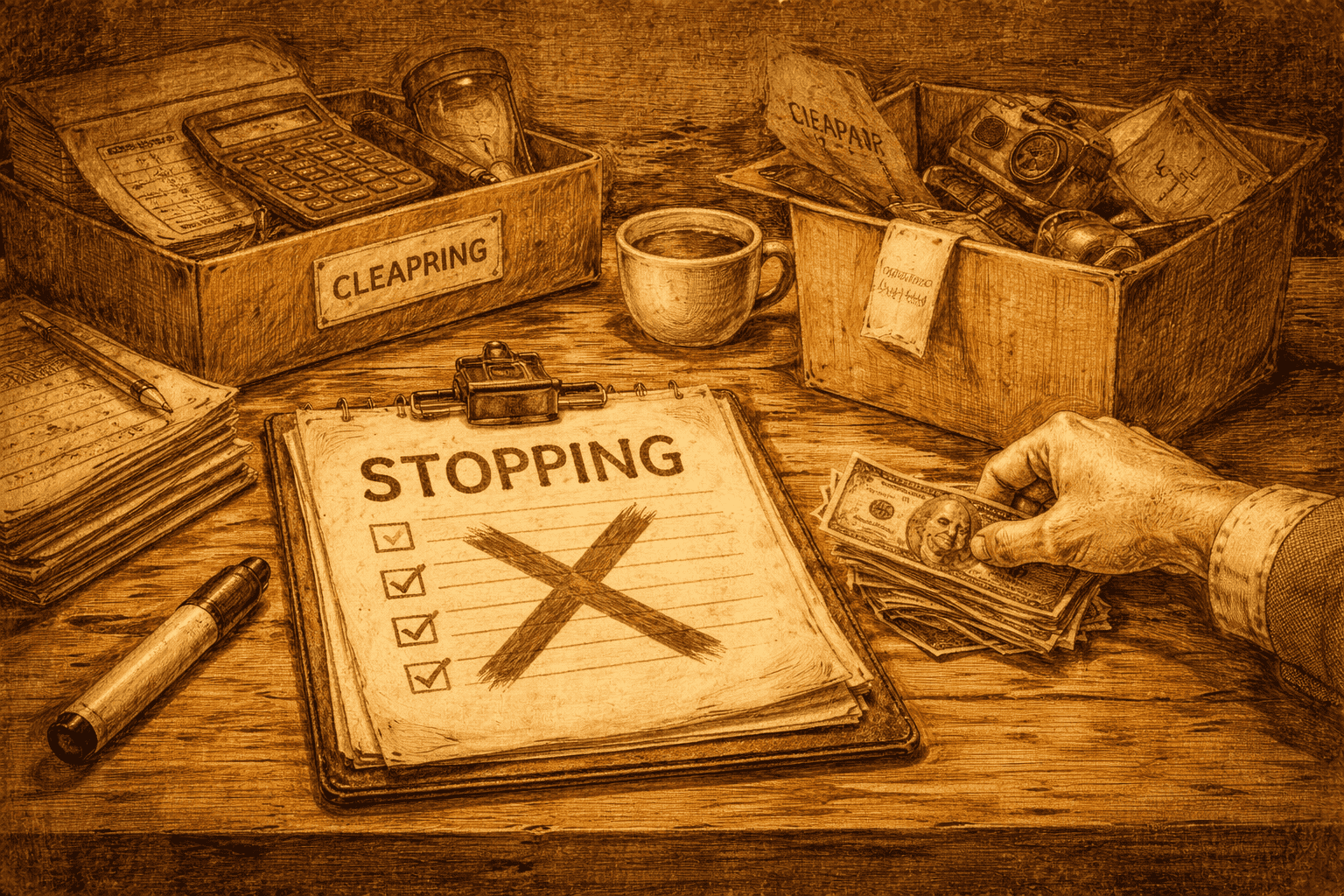
When stopping is the correct move (and how I decide)
Stopping is the decision most people try to avoid.
Not because it’s complicated, but because it feels final. Once you stop, there’s nothing left to optimise, wait for, or explain away.
For a long time, I treated stopping as failure. If something hadn’t sold, the assumption was that I just hadn’t figured it out yet.
That belief kept a lot of bad inventory alive far longer than it deserved.
Why stopping feels harder than it is
Stopping forces you to confront the original decision.
If an item doesn’t sell and you keep it listed, the mistake stays unresolved. You can still imagine a future where it works out.
When you stop, that future disappears. You have to accept that the judgement that brought the item in was wrong, incomplete, or based on assumptions that didn’t hold.
That’s uncomfortable, especially if you care about being good at this.
The shift that changed everything
I stopped treating stopping as an admission of failure and started treating it as a correction.
The original decision already happened. Whether I liked it or not, the cost was already incurred. The only thing I still controlled was how long I continued paying for it.
Once I saw stopping as cost control rather than defeat, it became much easier to do calmly.
How I decide now
I don’t stop randomly, and I don’t stop emotionally.
I stop when three things line up.
First, I can’t clearly argue that demand exists. Not theoretically. Not eventually. Right now.
Second, waiting no longer has a reason attached to it. There’s no event, no cycle, no change I’m waiting to observe.
Third, keeping the item creates friction. It takes up space, attention, or mental energy that could be used elsewhere.
When those three are true, stopping isn’t dramatic. It’s obvious.
What stopping actually looks like
Stopping doesn’t always mean throwing something away.
- It can mean exiting at a loss.
- It can mean bundling later.
- It can mean moving it out of active inventory entirely.
The important part is that it’s no longer pretending to be something it isn’t. It’s no longer a “work in progress”.
It’s a closed decision.
Why stopping improves judgement over time
Every time you stop cleanly, your future decisions get sharper.
- You remember what fooled you.
- You notice patterns sooner.
- You become more conservative in the right places.
Avoiding stopping does the opposite. It teaches you that decisions don’t have consequences, only delays.
That’s not a lesson you want to reinforce.
The quiet benefit no one talks about
Stopping reduces cognitive load.
- Fewer open loops.
- Fewer background checks.
- Fewer items quietly asking for justification.
Once I started stopping earlier and more deliberately, everything else sped up without me trying to make it faster.
Not because I worked harder, but because I carried less.
Where this fits in the series
If the first post is about diagnosing the problem, and the second is about recognising hidden decisions, this one is about closing the loop.
Stopping is not the end of the process. It’s what makes the next decision cleaner.
This post is part of the series
What to do when items don’t sell (and why optimisation isn’t the answer)