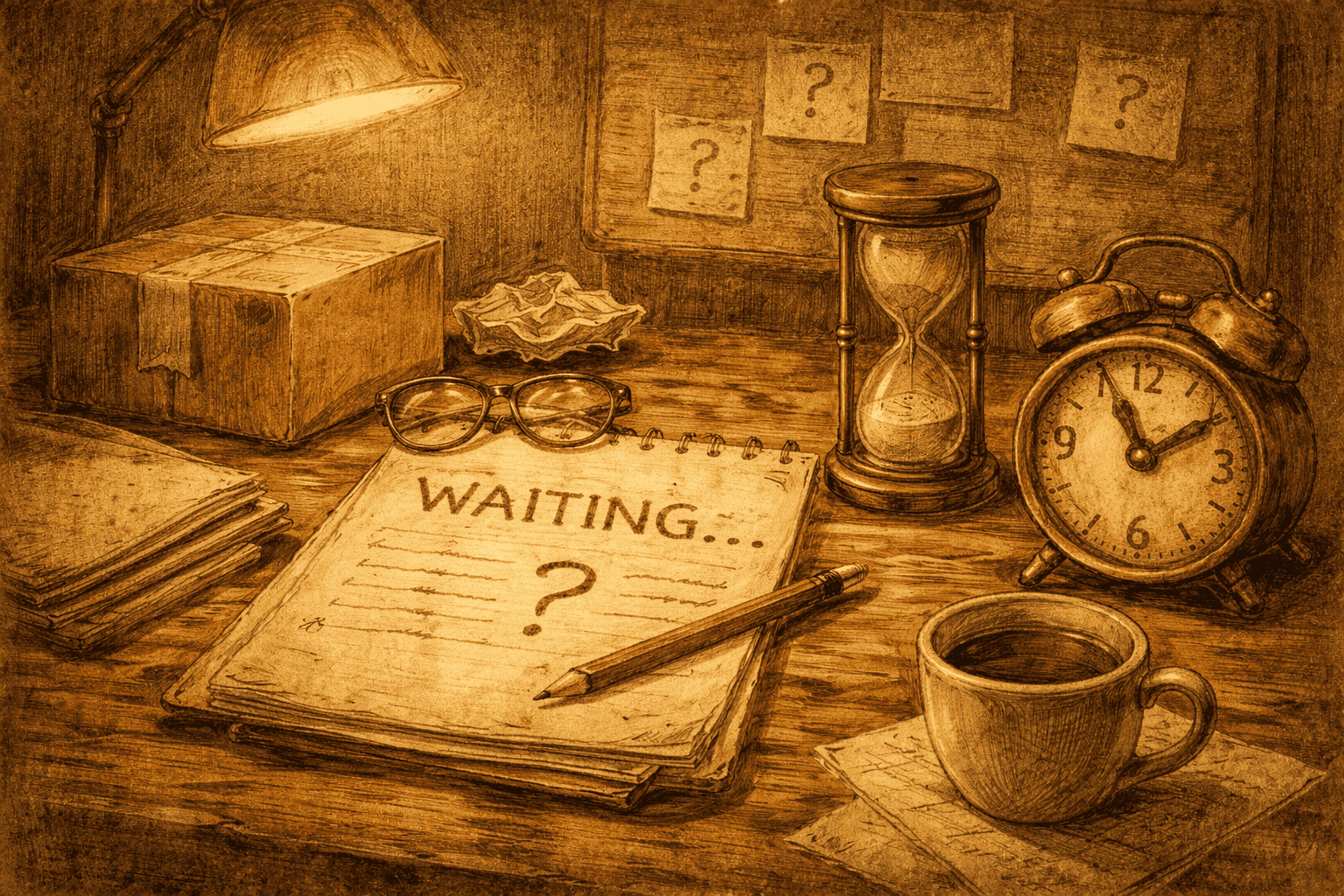
When something doesn’t sell, the easiest thing to do is nothing.
Not consciously. Not deliberately.
It just happens.
- The item stays listed.
- Time passes.
- You tell yourself you’re being patient.
For a long time, I thought this was neutral. I hadn’t decided anything yet, so I wasn’t wrong yet either.
That turned out not to be true.
Waiting is not neutral
Waiting feels passive, but it isn’t.
The moment you choose not to act, you’re still making a decision.
- You’re deciding to keep capital tied up.
- You’re deciding to keep attention allocated.
- You’re deciding not to revisit the original judgement that put the item in your inventory.
Most of the time, “waiting longer” isn’t a strategy. It’s a default.
Once I saw that clearly, it became uncomfortable to leave things untouched.
Why waiting feels responsible
Waiting feels like restraint. It feels disciplined. It feels like you’re giving the market time to catch up.
There’s also a quieter reason it feels good: it postpones admitting you might have been wrong.
As long as the item is still listed, the decision that led to buying it remains unresolved. You haven’t failed yet. You’re just early.
That framing is emotionally convenient, but it’s expensive.
Time has a cost even when nothing changes
An unsold item isn’t static.
- It occupies space.
- It occupies capital.
- It occupies a slot in your mental inventory.
Every time you scroll past it, some part of your attention checks in. Even briefly. Even subconsciously.
I underestimated that cost for years. I treated time as free as long as I wasn’t actively working on the item.
It isn’t.
The difference between patience and avoidance
Real patience has a reason.
You wait because:
- demand exists but is cyclical
- supply is temporarily high
- you have a clear time-bound thesis
Default waiting has none of that.
It’s just inertia with a nicer name.
Once I started asking myself why I was waiting, most answers didn’t hold up.
“I’ll give it a bit longer” isn’t a reason. It’s a delay.
What changed my behaviour
I stopped letting time pass without an explicit decision attached to it.
If I was going to wait, I needed to know:
- what I was waiting for
- how long I was willing to wait
- what I would do if nothing changed
If I couldn’t answer those three things, I wasn’t being patient. I was avoiding a judgement.
In those cases, the correct move was to decide, not to wait.
Why this matters for the rest of the series
Once you accept that waiting is a decision, everything else sharpens.
- Stopping becomes easier to justify.
- Reframing becomes intentional.
- Bundling stops feeling like a last resort.
You stop drifting and start choosing.
That’s the difference between managing inventory and carrying it.
This post is part of the series
What to do when items don’t sell (and why optimisation isn’t the answer)