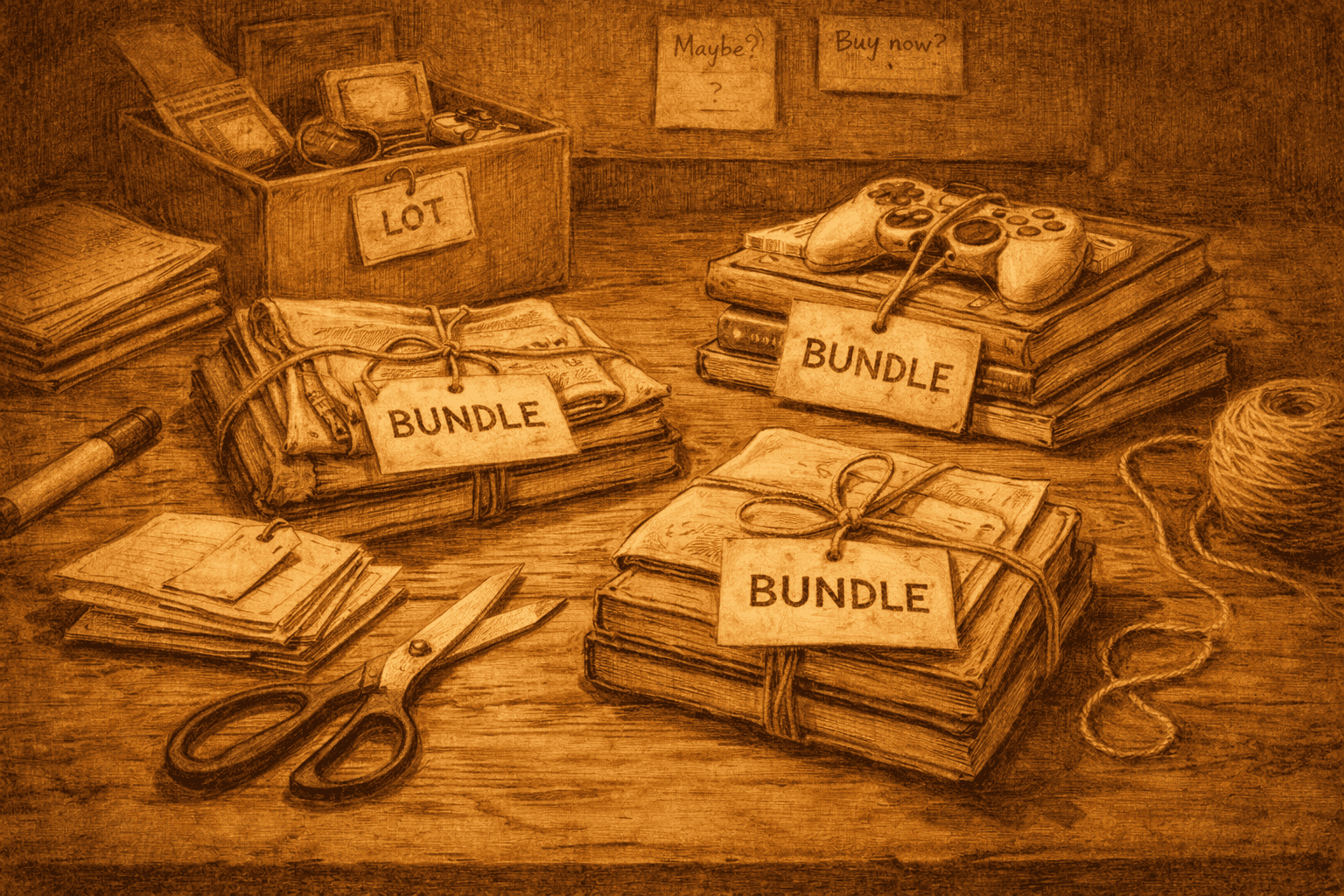
Bundling as reframing, not optimisation
Bundling is usually introduced as a tactic.
- Lower the price.
- Increase perceived value.
- Move slow stock.
That framing misses the point.
The reason bundling works has very little to do with cleverness and almost nothing to do with optimisation.
It works because it changes the question the buyer is answering.
Why individual items get stuck
When an item doesn’t sell on its own, it’s often because it asks too much of the buyer.
- Is this the exact version I want?
- Is the price right for this one thing?
- Is it worth the friction of buying now?
When demand is weak or marginal, those questions become reasons to defer.
The item isn’t wrong. It’s just too exposed.
What bundling actually does
A bundle doesn’t try to make each item more attractive.
It reduces the precision required to say yes.
Instead of asking whether one item is worth it, the buyer is asked a looser question: Is this collection, lot, or grouping worth it?
That shift matters.
The buyer stops evaluating individual value and starts evaluating overall usefulness or optionality.
The decision becomes simpler, even if the contents are more complex.
That’s not optimisation. It’s reframing.
When bundling makes sense
Bundling is appropriate when demand exists, but not cleanly.
You’ve already learned that people aren’t actively seeking the individual item.
You’ve stopped waiting.
You’ve accepted that optimisation won’t change that.
At that point, bundling becomes a way to recover value without pretending the original thesis still holds.
It’s a second judgement, not a rescue attempt.
What bundling is not
Bundling is not:
- a way to avoid stopping
- a way to extract maximum value
- a way to make bad items good
If the items are truly unwanted, bundling just delays the exit.
Used correctly, bundling is honest. It says: these things belong together now, even if they didn’t originally.
How bundling changed my thinking
Once I stopped treating bundling as a trick, it became easier to use calmly.
I no longer asked, “How do I make this sell?”
I asked, “What does this need to become?”
Sometimes the answer was a bundle. Sometimes it wasn’t.
Either way, the decision felt cleaner.
The quiet benefit of reframing
Bundling reduces friction for you as much as for the buyer.
- Fewer listings.
- Fewer open decisions.
- Fewer items demanding individual justification.
It’s a way of closing loops without forcing finality too early.
That’s why it belongs in this series. Not as a tactic, but as a judgement call.
Where this fits in the sequence
If stopping is about closing a decision, bundling is about changing the shape of one.
It’s what you do after you’ve accepted reality, not before.
This post is part of the series
What to do when items don’t sell (and why optimisation isn’t the answer)