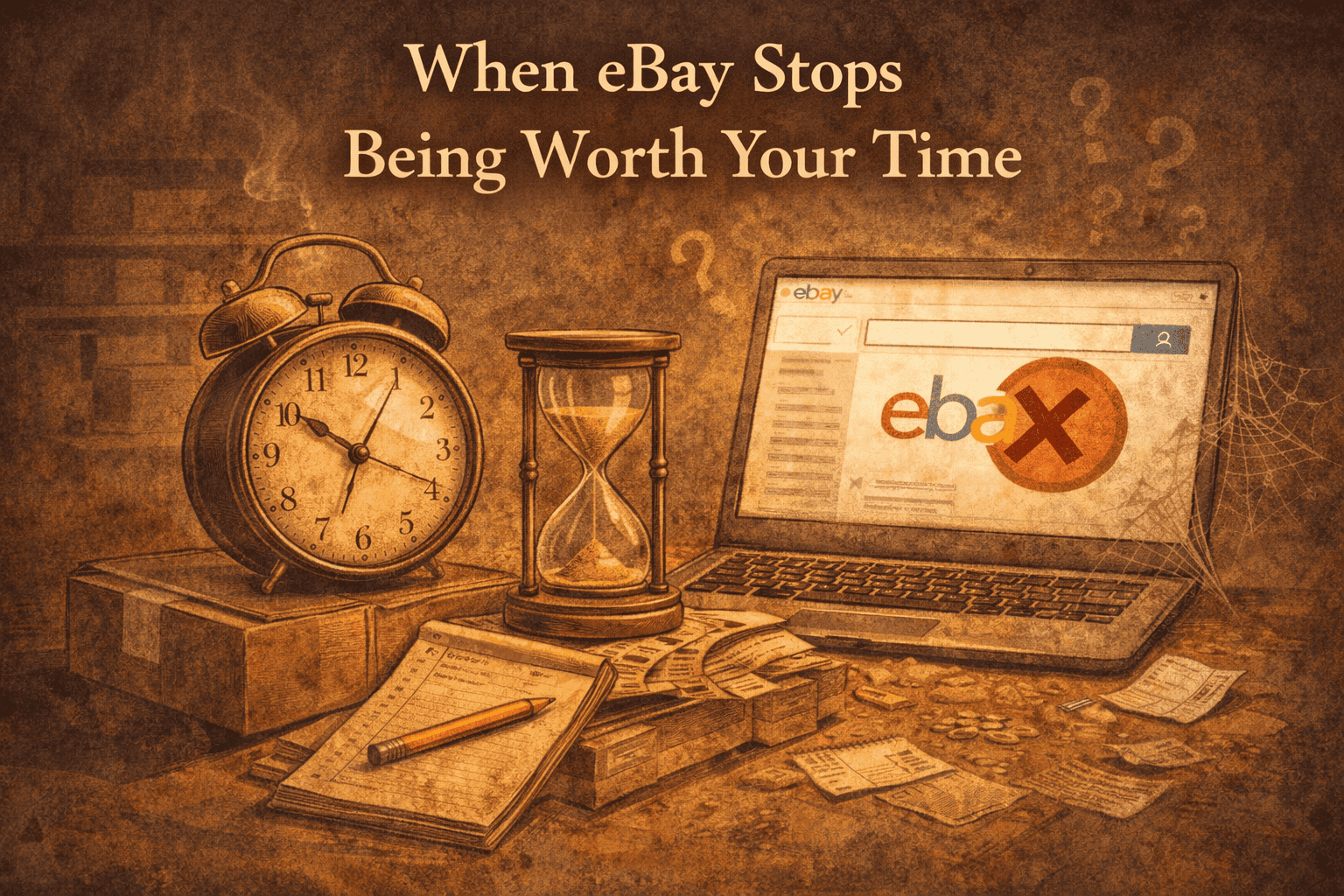
There is a quiet assumption baked into most advice about selling on eBay:
If it’s working, you should do more of it.
- More listings.
- More sourcing.
- More optimisation.
- More scale.
But eBay does not reward persistence indefinitely.
There is a point, different for everyone, where continuing becomes a choice rather than a default.
Recognising that point is a form of skill.
The early phase feels deceptively efficient
At the beginning, eBay often feels generous.
- You list a few items.
- They sell.
- The money arrives.
This creates a sense of momentum.
What’s easy to miss is that early efficiency is often driven by:
- novelty
- low expectations
- low volume
- low friction
None of these scale.
The signal most people ignore
eBay usually doesn’t “fail” loudly.
It erodes quietly.
You notice:
- more time spent per sale
- more messages for the same revenue
- more storage for the same margins
- more attention required to maintain the same results
Nothing breaks. It just stops feeling clean.
Many sellers respond by pushing harder, assuming the problem is effort.
Often, the problem is fit.
The opportunity cost becomes visible
At some point, eBay competes with other uses of your time.
- Not just work.
- But rest.
- Focus.
- Mental clarity.
An activity can be profitable and still be wrong.
The moment eBay begins to crowd out:
- higher-leverage work
- deeper learning
- or simply quieter days
…it deserves re-evaluation.
Scale doesn’t fix structural misalignment
When eBay feels heavy, the usual advice is to:
- automate
- outsource
- increase volume
- open a shop
- run promotions
Sometimes this helps.
Often it just makes the system louder.
Scaling magnifies whatever relationship you already have with the activity.
If you feel constrained at small scale, scale will not free you.
The sunk-cost trap
One reason people stay longer than they should is familiarity.
They’ve learned:
- the rules
- the workflows
- the exceptions
- the emotional terrain
Walking away feels like wasting that knowledge.
But skill does not disappear when you stop using it.
It transfers.
Understanding marketplaces, pricing, logistics, and buyer psychology remains useful — even if eBay itself no longer is.
Leaving well is part of using eBay well
Stopping is not failure.
It is alignment.
Some people use eBay:
- briefly
- intermittently
- seasonally
- or as a tool during specific life phases
That’s not underachievement. That’s appropriate use.
The mistake is treating eBay as something you must grow forever.
A better closing question
Instead of asking:
“How do I make this bigger?”
A more honest question is:
“Is this still earning its place in my life?”
If the answer is yes, continue deliberately.
If the answer is no, you don’t need permission to stop.
eBay will still be there if you need it again.
A practical example of this shows up in my breakdown of what vintage leather jackets actually sell for on eBay UK, where sell-through and break-even speed determined whether the category justified continuing. When recovery happens early, effort feels proportionate. When it drags, even profitable stock starts to feel heavy.